
The destiny number by name is every letter of a full name converted to a value, added, and reduced to one digit — reported with its compound, so Anita Deshpande is 52/7. That is not the same figure as the destiny number taken from a birth date, although both are called by that name. This article computes both for one person and labels each properly.
The confusion is not yours. Two long-established traditions use one word for two calculations, and a great deal of published material never says which it means. If a reading has told you that your destiny number is 7 and another has told you it is 8, neither is necessarily wrong. They are answering different questions.
The two figures both called a destiny number
Here is the split, plainly.
| What was added | Also called | This site's name for it | Anita Deshpande |
|---|---|---|---|
| Every letter of the full name | Expression number, name number, destiny number | Name total | 52/7 |
| Every digit of the full birth date | Life path, fate number, conductor, destiny number | Conductor | 35/8 |
| The day of the month only | Birth number, psychic number, driver | Driver | 23/5 |
The vocabulary splits roughly along lines of origin. Material written in the Western chart tradition tends to use destiny number for the name and life path for the date. Material written in the Indian tradition tends to use bhagyank — usually translated as destiny or fate number — for the whole date, and keeps namank or simply the name number for the letters.
This site uses conductor for the date total and name total for the letters, precisely so that the word destiny never has to carry two jobs. Where you see the phrase destiny number by name on this site, it means the letters. Where a figure comes from the date, it is labelled conductor.
One thing is not in dispute: the two numbers describe different things and are not substitutes. The date is fixed at birth and cannot be revised. The name can be changed, and frequently is — which is the whole reason a name total is interesting to a founder and a birth date is not.
How to calculate the destiny number by name
Chaldean values are the primary table here. There are eight of them, and no letter carries a 9.
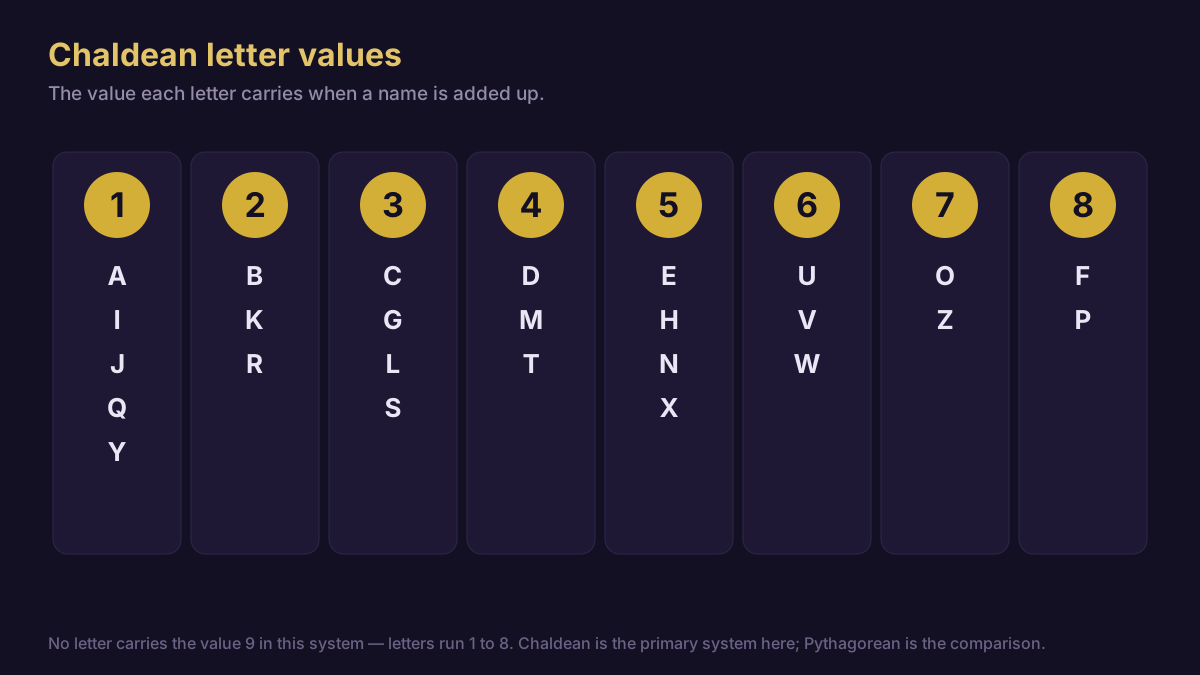
| Value | Letters |
|---|---|
| 1 | A, I, J, Q, Y |
| 2 | B, K, R |
| 3 | C, G, L, S |
| 4 | D, M, T |
| 5 | E, H, N, X |
| 6 | U, V, W |
| 7 | O, Z |
| 8 | F, P |
The method is four steps.
- Write the name as it is actually spelled. Strip honorifics — Dr, Shri, Mrs — because a person did not choose those as part of their name.
- Give every letter its value.
- Add the whole thing.
- Reduce by adding the digits until one remains. Keep the compound.
Take Anita Deshpande, word by word.
A N I T A
1 + 5 + 1 + 4 + 1 = 12

D E S H P A N D E
4 + 5 + 3 + 5 + 8 + 1 + 5 + 4 + 5 = 40

12 + 40 = 52
5 + 2 = 7
Her destiny number by name is 52/7. Always report it that way. The digit tells you the family; the compound tells you which member of it. Names totalling 25, 43 and 52 all reduce to 7 and this tradition reads them quite differently — the compound number reference sets out what each one is held to carry.
Why the order of addition never matters
You will see two reduction routes. One adds every letter in the name and reduces once. The other reduces each word first, then adds those digits:
ANITA 12 -> 3
DESHPANDE 40 -> 4
3 + 4 = 7
Same answer. This is not a coincidence and it is not a rule anyone had to invent. Repeatedly summing the digits of a number is the digital root, which is equivalent to taking the remainder after division by nine, and a remainder does not care what order the terms were added in. So the single digit is stable across every reduction path.
The compound is not stable. Reduce per word and you reach 7 by way of 3 and 4; add the whole thing and you reach it by way of 52. Whenever a compound is quoted, the path that produced it should be quoted with it.
The same name in the other alphabet
The comparison system, Pythagorean, runs 1 to 9 straight across the alphabet: A–I as 1–9, J–R as 1–9, S–Z as 1–8. It uses the 9, which Chaldean does not, and it gives different answers.
| System | ANITA | DESHPANDE | Total | Reduced |
|---|---|---|---|---|
| Chaldean | 12 | 40 | 52 | 7 |
| Pythagorean | 18 | 40 | 58 | 4 |
One name, one spelling, and two destiny numbers: 52/7 against 58/4. Neither table is a mistake. Both are internally consistent, which means the choice between them cannot be settled by arithmetic — only by deciding which tradition you are working in and then staying in it. The comparison of the two systems sets out why this site treats Chaldean as primary.
The rule that matters more than the choice: commit to a table before you see the answer. Running a name through both and keeping the flattering result is not a reading, it is shopping.
Worked example: one founder, four destiny numbers
Anita Deshpande, born 23 June 1986, is registering a consultancy.
The date figures
Driver — the day of the month alone:
Day = 23
2 + 3 = 5
Driver = 23/5
Conductor, the figure most Western material would call her destiny number:
23 / 06 / 1986
2 + 3 + 0 + 6 + 1 + 9 + 8 + 6 = 35
3 + 5 = 8
Conductor = 35/8
The per-part route reaches the same digit by a different compound: day 23 reduces to 5, month 6 stays 6, and the year gives 1 + 9 + 8 + 6 = 24, then 2 + 4 = 6. So 5 + 6 + 6 = 17, and 1 + 7 = 8. Compound 17 rather than 35, digit 8 either way.
The name figures
Chaldean name total 52/7, as computed above. Pythagorean name total 58/4.
So one woman, asked for her destiny number, has four defensible answers: 52/7, 58/4, 35/8, and — if whoever asked meant the birth number — 23/5. This is exactly why a reading that gives you a bare digit with no working is unusable. You cannot tell what it counted.
What the tradition makes of the combination
Her driver is 5, her conductor is 8, and her destiny number by name is 7. In this system 5 is friendly to 7, and 8 is friendly to 7. A name landing on a number both date figures get on with is the comfortable case, and it is the case here.
Read together: a quick, verbal operator (5) on slow, accumulating terms (8), carrying a specialist's name (7). The tradition would expect someone who sells and talks well, whose results arrive later than she wants them to, and whose reputation is built on depth rather than reach. That is a description to argue with, not a forecast.
What each destiny number by name is read to mean
Each digit carries a planet, and the working character follows from it. These are the readings this system attaches to a name total, which is not identical to what the same digit means as a birth figure — a name is a public claim, and it is read as what the name announces.
| Name total | Planet | What the name announces | Where it sits well | What it costs |
|---|---|---|---|---|
| 1 | Sun | A single authority; one hand on the wheel | Founder-led firms, sole practices, first movers | Hard to hand over; the name outlives the willingness to lead |
| 2 | Moon | Partnership, responsiveness, service | Agencies, retention businesses, two-founder firms | Reads soft; underprices to keep the peace |
| 3 | Jupiter | Teaching, breadth, persuasion | Publishing, training, advisory, media | Promises scope the delivery must then match |
| 4 | Rahu | Systems, the unorthodox angle, the unseen | Technology, infrastructure, logistics | Carries a penalty as a trading name in this tradition |
| 5 | Mercury | Speed, trade, talk | Retail, broking, agencies, anything transactional | Nothing settles long enough to compound |
| 6 | Venus | Comfort, taste, negotiation | Hospitality, interiors, fashion, wellbeing | Confuses being liked with being paid |
| 7 | Ketu | Specialism, research, a closed door | Consulting, laboratories, niche craft | Reluctant to sell; markets that are too small |
| 8 | Saturn | Weight, permanence, accumulation | Property, land, manufacturing, long assets | Late rather than unlucky; penalised as a trading name |
| 9 | Mars | Drive, competition, execution | Operations, turnarounds, contested sectors | Burns people, including the founder |
Two of those need the caveat spelled out. 4 and 8 are penalised as trading-name totals in this system, which is not the same as calling them bad numbers. As a birth figure, 8 is read as slow and accumulating and 4 as structural and contrarian; neither is a defect. As the name over a door they are treated as heavy, and the site's calculators apply that penalty rather than pretending it away. Our piece on what the business numbers mean works through each digit in more detail.
The two halves inside the name total
The name total has two components most readings never separate. Split the letters into vowels and consonants and you get two further figures.
Vowels      A I A E A E
            1 + 1 + 1 + 5 + 1 + 5 = 14
            1 + 4 = 5

Consonants  N T D S H P N D
            5 + 4 + 4 + 3 + 5 + 8 + 5 + 4 = 38
            3 + 8 = 11
The vowel total is the soul urge, 14/5 here: the tradition reads it as the motive, what the person is actually after. The consonant total is the personality, 38/2 once 11 reduces: the impression the name makes before anyone has met its owner. Together they add back to 52.
For a founder the split is useful for a narrow reason. If your soul urge and your personality disagree — a 5 motive behind a 2 surface, as here — the tradition reads it as someone who wants movement but presents as accommodating. Whether or not you believe the mechanism, that is a worthwhile thing to write down before a negotiation.
Which spelling of the name counts
This is where the method gets uncomfortable, and where honest practitioners disagree. Small spelling changes move the total a long way.
| Name as written | Chaldean total |
|---|---|
| Anita Deshpande | 52/7 |
| Anita R Deshpande | 54/9 |
| Anita Rao Deshpande | 62/8 |
| Anitha Deshpande | 57/3 |
| Anita Deshpandey | 53/8 |
Five spellings of one person, five different destiny numbers, including four different digits. No arithmetic settles which is correct, because the arithmetic is not the disputed part.
The conventions in circulation:
- The birth-certificate name. Defensible, and the usual answer in the Western tradition. It is also the name many people never use, and some registries record with a spelling nobody in the family recognises.
- The name you are known by. The argument is that a name works through being used, so the used name is the live one. This is the more common position in the Indian tradition, and it is the one this site leans towards for business questions.
- The signed name. A narrower case, used where the question is about contracts and authority.
The practical resolution: compute the one you actually use, and say which you used. A reading that does not state its input cannot be checked, and a reading that cannot be checked is not worth acting on.
Two related traps. Diacritics and non-Latin scripts have no defined values here — a name in Devanagari or Arabic must be romanised first, and different romanisations produce different totals, a problem the Unicode normalisation rules address for text processing but which no numerological table has ever settled. And repeated letters count every time; the occasional claim that they count once has no standing in any standard reading of this system.
Reading the destiny number by name against a trading name
A founder's name total is one input. The trading name is another, and they are judged against different things.
Anita's consultancy candidate is Deshpande Analytics:
D E S H P A N D E
4 + 5 + 3 + 5 + 8 + 1 + 5 + 4 + 5 = 40

A N A L Y T I C S
1 + 5 + 1 + 3 + 1 + 4 + 1 + 3 + 3 = 22

40 + 22 = 62
6 + 2 = 8
Legal suffixes are left out of that sum. Ltd, LLP, Pvt Ltd and Inc are conferred by a registrar rather than chosen, and in the United Kingdom the rules on incorporation and names make one of them compulsory — so counting it would score the same shop differently in two countries for a reason that has nothing to do with the shop.
Here is the part that surprises people. A trading name is not graded by looking up the founder's name total in a compatibility matrix. It is graded against her two date figures, driver 23/5 and conductor 35/8, and the rule that does the work is that a name landing on the founder's own number is the strongest alignment this method recognises. Deshpande Analytics at 62/8 lands exactly on her conductor. That alignment carries it, even though 8 is one of the two totals penalised as a trading name.
Running the shortlist through the site's business name analyser against those two figures:
| Candidate | Total | Fit against driver 5 and conductor 8 |
|---|---|---|
| Deshpande Data | 50/5 | Excellent (100) |
| Deshpande Research | 66/3 | Excellent (100) |
| Deshpande Partners | 70/7 | Excellent (100) |
| Deshpande Analytics | 62/8 | Strong (84) |
| Deshpande Labs | 49/4 | Weak (41) |
Deshpande Labs is the instructive row. It is only four letters different from the strongest candidate, and it lands on 4 — friendly to her driver of 5 but adverse to her conductor of 8, with the trading-name penalty applied on top. If you are weighing a rename against an established name, the guide to business name correction covers what the change costs before the numbers are even considered, and the founder compatibility tool tests a shortlist against a founder's figures directly.
Where two founders are involved, neither one's destiny number by name is the deciding figure — partner-to-partner fit averages both directions between their date numbers, which is a different calculation again and is covered in the guide to partnership business names.
Frequently asked questions
Is the destiny number the name number or the birth date number?
Both, depending on who is writing. Western chart material generally uses destiny number for the full-name total and life path for the birth date. Indian material generally uses it for the birth date, translating bhagyank as destiny or fate. Neither usage is wrong. Ask any reading which one it computed, and if it cannot say, discard it.
How do I calculate my destiny number by name?
Convert every letter using the Chaldean table, add the lot, and reduce to a single digit while keeping the compound. Anita Deshpande gives 12 + 40 = 52, then 5 + 2 = 7, reported as 52/7. Strip honorifics. Count repeated letters every time. Use the spelling you actually use, and state which spelling you used.
Is the destiny number the same as the expression number?
Where destiny number means the full-name total, yes — expression number, name number and namank all describe that same calculation. The label changed as the material crossed traditions; the arithmetic did not. The one real variation is the letter table, since Chaldean and Pythagorean values give different totals for the same spelling.
Does a middle name or initial change the destiny number by name?
Yes, and often by more than people expect. Anita Deshpande is 52/7; adding the initial R takes it to 54/9, and the full middle name Rao takes it to 62/8. There is no convention that settles whether to include it. Decide once, apply it to every name you compare, and record the decision.
Can two different names have the same destiny number?
Constantly. Only nine digits exist, so any name total shares its digit with roughly a ninth of all names. That is why this system reports the compound: 25/7, 43/7 and 52/7 are all sevens and are read as different sevens. A reading that gives you only the digit has discarded most of the information.
Which matters more, the name total or the birth date total?
Most of this tradition treats the date figures as heavier, on the grounds that they cannot be changed and a name can. The name total is treated as the adjustable variable — the one input a founder actually controls. That is a statement about which lever exists, not a claim that either one predicts anything.
Where this runs out
There is no evidence base. No controlled study shows that the letters of a name or the digits of a date predict character or commercial outcome. This is a traditional interpretive framework with a long history and no experimental support. Every reading above is a prompt for reflection and planning, not a finding, and nothing here is financial, legal or medical advice.
The ambiguity this article is about is not fully resolvable. Naming the two figures clearly stops a reader mixing them up. It does not tell you which tradition is right about which deserves the word destiny, because that is a question about vocabulary rather than about arithmetic.
The input is unstable in a way the output hides. Five spellings of one name gave four different digits above, and no rule inside the system picks between them. The same applies to birth records, which are wrong more often than people assume and can shift a day across time zones. A confident single digit conceals all of that.
The read is broad by construction. Nine name totals, nine drivers and nine conductors describe the entire population in seven hundred and twenty-nine combinations. Any description covering that many people is general, and general descriptions feel personally accurate to almost everyone — an effect psychologists call the Barnum effect, and one this method has no defence against.
It cannot tell you the things that decide businesses. Whether anyone wants what you sell, whether the price works, whether the co-founder is trustworthy, whether the capital lasts long enough. None of that is in a name or a date. The core calculators will give you every figure discussed here in a few seconds, and what business numerology is sets out the wider frame — but a clean set of numbers is a vocabulary for a conversation, not a substitute for having it.
Used honestly, the destiny number by name does one modest job. It forces you to write down what your name claims about you before you commit it to a door, a domain and ten years of invoices. That is worth an afternoon, and it is not worth more than the evidence supports.