
Business numerology in India reads four inputs: the founder's date of birth, the trading name as it will actually be filed, the registration date, and the premises. Two of those are constrained by rules no numerologist controls — the registrar's name-availability test, and the transliteration you choose when an Indian-language word is written in English. Work in that order and the numbers get the last word, not the first.
What business numerology in India actually reads
The arithmetic is the same everywhere. What changes in India is the order of operations and the size of the choices sitting outside the method.
The four inputs, and who controls each:
| Input | Derived from | Who decides it |
|---|---|---|
| Driver (mulank) | Day of the month of birth, reduced | Fixed at birth |
| Conductor (bhagyank) | The whole date of birth, reduced | Fixed at birth |
| Name total | Chaldean letters of the trading name | You propose, the registrar approves |
| Date number | Day of the registration date, reduced, with the full-date total read alongside | You propose, the filing queue decides |
Chaldean values are the primary system on this site, and the values are these:
A, I, J, Q, Y = 1 · B, K, R = 2 · C, G, L, S = 3 · D, M, T = 4 · E, H, N, X = 5 · U, V, W = 6 · O, Z = 7 · F, P = 8
There is no 9 for letters in Chaldean, so a 9 in a name total always arrives by addition, never from a single letter. Pythagorean runs A–I as 1–9 and gives different answers on the same name; the comparison of Chaldean and Pythagorean sets out why this site treats one as primary rather than averaging them.
Two India-specific facts do most of the damage in practice. The first is that the name you file is not the name you speak — it is a romanisation, and there are usually three or four defensible ones. The second is that the registrar can refuse your first choice, which means the name you calculated may not be the name you get.
The suffix the registry gives you is not counted
A private limited company, an LLP and a one-person company all carry a statutory tail. None of it counts.
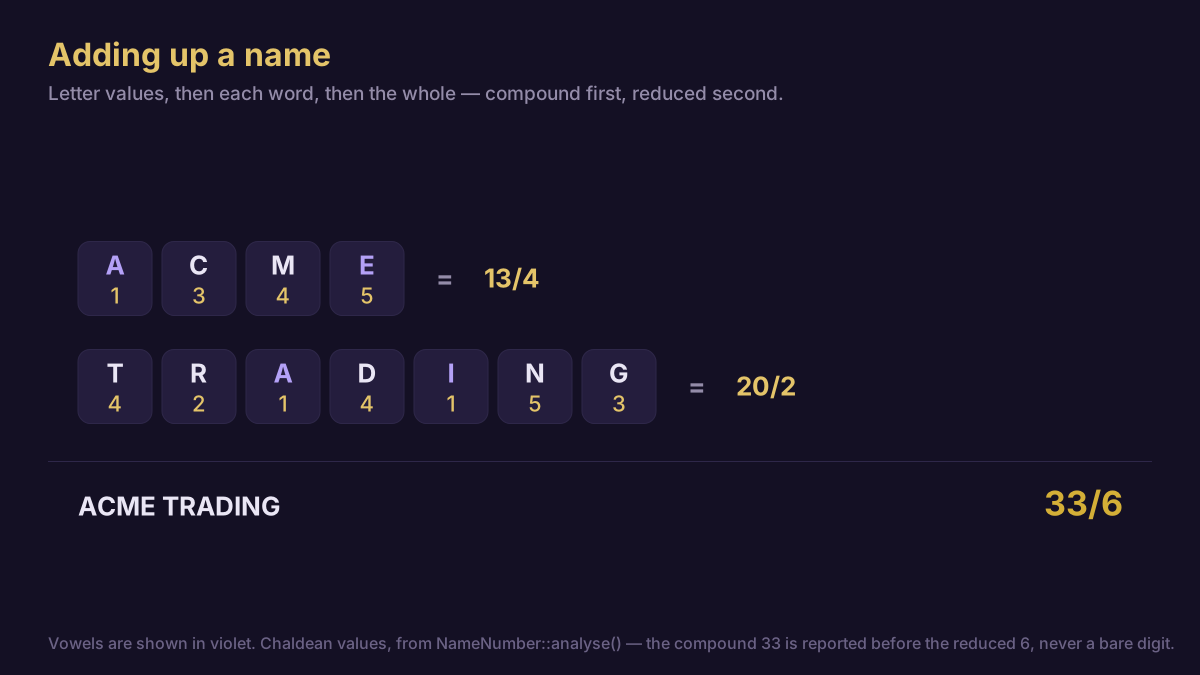
The test the tradition applies is simple: did you choose it, or did the government require it? A suffix conferred by statute is common to lakhs of companies and carries no signature of yours. So PRIVATE LIMITED, LIMITED, LLP, OPC and the rest are stripped before the letters are added.
| Filed at the registry | Letters actually counted | Total |
|---|---|---|
| LAKSHMI AGRO EXPORTS PRIVATE LIMITED | LAKSHMI AGRO EXPORTS | 66/3 |
| LAKSHMI AGRO EXPORTS LLP | LAKSHMI AGRO EXPORTS | 66/3 |
| LAKSHMI AGRO EXPORTS OPC PRIVATE LIMITED | LAKSHMI AGRO EXPORTS | 66/3 |
Type OPC without brackets when you check a one-person company: the business name analyser strips OPC as a suffix but reads (OPC) as letters, which gives 84/3 instead.
Same reading, three structures. That is the intended result: the structure is a tax and liability decision, and nothing in this system has an opinion about it.
Where practitioners do disagree is the word that is not statutory. INDIA in SOMETHING INDIA PRIVATE LIMITED is a word you chose and the method counts it. So is ENTERPRISES, ASSOCIATES, INDUSTRIES, AND SONS. Those carry weight in the total and are the cheapest lever you have when a name is otherwise fixed by family or trademark reasons — adding or dropping INDIA can move a total by twelve, since INDIA is 12/3 on its own. The business name analyser will show the letter trace for any variant you type.
One more convention, and it is the site's, not a universal one: the ampersand is not counted, and digits in a name are counted at face value. R K & CO reads as R K CO.
Name availability comes before any number
This is the order that gets reversed most often, and it wastes the most time.
A name is reserved through the registry before anything is incorporated, and it is refused on grounds that have nothing to do with numerology: it is identical or too nearly resembles an existing company or LLP, it includes a registered trade mark in the same class without consent, it does not sit with the stated principal objects, or it falls foul of restricted words. Section 4 of the Companies Act 2013 is the statutory basis; the detail sits in the incorporation rules made under it.
The practical consequence: calculate a shortlist, not a name. Six candidates that all read well, ranked, so that a refusal costs you a resubmission rather than a rethink. A founder who computes one perfect total and then discovers it is taken has to start the arithmetic again, usually under time pressure, which is when bad compromises get made.
Two checks worth running before you get attached to a total:
- The registry's own name-availability search, which is free and takes a minute.
- The trade mark register. A name can clear the companies register and still collide with a mark in your class. The public trade mark search at the Indian patent office is open to anyone. A mark in the same class is an explicit ground for treating a proposed company name as undesirable.
Neither of those is a numerological test. They are the gate the numbers have to pass through, and they close first.
Word order and the "and" problem
Indian filings are full of names like SHARMA AND COMPANY, SHARMA & CO, SHARMA AND SONS. These are not equivalent in the arithmetic, and the system's rule on AND is the one to state plainly: written out, it is letters and it counts; as &, this site does not count it. Practitioners split on that, and there is no authority that settles it. Run both spellings and see whether the verdict actually moves — often it does not, and then the question is moot.
Spelling variants are the trap unique to Indian names
An English romanisation of an Indian-language word has no single correct form. Two spellings of the same spoken name give different totals, and sometimes different reduced digits.
| Written as | Chaldean working | Total |
|---|---|---|
| SRI | 3 + 2 + 1 | 6 |
| SHRI | 3 + 5 + 2 + 1 | 11/2 |
| SHREE | 3 + 5 + 2 + 5 + 5 | 20/2 |
| LAXMI | 3 + 1 + 5 + 4 + 1 | 14/5 |
| LAKSHMI | 3 + 1 + 2 + 3 + 5 + 4 + 1 | 19/1 |
| GANESH | 3 + 1 + 5 + 5 + 3 + 5 | 22/4 |
| GANESHA | 3 + 1 + 5 + 5 + 3 + 5 + 1 | 23/5 |
| DEEPAK | 4 + 5 + 5 + 8 + 1 + 2 | 25/7 |
| DIPAK | 4 + 1 + 8 + 1 + 2 | 16/7 |
Three things to read off that table.
Sometimes the digit holds and the compound moves. SHRI and SHREE both reduce to 2, but one arrives as 11 and the other as 20, and the tradition weights the compound more heavily than the reduced digit. DEEPAK and DIPAK are the same story at 25 and 16. Compound numbers are read individually — the compound number reference has what each is held to mean.
Sometimes the digit flips outright. LAXMI is a 14/5 and LAKSHMI a 19/1. That is a different reading of the same word, produced by a choice most founders make on the form in about four seconds.
The extra letter is not free. A great deal of Indian practice consists of adding a letter — a second K, a trailing A, an E — to move a total onto a favoured number. It works arithmetically. Whether it is wise is a separate question, and the honest answer is that it depends on how much the misspelling costs you in search, in pronunciation and in the patience of the person typing it. The trade-off is set out in correcting a business name, which also covers what changing a name after incorporation involves.
A fourth point, which is less about numerology than about consistency: pick one romanisation and use it everywhere — the incorporation papers, the GST registration, the signage, the domain, the invoices. A name that is spelled two ways across your own documents has, in the method's terms, no settled total at all, and in commercial terms is a nuisance at every bank counter.
Registration dates, GST and what counts as the birth date
The tradition reads a business's date the way it reads a person's: the day it came into being. In India there are several candidates for that day, and they do not agree.
| Date | What it is | How much you control it |
|---|---|---|
| Date of incorporation on the certificate | The day the registrar issues the CIN | Partly — the filing date is yours, approval is not |
| Effective date of GST registration | Usually the date liability arose or the application date | Very little |
| Udyam / MSME registration date | Self-declared registration on the MSME portal | Mostly yours |
| First invoice or first sale | The day the business first transacted | Yours entirely |
This site's working rule is that the incorporation date is the formal birth date for a registered company, and the first transaction is the birth date where there is no incorporation — a sole proprietorship, most obviously, which in India has no certificate at all and whose earliest official trace is often a GST registration or an Udyam entry. Practitioners disagree here, and the disagreement is real rather than cosmetic: a proprietorship that registered for GST in one year and started trading in another has two defensible date numbers.
What you can actually schedule is the filing, not the certificate. The registrar approves when the queue reaches you, and a date chosen to the day is a preference, not a guarantee. Build a window of three or four acceptable dates rather than one, and file early enough that a day's slippage still lands inside it. Scoring a range is what the launch date finder does, and choosing a registration date works through the method in full.
Business numerology in India, worked end to end
An invented example, every figure computed.
The founder. Priyanka Rao, born 28 June 1985.
Driver    (day of month):  28 → 2 + 8 = 10 → 1 + 0 = 1
Conductor (whole date):    2 + 8 + 0 + 6 + 1 + 9 + 8 + 5 = 39 → 3 + 9 = 12 → 1 + 2 = 3
A 28/1 driver and a 39/3 conductor. Those two figures are fixed and everything else is fitted to them.
| Figure | Friendly to | Neutral to | Adverse to |
|---|---|---|---|
| Driver 1 (Sun) | 2, 3, 5, 6 | 1, 4, 7, 9 | 8 |
| Conductor 3 (Jupiter) | 1, 2, 3, 5 | 4, 7, 8, 9 | 6 |
Note the conflict already visible: a 6 pleases the driver and offends the conductor. That is normal, and it is why the method scores both rather than picking one.
The business. An agricultural export firm in Nashik, to be incorporated as a private limited company. The family name for it is Lakshmi, and the object word is undecided between exports, foods and trading.
The candidates. Legal suffix stripped in every case.
LAXMI   = 3 + 1 + 5 + 4 + 1 = 14
LAKSHMI = 3 + 1 + 2 + 3 + 5 + 4 + 1 = 19
SHREE   = 3 + 5 + 2 + 5 + 5 = 20
AGRO    = 1 + 3 + 2 + 7 = 13
EXPORTS = 5 + 5 + 8 + 7 + 2 + 4 + 3 = 34
FOODS   = 8 + 7 + 7 + 4 + 3 = 29
TRADING = 4 + 2 + 1 + 4 + 1 + 5 + 3 = 20| Candidate, as it would be filed | Working | Total | Verdict against driver 1 and conductor 3 |
|---|---|---|---|
| LAKSHMI AGRO EXPORTS PRIVATE LIMITED | 19 + 13 + 34 = 66 | 66/3 | Excellent |
| SHREE LAKSHMI AGRO EXPORTS PRIVATE LIMITED | 20 + 19 + 13 + 34 = 86 | 86/5 | Excellent |
| LAXMI AGRO FOODS PRIVATE LIMITED | 14 + 13 + 29 = 56 | 56/2 | Excellent |
| LAXMI AGRO EXPORTS PRIVATE LIMITED | 14 + 13 + 34 = 61 | 61/7 | Strong |
| LAKSHMI AGRO FOODS PRIVATE LIMITED | 19 + 13 + 29 = 61 | 61/7 | Strong |
| LAKSHMI AGRO TRADING PRIVATE LIMITED | 19 + 13 + 20 = 52 | 52/7 | Strong |
Read the first and fourth rows together. The only difference between them is LAKSHMI against LAXMI — the same word, the same pronunciation, a spelling most founders would treat as a matter of taste. It moves the total from 66/3 to 61/7 and the verdict from Excellent to Strong, because 3 is friendly to both of this founder's figures and 7 is neutral to both.
That is the whole India-specific argument in one comparison, and it is also a warning: a method that swings on a transliteration is telling you something about its own precision.
The shortlist submitted. Three names, ranked: LAKSHMI AGRO EXPORTS, then SHREE LAKSHMI AGRO EXPORTS, then LAXMI AGRO FOODS. All three read well, so a refusal on the first costs nothing but a form.
The date. Target incorporation in March 2026. Run the month through the launch date finder with her date of birth and LAKSHMI AGRO EXPORTS (66/3) as the business name. The four dates that fall on her own driver score like this:
| Date | Date number | Digits | Total | Weekday ruler | Score |
|---|---|---|---|---|---|
| Sunday 1 March 2026 | 1 | 0 + 1 + 0 + 3 + 2 + 0 + 2 + 6 = 14 | 14/5 | Sunday, Sun, 1 | 76, Strong |
| Tuesday 10 March 2026 | 10/1 | 1 + 0 + 0 + 3 + 2 + 0 + 2 + 6 = 14 | 14/5 | Tuesday, Mars, 9 | 64, Moderate |
| Thursday 19 March 2026 | 19/1 | 1 + 9 + 0 + 3 + 2 + 0 + 2 + 6 = 23 | 23/5 | Thursday, Jupiter, 3 | 69, Moderate |
| Saturday 28 March 2026 | 28/1 | 2 + 8 + 0 + 3 + 2 + 0 + 2 + 6 = 23 | 23/5 | Saturday, Saturn, 8 | 58, Moderate |
All four are 1-days: the day of the month reduces to 1, the founder's own driver, which the finder scores as the strongest date number available. Their full-date totals, 14/5 and 23/5, both reduce to 5, but the finder ranks on the day, not the total. The weekday breaks the tie, read against the driver. Sunday is ruled by 1, her own number, and coincides with a date number of 1. Thursday is ruled by 3, friendly to a driver 1; Tuesday by 9, neutral to it; Saturday by 8, the one number adverse to a driver 1. Read the totals instead and the order would shift — the classical tables rate 23 Excellent and 14 Good, with a warning about risk — which is a genuine split between reading the day and reading the whole date.
Across the whole month the finder also places Thursday 12 March and Monday 30 March at 74, Strong. Both are 3-days, 12/3 and 30/3: friendly to her driver, and matching the name number 3.
The answer: Sunday 1 March 2026, first in the month's ranking at 76, with 12 March and 30 March as the rest of the window — filing the papers far enough ahead that approval lands on or near one of them.
One caveat, stated because leaving it out would be dishonest: this founder's personal year in 2026 computes to 26/8, which the tradition reads as the return year of the cycle — the year earlier work is expected to pay, with money, authority and structure in focus. It is not a reason to delay an incorporation, and it is not a promise either: a company's first year is still a first year, so budget for groundwork. Nothing here forecasts revenue.
Common practice, and where Indian practitioners disagree
Four splits come up constantly, and a reader is better served knowing they exist than being handed one answer.
Which alphabet. Chaldean dominates commercial practice in India, and this site treats it as primary. A significant minority works in Pythagorean, and a third group uses a Sanskrit-derived assignment applied to the Devanagari spelling rather than the English one. Those three will not agree on a name. There is no neutral referee, so the only defensible move is to state which system a reading uses.
Whether to reduce each word first. Some practitioners total the whole name; others reduce each word to a digit and add those. LAKSHMI AGRO EXPORTS is 66/3 whole, and a per-word approach gives a different compound. This site totals the whole name by default. Both are traditional.
Numerology against muhurat. A muhurat is astronomical — computed from the panchang for a place and a time — and numerology is arithmetic on a written date with no location or time term. They disagree often. Where a family expects a muhurat, numerology is the junior system in that room: take the muhurat window first and choose inside it.
Numerology against vastu. The same applies to premises. Vastu rules a direction and a layout; numerology reads the door number against the owner's birth number. The two can point opposite ways on the same unit, and the interaction is set out in vastu and numerology together.
On what all this costs: fees in the Indian market run from a few hundred rupees for a quick name reading to substantial sums for a full corporate consultation, with no regulator, no qualification and no standard of care behind any of it. What consultants charge sets out what the price ranges actually buy.
Frequently asked questions
Is Pvt Ltd counted in business name numerology?
No. The tradition strips any suffix the state requires — PRIVATE LIMITED, LIMITED, LLP, OPC, INC — on the reasoning that a tail shared by lakhs of companies carries none of your choice. Words you selected are counted, including INDIA, ENTERPRISES and AND SONS. So the same trading name reads identically whether you incorporate as a private limited company or an LLP.
Which spelling should I use for an Indian business name?
Whichever one you will use consistently everywhere. The method will give you a different total for LAXMI (14/5) and LAKSHMI (19/1), and if one matches your figures better, that is a genuine input. But a spelling that people mistype, mispronounce or cannot find in search costs you more every day than the numbers gain you once. Decide the commercial question first.
Does the MCA reject a name for numerological reasons?
No. The registry tests availability against existing companies and LLPs, registered trade marks in the same class, restricted and offensive words, and consistency with your stated objects. Numerology is not among the grounds. This is why a numerological shortlist should have five or six ranked candidates rather than one favourite.
Which date should I use for a business in India — incorporation or GST?
For a registered company, the date of incorporation on the certificate. For a proprietorship, which has no incorporation date, the first transaction is the older and more defensible reading, with the GST or Udyam registration date as a formal alternative. Practitioners split on this and it matters: the two dates often fall in different years.
Can I change my company name later if the numbers are wrong?
A registered company can change its name, but it is a formal process with board and shareholder approval, a fresh name reservation, a revised certificate and consequential changes to bank records, GST, signage and contracts. It is neither quick nor free. That cost is the argument for doing the arithmetic before incorporation rather than after.
Where business numerology in India runs out
It does not predict trade. No controlled study supports any claim that a name total, a registration date or a door number affects revenue, survival or margin. This is a traditional interpretive framework with a long history and no experimental backing. Treat it as a structure for reflection and planning. Nothing in it is financial, legal or medical advice, and nothing here is a promise about how a business will perform.
Transliteration has no right answer. The single most consequential input in an Indian reading — how a word is spelled in English — is not determined by the tradition, by the language, or by anything else. Any total built on LAKSHMI is one plausible romanisation away from being a different total. A method whose output moves when a defensible spelling changes is coarse by construction, and should be quoted that way.
The registry outranks the method, every time. Availability, trade mark conflict and object consistency decide what you can be called. The numbers only ever choose among the names the law will actually let you have, and on a crowded register that set can be small.
The date is only partly yours. Approval timing sits with the registrar, and a GST effective date is usually set by when liability arose, not by preference. An article that tells you to incorporate on a chosen day is describing a filing target, not an outcome you control.
Nine numbers is a coarse instrument. Roughly one date in nine shares any given verdict, and one name total in nine any given reading. That is a useful filter for a shortlist and far too blunt to justify delaying a launch by a season or overpaying for a domain.
It cannot tell you the things that decide the business. Whether the export licence comes through, what the buyer in Rotterdam pays, how the rupee moves, whether the second partner stays. Used honestly, the method's real service is procedural: it forces the name, the structure, the date and the premises to be decided deliberately, written down, and agreed between founders before the money goes out. That is worth something on its own terms, and it is the only thing it can be relied on to do.