
Numerology consultant fees run from nothing to five figures, and the price tracks reputation far more closely than it tracks method. A written report on a trading name is commonly ₹5,000 to ₹25,000 in India and $200 to $600 elsewhere. Most of the arithmetic inside one is free to compute. What the fee actually buys is judgement about that arithmetic, and judgement is the part you have to test before you pay.
This site sells reports, which is a conflict of interest worth putting in the second paragraph rather than the footer. The test below is therefore written so that it can be applied to us as easily as to anyone: compute the free half first, and see how much is left.
What numerology consultant fees buy, tier by tier
"A consultation" covers five quite different products. Comparing prices across them is the most common way a buyer overpays, because the cheap thing and the dear thing are not the same thing at all.
| Format | India | International | What is normally in it |
|---|---|---|---|
| Automated calculator | Free | Free – $30 | A total, a reduced digit, a stock paragraph |
| Quick name check | ₹500 – ₹2,500 | $50 – $150 | A verdict on one or two candidates, little working |
| Written business report | ₹5,000 – ₹25,000 | $200 – $600 | Founder chart, name arithmetic, computed alternatives, dates |
| Report plus a live session | ₹25,000 – ₹1,00,000 | $600 – $2,000 | The above, plus 30 to 60 minutes of questions |
| Ongoing advisory | ₹1,00,000 upward | $2,000+ per year | Multiple entities, multiple founders, access over time |
These are advertised list prices, observed across a market that moves and varies by city. Read the table as "what should I get", not "what should I pay". The Indian market for this service is older, larger and far more competitive, so comparable depth often costs less there — a point covered further in the guide to how the method is applied to an Indian company.
Two rows deserve a warning. The automated tier is honest about what it is: arithmetic with a paragraph attached. The ongoing advisory tier is the one where the deliverable is least defined, because access is not a document and cannot be checked against a checklist afterwards.
The arithmetic you can do for nothing before paying anyone
Every number in the first half of a business report is ordinary addition. The reduction step that looks mystical on the page is the digital root, a standard piece of arithmetic that any schoolchild can perform and any calculator can confirm. That matters commercially: nobody can charge a premium for a sum, so a fee has to be justified by something else.
Here is a founder we will follow through the rest of this article. Ranjit was born on 17 March 1988 and is naming a spice importer.
Driver     = day of the month = 17 → 1 + 7 = 8
Conductor  = 1 + 7 + 0 + 3 + 1 + 9 + 8 + 8 = 37 → 3 + 7 = 10 → 1 + 0 = 1
Driver 17/8, conductor 37/1. Compound first, reduced digit second, always — the tradition treats 17 and 26 as different arrivals at the same 8. Two lines of addition, and they are the input to everything that follows.
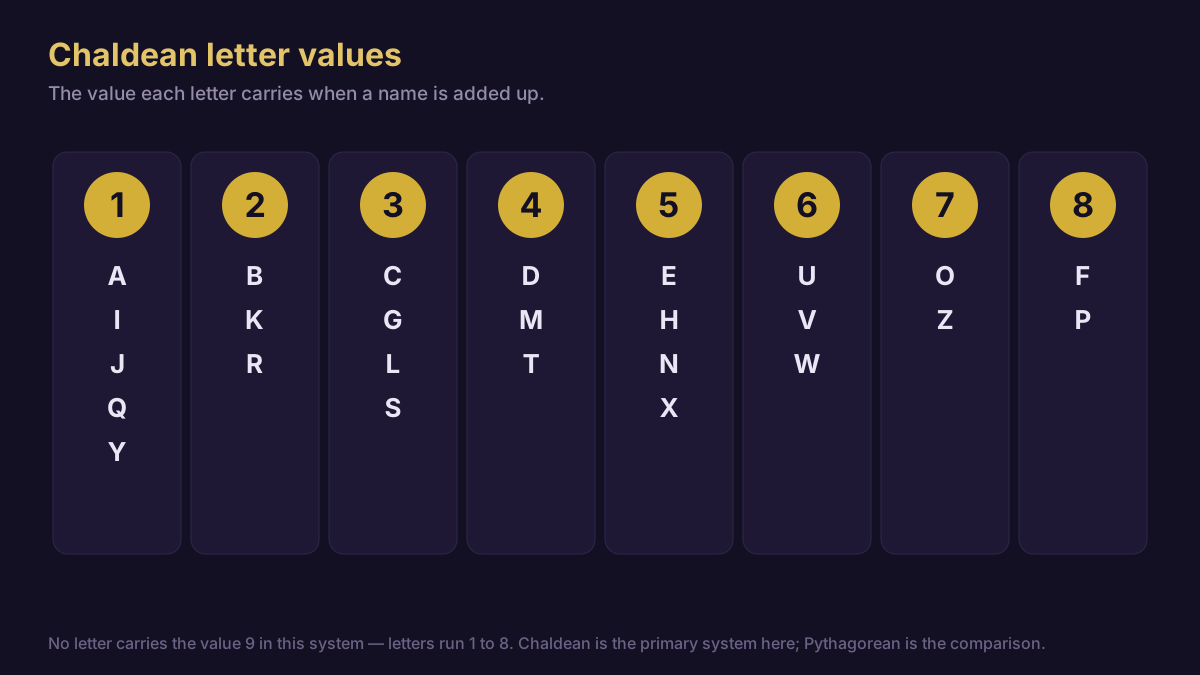
The trading name is the second free calculation. Chaldean values run 1 to 8, with no letter carrying a 9:
A, I, J, Q, Y = 1 · B, K, R = 2 · C, G, L, S = 3 · D, M, T = 4 · E, H, N, X = 5 · U, V, W = 6 · O, Z = 7 · F, P = 8
The proposed name is SAFFRON ROUTE.
S A F F R O N = 3 + 1 + 8 + 8 + 2 + 7 + 5 = 34
R O U T E = 2 + 7 + 6 + 4 + 5 = 24

34 + 24 = 58 → 5 + 8 = 13 → 1 + 3 = 4
SAFFRON ROUTE = 58/4. No suffix is counted: Pvt Ltd, LLP and Inc are conferred by a registrar rather than chosen, and the method has never counted a conferred word.
Three more free outputs complete the free half — the Lo Shu grid from the same birth date via the Lo Shu grid tool, the Pythagorean cross-check, and the name-to-founder verdict from the business name analyser. The core calculators produce all of it in about twenty minutes. Anyone selling those five outputs alone is selling you a calculator run.
The cross-check is worth doing before you buy, because it often decides whether a report is worth buying at all:
Pythagorean: S A F F R O N = 1 + 1 + 6 + 6 + 9 + 6 + 5 = 34
Pythagorean: R O U T E = 9 + 6 + 3 + 2 + 5 = 25
34 + 25 = 59 → 5 + 9 = 14 → 1 + 4 = 5
Chaldean says 58/4. Pythagorean says 59/5. One of those totals is among the weakest a trading name can carry and the other is among the strongest, from the same eleven letters. A report that quotes one system and stays silent about the other has hidden the most interesting thing on the page. The difference between the two systems is not a footnote; it is the reason a second opinion has any value.
A worked example: what the paid half actually adds
Ranjit's free half gives him a driver of 17/8, a conductor of 37/1, and a Chaldean name total of 58/4 that the analyser grades Avoid — 4 is one of the two totals this system marks down for any trading name, and it sits badly against an 8 driver besides. So he knows the answer is no. What he does not know is what to do about it, and that is the work a fee should pay for.
A competent report answers with computed alternatives, not suggested words. Every row below was totalled on the same table, against the same founder.
| Candidate | Chaldean words | Total | Reduced | Verdict for this founder |
|---|---|---|---|---|
| SAFFRON ROUTE | 34 + 24 | 58 | 4 | Avoid |
| SAFFRON TRAIL | 34 + 11 | 45 | 9 | Weak |
| THE SAFFRON ROUTE | 14 + 34 + 24 | 72 | 9 | Weak |
| SAFFRON ROUTE TEAS | 34 + 24 + 13 | 71 | 8 | Avoid |
| SAFFRON ROAD | 34 + 14 | 48 | 3 | Excellent |
| SAFFRON ROUTE SPICE | 34 + 24 + 20 | 78 | 6 | Excellent |
| SAFFRON ROUTE FOODS | 34 + 24 + 29 | 87 | 6 | Excellent |
Four findings in that table are worth more than the arithmetic that produced them.
The smallest change wins. SAFFRON ROUTE SPICE keeps the brand intact, adds one word, and moves 58/4 to 78/6. A report that opens with "change your name" when adding a descriptor would have done is either careless or selling a rebrand.
Adding words is not automatically an improvement. SAFFRON ROUTE TEAS reads well and lands on 71/8, which for this founder is refused rather than merely weak. Scoring is the only thing that distinguishes the two, and no amount of taste will do it.
The definite article is not free. THE adds 14, which is why THE SAFFRON ROUTE goes to 72/9 and out of contention.
The recommended set is short. For a driver 8, this system reads name totals of 3, 5, 6 and 7 as the recommended band. Everything else needs a specific argument. Run the pairing yourself on the name and founder score, which shows its components rather than a single figure.
That is roughly two hours of work for someone who knows the tables, and it is the honest core of a mid-band report. If a quoted fee is well above the mid band, the extra is buying live time, reputation, or page count — not more of this.
Why the same name total gets different verdicts
Here is the clearest test of whether a report was written for you or printed for everybody. Take SAFFRON ROUTE's 58/4 and read it against each of the nine driver numbers.
| Driver | 4 as the name total | Why |
|---|---|---|
| 1 | Weak | Nothing in the pairing objects, but a 4 name slows a founder whose advantage is deciding first. |
| 2 | Avoid | An adverse pairing compounded by the trading-name penalty that 4 carries anyway. |
| 3 | Weak | No conflict, no support. A 3 founder gets none of the momentum a 1, 2, 3 or 5 name would return. |
| 4 | Avoid | The founder's own number, which is usually the strongest reading — but not this digit, and doubling the penalty is not a plan. |
| 5 | Strong | The one driver that takes a 4 name comfortably. Only the trading-name penalty keeps it off the top grade. |
| 6 | Weak | Workable in daily practice, unremarkable on paper, and 6 has four better options available. |
| 7 | Weak | Two inward numbers. The business will be thorough and quiet, which is not what most 7 founders need from a brand. |
| 8 | Avoid | Ranjit's row. Saturn behind Rahu is the pairing this system marks down hardest as a trading name. |
| 9 | Avoid | Refused. A 9 founder should not be trading under a 4 total whatever the name sounds like. |
Eight rows read poorly and one reads well. So "4 is a bad business number" is almost true and still wrong, and a reading that states it as a rule has told you nothing about your own position. Any report whose verdicts would be unchanged if your birth date were different is boilerplate, at any price. The same principle drives every correction to an existing business name: the target is not a lucky number, it is a number that suits one particular founder.
What numerology consultant fees look like beside the other costs of a name
A price only means something next to the decision it informs. Two of the other costs on the same decision are published and fixed.
| Cost on the same decision | Published price | What it is |
|---|---|---|
| Registering a UK private limited company | £100 online, £124 by post | The registrar's own fee, usually processed within 24 hours |
| Registering one UK trade mark, one class | From £205, plus £60 per extra class | Ten years of protection for the name |
| A mid-band written numerology report | ₹5,000 – ₹25,000 / $200 – $600 | An opinion on which name to file |
The UK figures come from the government's own guidance on registering a company with Companies House and on registering a trade mark; other jurisdictions differ in amount, not in shape. The comparison is not a criticism of anybody's pricing. It is a scale. A reading that costs several times what the state charges to make the name legally yours is a large bet on a soft input, and the size of that bet is the buyer's call, not the practitioner's.
The other cost worth putting on the table is the cost of changing the name later: signage, packaging, domains, printed stock, search rankings, and the customers who lose you. Nobody has a credible figure for it, so nobody should quote one — but it is the reason a reading is worth more before you file than after, and it is the argument a good consultant makes without inflating it.
What raises the price, and what should not
Five factors explain most of the spread. Only the first is about the analysis.
Depth. A single-name check is fifteen minutes. A founder chart, two systems, six computed candidates and a set of date options is a working day. That belongs in the price.
Live time. A call is the most expensive component of any advisory service. A written-only report is cheaper for the same reason a written-only report is cheaper everywhere.
Audience. A practitioner with a large following charges a multiple of one without, for identical arithmetic. That is normal in every advisory market and is not evidence about method.
Turnaround. Same-day work carries a premium, as it does in every trade.
Bundling. Where stones, yantras or corrections are included or offered as a follow-on, treat the purchase as two purchases and price them separately in your own head.
What should not raise the price is a claimed success rate. There is no measurable accuracy in this field to charge against, nobody publishes a denominator, and a pricing argument built on results is the one to walk away from. The same goes for urgency: where a reading arrives with a deadline attached, the deadline is commercial.
What a numerology consultant cannot sell you
Some of what buyers expect for their money cannot be delivered by anyone at any fee, and a practitioner who says so plainly is demonstrating competence rather than weakness.
| Not available at any price | Who actually decides it |
|---|---|
| Whether the name is legally available | The company registrar |
| Whether it collides with a trade mark in your class | The trade mark registry, and eventually a court |
| Whether the domain or the handle is free | The registry and the platform |
| Whether customers can spell or say it | Customers |
| Whether the business will succeed | Too many inputs to list |
| A guaranteed result of any kind | Nobody |
A reading is guidance for reflection and planning. It is not financial, legal or medical advice, and a report that drifts toward any of the three has exceeded what the material supports. The published methodology is where a serious practice states its rules in advance so that a buyer can hold it to them; ours is public for that reason, and so are the report formats and prices this site sells.
A three-question value test
Long buyer checklists rarely survive contact with a sales conversation — the full version is set out in the companion guide to what a business numerology report should contain. Three questions do most of the work, and each has a right answer.
One: which system, and will I see every letter? The right answer names Chaldean or Pythagorean, states whether suffixes are counted, and promises letter-by-letter working for every candidate. A total without its addition cannot be checked, and an unverifiable number is an opinion with a price tag.
Two: how many alternatives will be computed, and can I add more afterwards? The right answer is a specific count, agreed before payment, plus a stated policy on re-scoring. Naming is iterative; you will think of a better candidate three days after delivery, and whether that is included, chargeable or refused is the term most often left unsaid and most often regretted.
Three: what will this report not claim? The right answer arrives immediately, because someone who has thought about their method has thought about its edges. An evasive answer here is more informative than any credential. A practitioner comfortable saying "the two systems disagree about your name and here is which one I follow and why" is doing the job. One who changes the subject is selling certainty, which is the one thing not in stock.
If the free half already reads well — your name total sits in the band your driver supports, the two systems agree, the date is workable — the marginal value of paying drops sharply. You are then buying interpretation rather than a diagnosis, which is a legitimate purchase at a proportionate price. If the free half reads badly, you arrive at the conversation knowing exactly what to ask, which is worth more than the fee difference between bands.
Frequently asked questions
How much does a business numerology consultation cost?
A written business report commonly runs ₹5,000 to ₹25,000 in India and $200 to $600 internationally. Quick single-name checks start around ₹500 or $50, and reports bundled with a live session typically run ₹25,000 upward or $600 to $2,000. These are advertised list prices; they vary widely by city and by the practitioner's audience size rather than by depth of work.
Are expensive numerology consultants better than cheap ones?
Not reliably. Numerology consultant fees track reputation, live consultation time and local market conditions, none of which is a measure of method. A ₹2,000 report showing every calculation can be checked; a ₹40,000 report showing none cannot. Judge the deliverable against the three questions above — declared system, computed alternatives, stated limits — and treat price as information about the seller, not the reading.
Can I get a business numerology report for free?
You can get the calculations free. Driver, conductor, Lo Shu grid, Chaldean name total and the founder pairing are all plain addition, and free calculators produce them correctly. What is not free is a considered comparison of several candidate names and a practitioner's reasoning about your particular position. Do the arithmetic first — it makes you a much harder person to sell a weak report to.
What should a business numerology report contain?
The system used and its reduction rules, the founder's driver and conductor with the working shown, the trading name totalled letter by letter as compound and reduced, a cross-check in the second system, the founder-to-name verdict with reasoning, and a limits page. Anything recommending a change should include at least three alternatives with their totals computed, not merely suggested.
Is a live consultation worth the extra fee?
It depends entirely on whether you have questions a document cannot answer. If you are choosing between two computed names that score identically, a conversation is useful. If you want the report read aloud, it is not. Ask what the session covers and how long it runs, in writing, before agreeing to the higher band.
Do consultants check whether the name is available?
Almost never, and the honest ones say so up front. Availability is decided by the company registrar, trade mark availability by the registry, and the domain by whoever registered it first. Run those checks before commissioning a reading, or you may pay to have a name scored that you cannot legally use.
Where this runs out
There is no licensing body, no examination and no protected title in this field. Anyone may call themselves a business numerology consultant and set any fee. That is not an accusation, only the state of the market, and it moves the whole burden of assessment onto the buyer. Price carries no information about competence. Testimonials carry little, because dissatisfied clients rarely publish and satisfied ones cannot know what would have happened otherwise.
There is also no controlled evidence that any of this affects commercial outcomes. What exists is a traditional system applied consistently, plus a great deal of after-the-fact pattern matching that cannot distinguish itself from coincidence. The SAFFRON ROUTE example shows the internal problem without needing a sceptic: two established systems, the same eleven letters, answers of 58/4 and 59/5. Both cannot be describing the same fact. This site follows Chaldean and says so; a report that hides the disagreement is more confident than the material allows.
The practical limits are firmer still. No reading can tell you whether the market wants what you sell, whether your margins work, or whether the name is yours to use. It cannot predict revenue and is not a substitute for financial, legal or medical advice.
The sensible way to spend here is the way you would spend on any other soft input: a proportionate amount, on a decision that is still open, from someone who shows their working. Nobody should pay a fee they would miss for a reading of any kind. Bought at a price that hurts, in the expectation of a result, it cannot be worth it, because the expectation was never on offer.