
Name correction numerology adjusts the spelling of a business name — a doubled letter, an added H, a dropped silent vowel — so the Chaldean total lands on a different number while the name still sounds identical. Nothing about the legal entity moves. A correction belongs on signage, the website and the cards. It does not belong on your certificate of incorporation.
That last point is the part most commonly got wrong. What follows is the arithmetic, three corrections computed end to end, and a plain account of what the method cannot do.
A correction is not a change
The site covers changing a company name outright elsewhere. This is the smaller operation, and the two are worth separating because they carry completely different costs.
| Name correction | Name change | |
|---|---|---|
| What moves | Spelling only | The word itself |
| How it sounds | Identical | Different |
| Registrar involved | No | Yes |
| Existing trademark | Usually still relevant to the old spelling | May need refiling |
| Signage, cards, website | Reprinted | Reprinted |
| Domain, email, invoices | Often reprinted | Always reprinted |
| Search visibility | Largely retained | At risk |
| Typical arithmetic effect | Moves the total by 1 to 8 | Moves it anywhere |
A correction is a spelling variant, not a new word. Kestrel becomes Kestrell. Tanvi becomes Thanvi. Marlowe becomes Marlow. Said aloud in a phone call, nobody notices. Written down, the Chaldean total is different, and that is the entire mechanism. You are not asking customers to learn a new word; you are asking a signwriter to set one extra letter.
What name correction numerology actually changes
Three things, and only three.
The compound total. Each letter carries a Chaldean value. Add a letter and the total goes up by that letter's value; remove one and it goes down. The compound is reported over its reduced digit — 52/7, 55/1 — compound first, reduced second. The business name analyser shows the trace for each.
The reduced digit, usually. Most edits move it, but not all. Adding 9 to any total leaves the reduced digit exactly where it was, so a correction whose net value is 9, 18 or 27 is invisible at the digit level however much the compound shifts.
The reading against the founder. This is the point of the exercise. A trading-name total is never read alone; it is read against the founder's driver and conductor, so the same correction that helps one founder does nothing for another. What the business numbers mean sets out the character of all nine in trade.
What a correction does not change: the registered entity, the incorporation date, the premises, the founder's own numbers, or anything at all about the product. Those are separate readings with separate authorities.
One rule holds throughout, and it is not negotiable. The registrar-conferred suffix is never counted. Pvt Ltd, LLP, Inc, GmbH, Limited — these are conferred by a registry, shared by millions of companies, and chosen by nobody. Score the trading name only. A method with an optional switch will always produce the answer you already wanted.
The letters that move a total, and by how much
Chaldean assigns values 1 to 8. There is no 9 for a letter; nine appears only as a total.
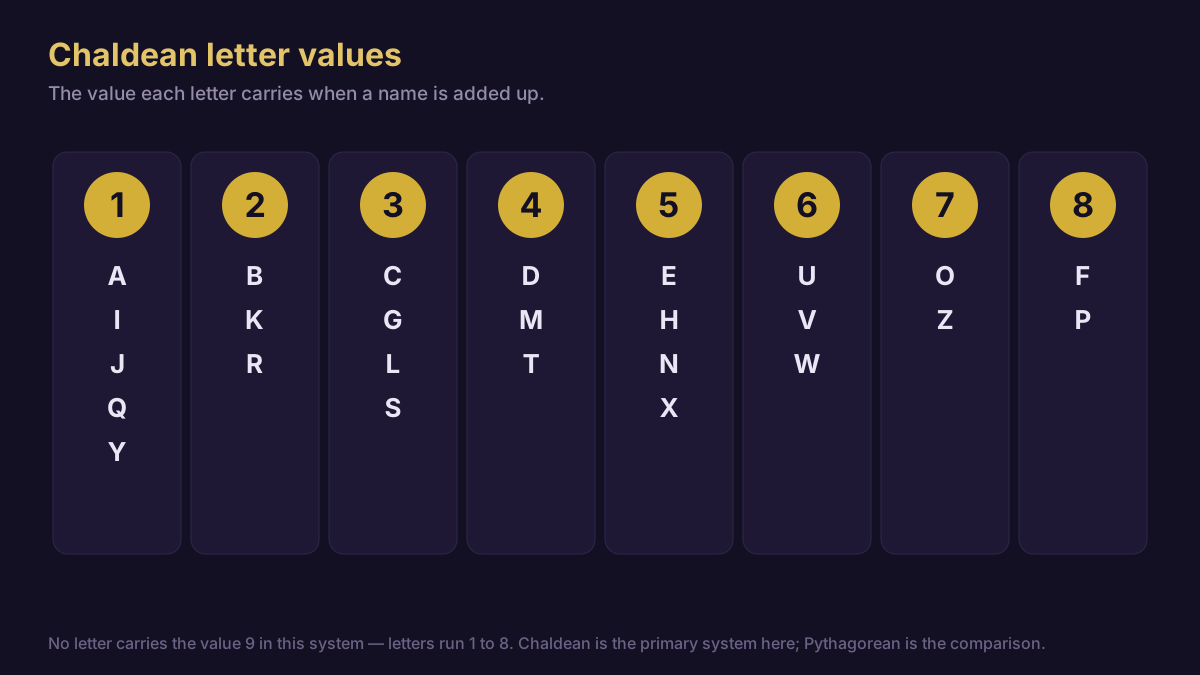
| Value | Letters |
|---|---|
| 1 | A, I, J, Q, Y |
| 2 | B, K, R |
| 3 | C, G, L, S |
| 4 | D, M, T |
| 5 | E, H, N, X |
| 6 | U, V, W |
| 7 | O, Z |
| 8 | F, P |
From that table, the standard correction moves follow directly. This is the working vocabulary:
| Edit | Example | Sound | Chaldean effect |
|---|---|---|---|
| Double a C, G, L or S | Kestrel to Kestrell | unchanged | +3 |
| Double an E, H or N | Vinod to Vinnod | unchanged | +5 |
| Double a B, K or R | Sarika to Sarrika | unchanged | +2 |
| Double a D, M or T | Sumit to Summit | unchanged | +4 |
| Add an H after a stop | Tanvi to Thanvi | unchanged for most speakers | +5 |
| Add a trailing E | Clark to Clarke | unchanged | +5 |
| Drop a silent trailing E | Marlowe to Marlow | unchanged | −5 |
| Write PH for F | Stefan to Stephan | unchanged | 8 + 5 = 13, so +5 |
| Write Z for S | Analyse to Analyze | unchanged | +4 |
| Write K for C | Clarity to Klarity | unchanged | −1 |
| Swap I for Y | Lira to Lyra | unchanged | 0 |
| Swap C for S | Cyrus to Syrus | unchanged | 0 |
The last two rows are there deliberately. Two of the most commonly sold "corrections" do nothing at all in Chaldean, because I and Y both carry 1 and C and S both carry 3. Lyra Foods and Lira Foods are both 36/9; Cyrus Labs and Syrus Labs are both 24/6. If someone recommends that swap and quotes a new total, check the arithmetic yourself.
Those same swaps are not neutral in the comparison system: under Pythagorean, Cyrus Labs is 30/3 and Syrus Labs is 28/1, because C is 3 there and S is 1. Which system you work in decides whether an edit is a correction or a no-op, and the argument for the primary one is set out in Chaldean and Pythagorean side by side.
Name correction numerology: three worked examples
Three invented businesses, three different edits, all computed end to end. Every figure below can be reproduced in the calculators.
One: a doubled letter
The founder was born on 12 December 1985. Driver is the day reduced: 1 + 2 = 3. Conductor is the whole date: 1 + 2 + 1 + 2 + 1 + 9 + 8 + 5 = 29, then 2 + 9 = 11, then 1 + 1 = 2. Reported as 29/2.
The trading name is Kestrel Freight.
KESTREL = 2 + 5 + 3 + 4 + 2 + 5 + 3 = 24
FREIGHT = 8 + 2 + 5 + 1 + 3 + 5 + 4 = 28
Whole name: 24 + 28 = 52. 5 + 2 = 7. Kestrel Freight is 52/7.
Against this founder, 7 sits flat. 3 is neutral to 7, and the conductor 2 is neutral to 7 as well. The name analyser grades the pairing Workable, which is the verdict for a name that neither helps nor hinders. Most working businesses sit here and never notice.
The correction doubles the final L, which adds 3.
KESTRELL = 2 + 5 + 3 + 4 + 2 + 5 + 3 + 3 = 27
Whole name: 27 + 28 = 55. 5 + 5 = 10, then 1 + 0 = 1. Kestrell Freight is 55/1.
Now 3 is friendly to 1, and 2 is friendly to 1 as well. Both of the founder's numbers align, and the verdict moves to Excellent. One letter, no change in pronunciation, no filing.
Two: an added H
The founder was born on 13 May 1980. Driver: 1 + 3 = 4. Conductor: 1 + 3 + 0 + 5 + 1 + 9 + 8 + 0 = 27, then 2 + 7 = 9. Reported as 27/9.
The trading name is Tanvi Interiors.
TANVI = 4 + 1 + 5 + 6 + 1 = 17
INTERIORS = 1 + 5 + 4 + 5 + 2 + 1 + 7 + 2 + 3 = 30
Whole name: 17 + 30 = 47. 4 + 7 = 11, then 1 + 1 = 2. Tanvi Interiors is 47/2.
This is the worst case in the three. 4 is adverse to 2, and 9 is adverse to 2 as well, so both of the founder's numbers read against the name. The engine returns Avoid. That does not mean the business fails; it means the tradition reads the pairing as friction, and a founder in this position is likely to feel they are pushing the name uphill.
The correction inserts an H after the T — the spelling most South Asian registries see a dozen times a day, and one that changes nothing for most speakers. H is 5.
THANVI = 4 + 5 + 1 + 5 + 6 + 1 = 22
Whole name: 22 + 30 = 52. 5 + 2 = 7. Thanvi Interiors is 52/7.
4 is friendly to 7. The conductor 9 is neutral to 7, so one number aligns and the other stands aside. The verdict is Excellent, though the compound, 52, carries no business verdict and is read classically as unfavourable, the same as 43. Note what happened to the first word on its own: 17/8 became 22/4. Both digits the method treats as difficult for a trading name — but the whole-name total is what is read, and that is what moved.
Three: a dropped silent E
The founder was born on 28 May 1991. Driver: 2 + 8 = 10, then 1 + 0 = 1. Conductor: 2 + 8 + 0 + 5 + 1 + 9 + 9 + 1 = 35, then 3 + 5 = 8. Reported as 35/8.
The trading name is Marlowe Studio.
MARLOWE = 4 + 1 + 2 + 3 + 7 + 6 + 5 = 28
STUDIO = 3 + 4 + 6 + 4 + 1 + 7 = 25
Whole name: 28 + 25 = 53. 5 + 3 = 8. Marlowe Studio is 53/8.
Here 1 is adverse to 8, and the conductor is itself an 8 — and 8 is adverse to 8 as well, so neither of the founder's numbers has anywhere to go. The verdict is Avoid. This is the situation people usually mean when they say a name "is not working": not a dramatic reading, just two hard blocks in the same chart.
The correction removes the silent trailing E, which subtracts 5. Marlowe becomes Marlow. Nobody hears a difference.
MARLOW = 4 + 1 + 2 + 3 + 7 + 6 = 23
Whole name: 23 + 25 = 48. 4 + 8 = 12, then 1 + 2 = 3. Marlow Studio is 48/3.
1 is friendly to 3, and 8 is friendly to 3. Both align. The verdict is Excellent. The compound is the weak point: 48 is advised against for a company name, with 39 or 57 the preferred routes to 3.
The three side by side
| Business | Before | Verdict | Edit | After | Verdict |
|---|---|---|---|---|---|
| Kestrel Freight | 52/7 | Workable | double the L | 55/1 | Excellent |
| Tanvi Interiors | 47/2 | Avoid | add an H | 52/7 | Excellent |
| Marlowe Studio | 53/8 | Avoid | drop the silent E | 48/3 | Excellent |
Three founders, three targets. Thanvi would read only Workable for the first founder, and Marlow only Workable for the second: there is no universally correct correction, which is why a list of "lucky spellings" is worth nothing without a birth date attached. Run your own pairing in the name change calculator.
Where a corrected spelling belongs, and where it must not
This is the section to read twice.
A corrected spelling is a trading name. It goes on the shopfront, the website, the business cards, the invoices' letterhead, the social handles, the email signature and the way you answer the phone. That is the name the world transacts with, and in this tradition it is the name being read.
A corrected spelling does not go on legal documents. The certificate of incorporation, the register entry, the tax registration, the bank mandate, the statutory filings and any contract that identifies the party — all of those carry the registered name exactly as registered. Changing that is not a correction at all; it is a formal name change with a different process behind it. In the UK, for example, the registrar's guidance is explicit that a company name change requires a shareholder resolution and that the new name does not take effect until it is registered. Other jurisdictions differ in detail and not in principle.
The registered name still has to appear where the law says it appears. UK guidance on signs, stationery and promotional material requires the registered company name on a sign wherever the business operates and on company documents, publicity and letters. A corrected trading name sits alongside that, not instead of it — which is the ordinary arrangement anyway, with the registered name in small type at the foot of the page.
And the suffix is never counted, in either direction. If your registered name is Kestrell Freight Private Limited, you score KESTRELL FREIGHT and stop. Adding the suffix would change the total, and a total you can move by including or excluding a phrase the registrar handed you is not measuring anything about your name.
One caution that is not a numerology point: a trademark protects a particular mark as used with particular goods or services, and the US office's explanation of what a trademark actually covers is worth five minutes before you reprint anything. A respelled version may fall outside what you registered — a question for a professional adviser, not a calculator.
Corrections that change nothing
Some edits look like work and are not.
The I-for-Y and C-for-S swaps, covered above: both are worth zero in Chaldean. Any edit whose net value is nine, which leaves the reduced digit untouched. Case, spacing and punctuation — upper case, lower case, a hyphen, an ampersand, a full stop after an initial are all normalised away before scoring, so KESTRELL, Kestrell and kestrell are one number.
Two more are not corrections at all. Swapping "Freight" for "Logistics" replaces a word rather than respelling one, and it changes what the business appears to do — a marketing decision that should not be made by arithmetic. And changing only the domain moves nothing here: the extension is not part of the name, and reading a domain is its own subject with its own rules.
When name correction numerology is the wrong tool
There are cases where the method has nothing useful to offer, and saying so is part of using it honestly.
When the name is already aligned. If the pairing reads Excellent, there is nothing to correct. Chasing a higher score by adding letters is how businesses end up with names nobody can spell.
When the problem is the word, not the spelling. A name that is hard to say, already trademarked, unfortunate in a second language, or simply wrong for the category cannot be fixed by a letter. That is a name change, and the guide to choosing a business name is the right starting point.
When the correction costs more than the reading is worth. Reprinting is real money: signage, vehicle livery, packaging, uniforms, catalogues and a decade of search results all carry the old spelling. The tradition offers no figure for that trade-off because there is none. And a doubled letter customers will never type is a correction that costs traffic — test the corrected spelling as a search query before committing to it.
When somebody is selling certainty. A correction is a hypothesis about fit between a name and a founder — material for reflection and planning, not a forecast. Anybody presenting it as one has stopped doing the method and started doing sales. This system's conventions are stated openly in the methodology.
Frequently asked questions
What is name correction in numerology?
It is the practice of adjusting the spelling of a name — usually by doubling a letter, adding an H, or dropping a silent vowel — so that its Chaldean total lands on a different number, without changing how the name is pronounced. The word stays the same word. Only the letters change. It is distinguished from a name change, where the word itself is replaced.
Do I have to change my company registration after a name correction?
No, and in this system you should not. A correction applies to the trading name: signage, website, cards, email, social accounts. The registered name on the certificate, the tax records and the statutory filings stays exactly as it is. If you want the registered name itself altered, that is a formal name change with a resolution and a filing behind it, and it is a different decision.
Does adding an extra letter really change the numerology?
Arithmetically, yes, immediately and by a known amount. An added L adds 3, an added H adds 5, an added R adds 2. Whether that shift means anything about how the business goes is the open question, and this site does not claim to have settled it. What the method can say is that the pairing between name and founder reads differently after the edit, and it shows the working so you can check it.
Should Pvt Ltd, LLP or Inc be included in the total?
No. Entity suffixes are conferred by a registrar, not chosen by you, and they are shared by millions of companies, so they carry no information about your particular name. Score the trading name only. The practical reason matters as much as the traditional one: a method you can toggle on and off to get a preferred answer is not a method.
How do I know which correction to make?
Work backwards from the founder's numbers rather than forwards from a list of lucky totals. Establish the driver and conductor first, find which name totals read well against them, then look for the smallest spelling edit that reaches one. Your own destiny number from your name is part of the same chart. The smallest edit that reaches a good total is almost always the right one.
Is a corrected spelling bad for search visibility?
It can be, so check before committing. If customers search for the original spelling, a corrected sign nobody types is a cost with no return. Most businesses that correct a name keep the original domain and registered name and treat the corrected form as a display name — which is also the arrangement involving the least reprinting.
Where this runs out
The method cannot tell you whether a corrected name will make a business do better. Nothing here should be read that way. What it offers is a structured account of fit between a name total and a founder's numbers, with every step shown, so you can judge the reasoning rather than take the conclusion.
It also runs out where the systems disagree, and the three examples above show it plainly. Under Chaldean, dropping the E from Marlowe moves the name from 53/8 to 48/3, which reads well for that founder. Under Pythagorean, the same edit moves Marlowe Studio from 58/4 to 53/8 — a move in the other direction on a digit the tradition treats as heavy. Two defensible systems, one edit, opposite verdicts. This site works in Chaldean and says so; a practitioner working in Pythagorean would correct that name differently, and neither of us can prove the other wrong.
Practitioners disagree on more than the alphabet. Some read the compound and largely ignore the digit. Some sum each word and then add the digits rather than totalling the whole name. Some hold 11, 22 and 33 back as masters; this site reduces to 1 to 9 by default and reports the compound alongside. Each choice changes the answer, and none is settled by evidence, only by convention.
The method is also silent on everything that actually decides whether a name works: whether people can spell it after hearing it once, whether the domain and trademark are clear, whether it survives the next market, and whether it still fits in ten years. Those are checkable. Check them first, then use the correction as a tie-breaker between spellings that all pass.
Used that way — as one input, applied to signage rather than certificates, with the arithmetic on the table — name correction is a cheap and reversible piece of thinking. Used the other way, it is an expensive reprint with a story attached.