
The numerology meaning of numbers in business is read differently from the meaning of the same number in a personal chart. A business number describes a trading character: how the firm gets paid, which sectors it suits, and the specific way it tends to fail. Below, one section per digit, 1 to 9, with the arithmetic shown.
You have probably arrived holding a result — a name total, a driver number, a date. The digit alone is not the reading. What it means depends on which number it is: a name total describes the business, a founder number describes the person choosing, and the same digit says different things in each role.
The numerology meaning of numbers in business, at a glance
The planet and "named first" columns come from the site's own data rather than from memory; the trading character and failure mode are readings. "Named first" means the sectors where this system lists the digit ahead of every other — the strongest statement it makes about fit.
| No. | Planet | Trading character | Named first for | Failure mode |
|---|---|---|---|---|
| 1 | Sun | Command, originality, one visible owner | Energy and electricals, with a condition | Concentration: nothing survives the founder leaving |
| 2 | Moon | Relationship, service, repeat contact | Healthcare, pharma and wellness | Drift: decisions deferred to whoever is in the room |
| 3 | Jupiter | Teaching, expression, advice sold as product | Media, education, consulting, personal brands, restaurants | Spread: many offers, none profitable |
| 4 | Rahu | Systems, machinery, the unseen mechanism | Technology and IT, SaaS, automobile | Opacity: a business outsiders cannot read |
| 5 | Mercury | Trade, movement, margin on turnover | Eight sectors, from property and retail to logistics and telecom | Restlessness: the pivot that resets the compounding |
| 6 | Venus | Comfort, appearance, the premium end | Luxury and jewellery, textiles and apparel | Presentation costing more than it returns |
| 7 | Ketu | Research, specialism, work done out of sight | Nothing | Invisibility: a good product nobody is told about |
| 8 | Saturn | Accumulation, weight, assets that do not move | Construction, legal services, finance with a condition | Lateness: the timeline outlasts the funding |
| 9 | Mars | Force, completion, scale through volume | E-commerce, manufacturing, security and defence | Friction: energy spent on conflict, not output |
Two rows deserve a pause, because a meanings list usually smooths them over. 7 is named first for nothing. It appears in twelve sectors as a favoured number and leads none, which fairly describes a digit the tradition reads as supporting rather than driving. And 1 leads one sector, with a condition attached — a thin record for the number people assume is the best one to have.
Before the meaning: how the number is reached
A meaning is worthless if the digit under it was computed wrongly. Chaldean is primary here: it assigns letters eight values by sound, and no letter is worth 9, though a total can still reduce to 9.
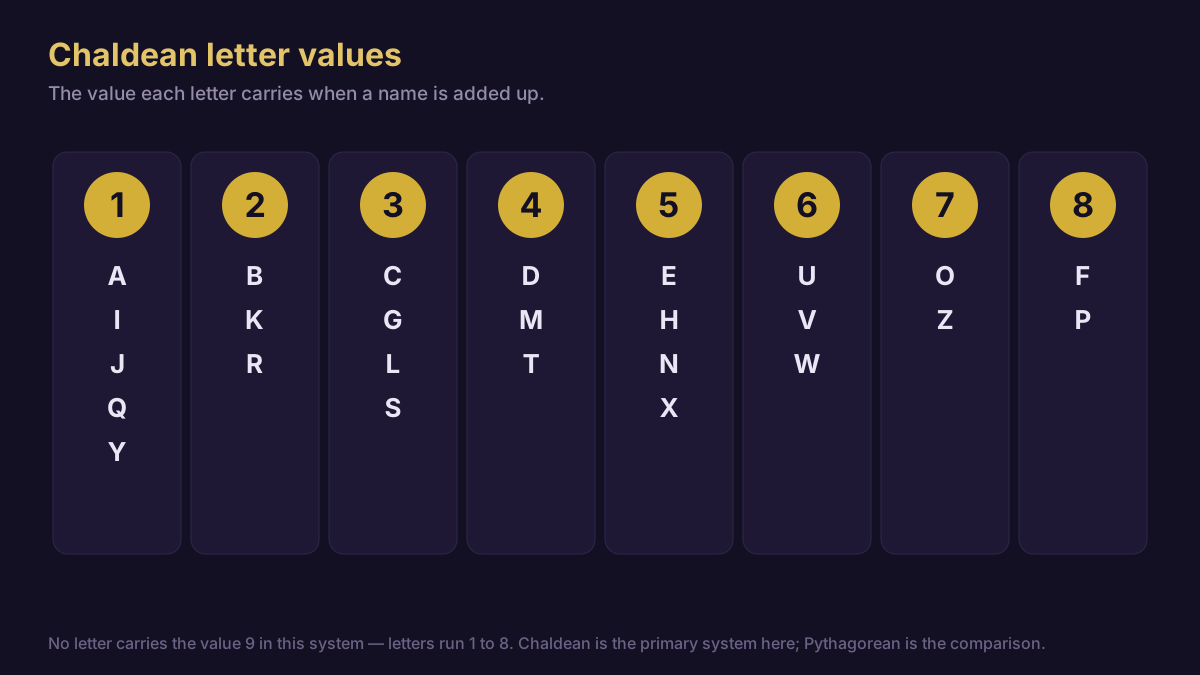
| Value | Letters |
|---|---|
| 1 | A, I, J, Q, Y |
| 2 | B, K, R |
| 3 | C, G, L, S |
| 4 | D, M, T |
| 5 | E, H, N, X |
| 6 | U, V, W |
| 7 | O, Z |
| 8 | F, P |
Take an invented firm, Meridian Textiles.
M E R I D I A N = 4 + 5 + 2 + 1 + 4 + 1 + 1 + 5 = 23
T E X T I L E S = 4 + 5 + 5 + 4 + 1 + 3 + 5 + 3 = 30
23 + 30 = 53
5 + 3 = 8
That is 53/8 — compound first, reduced digit second. Both are reported because they are not the same statement: a name reaching 8 through 53 and one reaching it through 44 share a digit and little else. The repeated digit-sum is ordinary arithmetic, not a special operation. Mathematicians call the end point a digital root, and the sequence it produces is catalogued as A010888. Nothing mystical happens in the reduction; interpretation is where the tradition begins.
Entity suffixes are excluded. Ltd, Pvt Ltd, LLP and Inc are conferred by a registrar, not chosen — UK rules require a private company's registered name to end in 'Limited' or 'Ltd' and forbid a trading name from carrying it. Counting a suffix the law hands you, then bans from your shopfront, reads the registrar's decision instead of yours. The business name analyser applies the convention and prints every letter value.
The numerology meaning of numbers in business: 1 to 5
1 — the Sun: command
1 is beginning, originality and a single point of authority. Commercially that means concentration: a 1 business gathers attention, credit and decisions toward one person. It suits named practices, first-to-market products and anything whose customer is buying one operator's judgement.
As a name total, 1 backs whoever is most visible, which is why it sits badly on an equal partnership — the number picks a founder even when the share register does not. As a founder number, driver 1 gets the narrowest recommended list in the system: name totals of 1 or 7 only. More on the number 1 in business.
2 — the Moon: relationship
2 is the number of the second party: responsiveness, negotiation, the long relationship rather than the fast transaction. It is named first for healthcare, pharma and wellness, and favoured across property, retail, education, consulting, hospitality, logistics and textiles.
The failure mode is drift. A 2 business is excellent at keeping a client and poor at deciding without one, so pricing and positioning end up set by whoever is currently in the room. Two sectors are advised against outright — digital marketing, and security and defence — both of which reward assertion. As a name total it is the most co-operative digit available, and the standard counterweight for a partnership. See the number 2 in business.
3 — Jupiter: expression
3 sells what it knows. Teaching, advising, broadcasting, performing: where the product is articulation, 3 leads five sectors — media, education, consulting, personal brands and restaurants. That is the second-broadest leadership record, after 5.
The failure mode is spread: 3 generates offers faster than it retires them, and often carries six revenue lines where two would be profitable. It is advised against in luxury and textiles, both about object rather than argument. As a founder number, driver 3 has an explicit short list — 3, 6 or 9. Note that 3 and 6 read as adverse to each other in the matrix, so that recommendation and the matrix disagree. More at the number 3 in business.
4 — Rahu: the mechanism
4 is the system nobody sees working. It leads technology and IT, SaaS and automobile, and is favoured in construction, media, consulting, manufacturing, energy, legal and security. Its association is with the unseen and the technical rather than with misfortune: 4 is not "unlucky" here, it is opaque.
That opacity is the failure mode — a 4 business is legible to its engineers and illegible to its customers, its bank and eventually its buyer. As a name total, 4 carries an explicit penalty: it is one of only two digits the scoring treats as adverse for a trading name, on the grounds that a name is a public object and 4 is not a public number. The penalty attaches to the name, not the owner. See the number 4 in business.
5 — Mercury: trade
5 is the commercial digit: movement, turnover, margin taken on volume rather than scarcity. It leads eight sectors, more than any other number, and it is the only number friendly to every other digit in the matrix — which is why 5 names and 5 founders forgive an awkward pairing.
The failure mode is restlessness. A business that moves too often never compounds; the fifth pivot in four years resets what the first four built. As a founder number, driver 5 has the widest recommended set in the system, because almost nothing offends it. That breadth is an advantage and a trap: a number that approves of everything gives you no filter. More at the number 5 in business.
The numerology meaning of numbers in business: 6 to 9
6 — Venus: the premium end
6 is comfort, aesthetics and the paid-for pleasant experience. It leads luxury and jewellery, and textiles and apparel, and is favoured across property, e-commerce, import-export, media, hospitality, restaurants, automobile and energy.
The failure mode is the cost of presentation: a 6 business spends on the showroom, the packaging and the fit-out, and the spend is real while the premium it buys is assumed. Education and healthcare are advised against, both being work that must sometimes be unwelcome. As a name total, 6 appears on more recommended lists than any other digit — every driver except 1 is pointed toward it somewhere. See the number 6 in business.
7 — Ketu: the specialist
7 is research, analysis and work done away from the counter. It is favoured in twelve sectors — technology, SaaS, education, consulting, healthcare, logistics, agriculture, security and more — and leads none of them. It is advised against in construction, manufacturing and legal services: three trades that are physical, adversarial or both.
The failure mode is invisibility. A 7 business builds something genuinely better, tells almost nobody, then reads the silence as a verdict on the product. As a name total it is a quiet, credible signal that suits a research-led firm and undersells a consumer brand. As a founder number, driver 7 is steered toward totals of 1, 5 or 6 — all more outward-facing than 7 itself, which is the point. More at the number 7 in business.
8 — Saturn: weight
8 is the most misread digit in the system. It is not unlucky; it is slow. Its asset class is property and land, its character is accumulation and endurance, and it leads construction, legal services, and finance with a condition. It is advised against in restaurants and food service, where the cycle is daily and 8's is not.
The failure mode is lateness: an 8 business is often right about the opportunity and wrong about the timeline, and runs out of money in the gap. As a name total, 8 carries the same explicit penalty as 4 — the second adverse trading-name total — because a name is fast and public and 8 is neither. The number 8 is friendly to 3, 5, 6 and 7, and adverse to 1, 2, 4, 9 and to another 8: the sharpest split in the matrix. See the number 8 in business.
9 — Mars: force
9 is drive, completion and scale reached by pushing. It leads e-commerce, manufacturing, and security and defence, and is favoured in technology, education, consulting, healthcare, automobile, energy and legal. No Chaldean letter is worth 9, so a 9 total is always arrived at rather than spelled directly.
The failure mode is friction: a 9 business spends on conflict what it could have spent on output — disputes with suppliers, churn in the team, competitors treated as enemies. It is advised against in restaurants and food service. Note also that 9 is friendly to 1, but 1 is neutral to 9. The matrix is directional, and reading it as symmetric is the commonest error in amateur charts. More at the number 9 in business.
Name total or founder number? The same digit, two jobs
The name total describes the business as the market meets it. The founder number — the driver, taken from the day of the month reduced — describes the person choosing. The method then asks a third question: does this total suit this founder? That is not the raw friendship matrix, because a name landing on the founder's own number is the strongest alignment the system recognises, and because 4 and 8 are penalised as trading names regardless of who owns them.
Here is what the method recommends for each driver, taken straight from the tool.
| Founder driver | Recommended name totals | Source of the list |
|---|---|---|
| 1 | 1, 7 | Stated explicitly |
| 2 | 1, 7, 6 | Stated explicitly |
| 3 | 3, 6, 9 | Stated explicitly |
| 4 | 1, 4, 6, 7 | Stated explicitly |
| 5 | 1, 2, 3, 5, 6, 7, 9 | Derived from friendships, minus the adverse totals |
| 6 | 1, 5, 6, 7 | Derived from friendships, minus the adverse totals |
| 7 | 1, 5, 6 | Derived from friendships, minus the adverse totals |
| 8 | 3, 5, 6, 7 | Derived from friendships, minus the adverse totals |
| 9 | 3, 6, 9 | Stated explicitly |
The last column matters. Four rows are derived rather than inherited: the source material gives no explicit list for drivers 5 to 8, so the tool fills the gap with that founder's friendly numbers, minus 4 and 8. Presenting all nine with equal authority would misrepresent the material.
Read as a grid — with the founder's driver and destiny number treated as the same digit for simplicity — the verdicts look like this.
| Founder driver | 1 | 2 | 3 | 4 | 5 | 6 | 7 | 8 | 9 |
|---|---|---|---|---|---|---|---|---|---|
| 1 | Excellent | Excellent | Excellent | Weak | Excellent | Excellent | Strong | Avoid | Workable |
| 2 | Excellent | Excellent | Excellent | Avoid | Excellent | Strong | Strong | Avoid | Avoid |
| 3 | Excellent | Excellent | Excellent | Weak | Excellent | Avoid | Workable | Weak | Strong |
| 4 | Excellent | Avoid | Workable | Avoid | Excellent | Excellent | Excellent | Avoid | Avoid |
| 5 | Excellent | Excellent | Excellent | Strong | Excellent | Excellent | Excellent | Strong | Excellent |
| 6 | Excellent | Workable | Avoid | Weak | Excellent | Excellent | Excellent | Weak | Avoid |
| 7 | Excellent | Workable | Workable | Weak | Excellent | Excellent | Excellent | Weak | Workable |
| 8 | Avoid | Avoid | Excellent | Avoid | Excellent | Excellent | Excellent | Avoid | Avoid |
| 9 | Excellent | Avoid | Strong | Avoid | Excellent | Avoid | Workable | Avoid | Excellent |
Two structural facts fall out. A name total of 5 is Excellent against all nine drivers, and a total of 1 against eight of them — the exception being a driver of 8, for whom it is an Avoid. And a driver of 5 has no bad option at all: its worst case is Strong. Where your driver and destiny number differ, the row shifts; the founder compatibility tool runs both against a real birth date.
Worked example: one calculator result, read end to end
An invented founder, Priya, born 14 March 1988, registering an apparel wholesaler.
Step 1 — her two numbers. The driver is the day of the month reduced; the destiny number, or conductor, is the whole date.
Driver:    14 → 1 + 4 = 5
Conductor: 1 + 4 + 0 + 3 + 1 + 9 + 8 + 8 = 34
           3 + 4 = 7
Priya is a driver 14/5 with a conductor of 34/7 — a trader by driver, a specialist by destiny.
Step 2 — the name. Meridian Textiles, computed above as 53/8.
Step 3 — read the digit as a business number. 8 is Saturn: accumulation, weight, a long cycle. For textiles and apparel, 8 is favoured but the fourth number named, behind 6, 2 and 5. The sector is not objecting. The name total is.
Step 4 — read it against Priya. The name's 8 is friendly to her driver of 5 and neutral to her conductor of 7 — one alignment out of two. But 8 is one of the two adverse trading-name totals, and the penalty applies regardless of the relationship. The analyser returns Workable, 61 out of 100: not a refusal, not a recommendation.
Step 5 — test an alternative. Keep the register, change the first word.
N O R T H W I N D = 5 + 7 + 2 + 4 + 5 + 6 + 1 + 5 + 4 = 39
39 + 30 = 69
6 + 9 = 15
1 + 5 = 6
Northwind Textiles is 69/6. Six is friendly to her driver of 5 and friendly to her conductor of 7 — two alignments, no adverse penalty, and on the recommended list for a driver 5. The analyser returns Excellent, 100. Separately, 6 is the number this system names first for textiles and apparel, so the sector reading and the founder reading agree.
| Candidate | Arithmetic | Total | Verdict for Priya |
|---|---|---|---|
| Meridian Textiles | 23 + 30 | 53/8 | Workable, 61 |
| Northwind Textiles | 39 + 30 | 69/6 | Excellent, 100 |
One word and sixteen points of letter value. That is the whole mechanism: the meaning of the digit did not move, the digit did. If the name is already registered and printed on contracts, changing a business name has its own arithmetic and its own costs.
Frequently asked questions
What is the best number for a business in numerology?
There is no single best number, and any page naming one is overselling. The method judges a name total against the founder's own numbers, so 1 is excellent for one founder and a poor fit for another. The closest general answer: a name total of 5 scores Excellent against all nine founder drivers and 1 against eight of them, while 4 and 8 carry an explicit penalty as trading names.
What does my business name number mean?
It describes the trading character of the business as customers meet it — 3 sells expertise, 5 sells movement, 6 sells comfort, 8 accumulates slowly. It is not a forecast. Read it alongside your own driver number, because the same total reads differently for different owners, and alongside your sector, where this system makes separate and occasionally contradictory statements.
Is 4 or 8 bad for business?
Neither is bad, and both are widely favoured as founder numbers and sector numbers. The penalty is narrow and specific: as a trading name total, 4 and 8 are the two digits the method marks adverse, because a name is public and fast while 4 is opaque and 8 is slow. An 8 founder in construction is on solid ground, provided the trading name does not also total 8.
What is the difference between a name number and a founder number?
The name number is the Chaldean total of the trading name, describing the business. The founder number is the driver, taken from the day of the month reduced, describing the owner. The method reads them together and adds a rule the raw matrix does not contain: a name landing on the founder's own number is the strongest alignment available — except on 4 and 8, which the matrix reads as adverse to themselves and which also carry the trading-name penalty.
Why do two numerology calculators give different meanings for the same number?
Usually because they use different alphabets. Chaldean assigns eight values by sound; Pythagorean runs A to Z through 1 to 9, and the two routinely produce different totals for the same name. Beyond that, the source material genuinely disagrees with itself on several points, and sites vary in whether they admit it. Pick one system and stay inside it.
Where this runs out
A meanings index invites more confidence than the material supports, so here is where the ground gets soft.
The characters are interpretive; the scores are mechanical. Everything in the "trading character" and "failure mode" columns is a reading, derived from the planetary attributions and the sector map. The verdict grid, the recommended-totals table and the arithmetic are computed. Two different kinds of claim, deserving two different levels of trust.
Four of the nine recommendation rows are derived, not inherited. Drivers 5 to 8 have no explicit list in the source material; the gap is filled by rule, and the table says so. Anyone presenting all nine as equally attested is filling a silence without mentioning it.
The system contradicts itself, and it is left visible. Driver 3 is explicitly recommended a name total of 6, while the matrix reads 3 and 6 as adverse. Both statements come from the same tradition. The site applies the explicit recommendation and prints the disagreement rather than quietly picking a side.
The method cannot tell you whether the business works. It has no view on your unit economics, your market, your hiring or your cash cycle. A name total of 6 will not make an unprofitable apparel line profitable, and none of this is financial, legal or medical advice. Where a reading touches a real decision — a rename, a partnership, a lease — the number is a prompt to examine it, not a verdict on it.
And the evidence runs the wrong way round. Every sector association is retrospective: the successful firms whose numbers fit get counted, the equally well-numbered firms that failed do not. That is survivorship bias, and it is the strongest honest argument against the whole approach. Used well, this is a structured way to interrogate a decision you were going to make on instinct. Used badly, it is a reason to rename a company that had nothing wrong with it.