
The Lo Shu grid planes are the eight straight lines of three cells crossing the 3×3 square: three rows, three columns and two diagonals. Each has a traditional name and meaning. A plane whose three cells are all occupied by your birth digits is read as complete; one with a gap is broken. That is the whole mechanic.
What the Lo Shu grid planes are
The square is fixed. Every reading in this tradition uses the same arrangement.
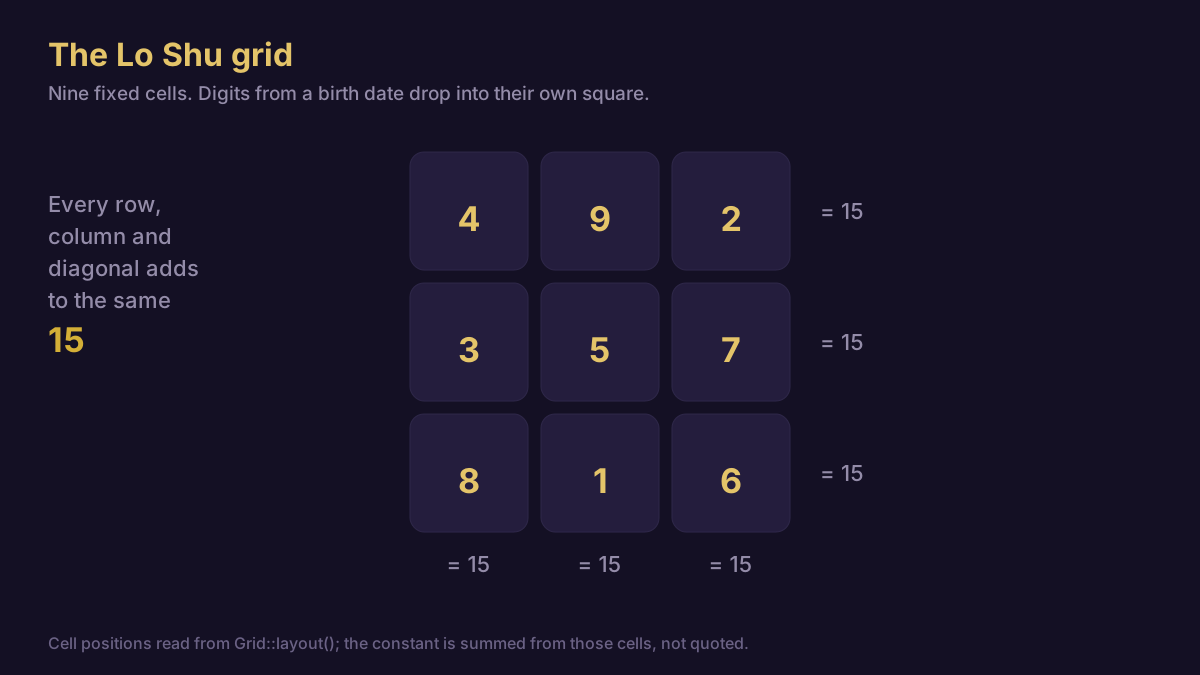
| Row | Left | Middle | Right |
|---|---|---|---|
| Top | 4 | 9 | 2 |
| Middle | 3 | 5 | 7 |
| Bottom | 8 | 1 | 6 |
Every row, column and diagonal adds to 15. That is what makes it a magic square, and why the digits sit where they do.
Now the part usually skipped. There are eight planes because there are exactly eight ways to choose three different digits from 1 to 9 that add to 15. Not roughly eight — exactly eight:
| Triple | Line in the grid |
|---|---|
| 1, 5, 9 | Middle column |
| 1, 6, 8 | Bottom row |
| 2, 4, 9 | Top row |
| 2, 5, 8 | Diagonal (earth) |
| 2, 6, 7 | Right column |
| 3, 4, 8 | Left column |
| 3, 5, 7 | Middle row |
| 4, 5, 6 | Diagonal (golden) |
Look for a ninth. There is not one: every other triple reaching 15 repeats a digit — 1+7+7, 3+3+9, 4+4+7, 5+5+5, 3+6+6 — and no cell can be counted twice. The set of planes is therefore not a matter of interpretation: lineages name them differently, but nobody can add one.
To fill the grid, write the date as DD-MM-YYYY, split it into single digits, discard the zeros — there is no zero cell — and add the driver, the conductor and the Kua. Driver is the day of the month reduced; conductor is the whole date added and reduced, reported compound first, as 35/8; the Kua comes from the birth year and sex. The core calculators produce both, and the Lo Shu grid tool populates the square.
All eight Lo Shu grid planes in one table
| Plane | Cells | Position | Also called | Complete | Broken |
|---|---|---|---|---|---|
| Mental | 4-9-2 | Top row | Mind plane | Detail and scope held together | Thinking in one register |
| Emotional | 3-5-7 | Middle row | Soul plane | Feeling weighs as much as analysis | Volatility, or flatness |
| Practical | 8-1-6 | Bottom row | Physical plane | Work gets finished | Plans that do not land |
| Thought | 4-3-8 | Left column | Planning plane | Ideas become sequences | A plan with no idea in it |
| Will | 9-5-1 | Middle column | Determination | Follows through | Strong starts that fade |
| Action | 2-7-6 | Right column | Activity plane | Moves early, ships often | Delay, over-preparation |
| Golden | 4-5-6 | Diagonal | Rajyog, golden yog | Work converts to standing | The ordinary case |
| Earth | 2-5-8 | Diagonal | Property row, silver yog | Property, land and asset-backed work | The ordinary case |
"Broken" is a term of art, not a judgement: most grids are missing three or four numbers, so most planes are broken.
The three rows
The rows are three registers of the same life: how you think, how you feel, how you act.
Mental plane, 4-9-2. Method, scope and perception of other people. Complete, it holds a detailed plan and a wide horizon at once — the plane of whoever writes the strategy. Broken at 4 is scope without sequence, a five-year view with no month one. Broken at 9 is competence with a short horizon. Broken at 2 is a strategy built for a spreadsheet, not the people inside it.
Emotional plane, 3-5-7. Expression, balance and reflection. Complete, decisions are taken emotionally as much as analytically — worth watching on hiring, pricing and partnerships. Broken at 3 is competence that cannot describe itself. Broken at 5 is rigidity, the plan followed past the point where the market moved. Broken at 7 is the missing review, mistakes repeated because they were never sat with.
Practical plane, 8-1-6. Accumulation, initiative and care. The delivery line: complete, it reads as a person around whom things get finished. Broken at 8 is the business that earns well and holds nothing; in this system 8 is slow and heavy rather than unlucky, its asset class property and land, as is 8 a good number for business sets out. Broken at 1 is delivery that waits for somebody to say go. Broken at 6 is finish and aftercare.
The three columns
If the rows are registers, the columns are stages: the left plans, the middle persists, the right does.
Thought plane, 4-3-8. Method with imagination and structure. Complete, it turns a loose idea into an ordered sequence somebody else could follow — the operating plan rather than the vision. Broken at 3 is a plan with no originality, identical to five competitors. Broken at 4 is a good idea that never becomes steps, dates and owners. Broken at 8 is a plan sized for a sprint when the work is a decade long.
Will plane, 9-5-1. Scope, balance and self, running through the centre. Complete, it is follow-through: the difference between starting nine businesses and running one for nine years. Broken at 5 is persistence that cannot bend. Broken at 1 is persistence borrowed from other people's expectations, which fails the moment nobody is watching. Broken at 9 is effort with no destination.
Action plane, 2-7-6. Relationship, analysis and service. Complete, it is somebody who moves: contacts the customer, ships the imperfect version, opens the shop and adjusts afterwards. Broken at 7 is action without review, motion that never compounds. Broken at 2 is action taken without checking who it affects, which in a small firm is how partnerships end. Broken at 6 is speed at the cost of finish.
The two diagonals: the golden and earth planes
The diagonals carry the strongest claims in the tradition and need the firmest handling.
Golden plane, 4-5-6. The diagonal from top-left to bottom-right, also called rajyog or the golden yog. Discipline, balance and responsibility, read as a capacity to convert steady work into position and standing over time — not luck, not a windfall, but accumulated reputation.
It is one of the less common lines, for arithmetic rather than mysterious reasons. Neither 4, 5 nor 6 comes free from a century prefix: a 19xx birth gives a 1 and a 9, a 20xx birth a 2, and none of that helps here. Each digit must come from the day, the month, the last two year digits, or the driver, conductor and Kua. That rarity is oversold. A complete 4-5-6 is not a promise of wealth or position, and no careful reading treats it as one. Its use is as a prompt: do you in fact do the patient accumulation the line describes?
Earth plane, 2-5-8. The diagonal from top-right to bottom-left, also called the property row or silver yog. The second of the two lines the tradition ranks highest, with a specific reading: property, land, real estate, mining and agriculture, and institutional or government work.
Unlike the golden line, this one gets structural help: anyone born from 2000 onwards has a free 2 from the year, and anyone born in the 1980s a free 8, so a complete 2-5-8 in a 1985 chart is not remarkable. The useful reading is not that money is coming, but that the tradition associates this pattern with a particular field — land, property and asset-backed work — rather than with fast, high-turnover trade. If your business is built the opposite way, the line tells you nothing to act on.
Which cells carry the most weight
Not every empty cell does equal damage. The centre sits on four lines, each corner on three, each edge on two.
| Cell | Position | Planes it sits on | Count |
|---|---|---|---|
| 5 | Centre | Emotional, Will, Golden, Earth | 4 |
| 4 | Corner | Mental, Thought, Golden | 3 |
| 2 | Corner | Mental, Action, Earth | 3 |
| 8 | Corner | Practical, Thought, Earth | 3 |
| 6 | Corner | Practical, Action, Golden | 3 |
| 9 | Edge | Mental, Will | 2 |
| 3 | Edge | Emotional, Thought | 2 |
| 7 | Edge | Emotional, Action | 2 |
| 1 | Edge | Practical, Will | 2 |
The counts add to 24, as they must: eight planes of three cells each.
The consequence is that a missing 5 breaks half the grid at once, taking out the emotional row, the will column and both diagonals. Nothing else in the square can do that. A missing corner takes three lines, a missing edge two. So read the centre first; the number itself is covered on number 5.
Reading the Lo Shu grid planes in a real chart
An invented founder, a man born 25 April 1986, running a two-person architectural practice.
The digits. 25-04-1986 gives 2, 5, 0, 4, 1, 9, 8, 6. Drop the zero: 2, 5, 4, 1, 9, 8, 6.
Driver. The day is 25. 2 + 5 = 7, so 25/7.
Conductor. 2 + 5 + 0 + 4 + 1 + 9 + 8 + 6 = 35. Then 3 + 5 = 8, so 35/8.
Kua. The year 1986: 1 + 9 + 8 + 6 = 24, then 2 + 4 = 6. For a man, 11 − 6 = 5, so Kua 5. (For a woman it would be 6 + 4 = 10, then 1.)
The grid. Entries: one each of 1, 2, 4, 6, 7 and 9, two 5s — the second is the Kua — and two 8s.
| Row | Left | Middle | Right |
|---|---|---|---|
| Top | 4 | 9 | 2 |
| Middle | (empty) | 55 | 7 |
| Bottom | 88 | 1 | 6 |
Only the 3 is missing. The eight planes:
| Plane | Cells | Status |
|---|---|---|
| Mental | 4-9-2 | Complete |
| Emotional | 3-5-7 | Broken, no 3 |
| Practical | 8-1-6 | Complete, 8 doubled |
| Thought | 4-3-8 | Broken, no 3 |
| Will | 9-5-1 | Complete |
| Action | 2-7-6 | Complete |
| Golden | 4-5-6 | Complete |
| Earth | 2-5-8 | Complete |
Six complete, two broken — and the two broken are exactly the lines through cell 3, as the weight table predicts. For a woman the Kua of 1 would double the 1 instead, and no plane would change.
Stated as the tradition would: a practice that plans, persists, delivers and accumulates, with one weakness in the register of expression. The gap sits where the emotional row meets the thought column, read as difficulty giving an idea its language — good buildings, a thin website, work won by referral. Whether that matches the real practice is a question the grid cannot answer and the founder can.
The same date under a different convention
Remove the driver, conductor and Kua, as some lineages do, and fill from the raw date digits only: 2, 5, 4, 1, 9, 8, 6. Now both 3 and 7 are missing, and the action column 2-7-6 breaks, having been complete a moment ago. Six complete planes become five — same person, same date, different answer. A reading is only as stable as the method behind it, so one worth having states its convention up front, as the methodology page does.
A grid with no complete plane at all
A second invented founder, a man born 30 August 1990. Digits 3, 0, 0, 8, 1, 9, 9, 0, so 3, 8, 1, 9, 9 once the zeros go. Driver 30/3; conductor 3+0+0+8+1+9+9+0 = 30, then 3, so 30/3. Kua: 1 + 9 + 9 + 0 = 19, then 10, then 1; for a man 11 − 1 = 10, then 1. Entries: two 1s (one of them the Kua), three 3s, one 8, two 9s.
Against the eight planes: mental (the 9 only), emotional (the 3 only) and earth (the 8 only) are thin; practical 8-1-6, thought 4-3-8 and will 9-5-1 are each one cell short; action 2-7-6 and golden 4-5-6 are empty.
Not one complete plane, and two entirely empty — an ordinary chart belonging to nobody unusual. (For a woman the Kua would be 5, which completes the will plane 9-5-1.) Three lines are one cell short, which the tradition treats as functioning with effort rather than failing, and the triple 3 reads as expression running ahead of execution. One date held seven distinct digits and the other four: a property of numerals, not a ranking of two people.
Complete, broken and empty: what the grades mean
| Grade | Cells filled | Traditional reading |
|---|---|---|
| Complete | 3 of 3 | The faculty operates without deliberate effort |
| One short | 2 of 3 | The faculty operates, but has to be worked at |
| Thin | 1 of 3 | The faculty appears only in flashes |
| Empty | 0 of 3 | The faculty is built from scratch or borrowed |
Most planes in most charts are one short or thin, so those grades say little; complete and empty are the informative ones. An empty plane is not a prediction. The tradition treats an absent faculty as one you acquire, hire or partner for, which is why founders are compared across grids rather than within one, as the founder compatibility tool does.
Frequently asked questions
How many planes are there in the Lo Shu grid?
Eight: three rows, three columns and two diagonals. The number is fixed by arithmetic, not tradition — there are exactly eight ways to pick three different digits from 1 to 9 summing to 15, and the square turns each triple into a line. No lineage can add a ninth.
What is rajyog in the Lo Shu grid?
Rajyog, also called the golden yog or golden plane, is the diagonal 4-5-6 running from the top-left cell to the bottom-right. It is read as a capacity to turn patient, ordinary work into standing over time, and it is uncommon because none of its digits comes free from a century prefix. It is not a promise of wealth.
What does a complete mental plane mean?
It means all three cells of the top row — 4, 9 and 2 — are occupied. The traditional reading is a mind holding method, scope and the perception of other people at once, which suits planning work. Anyone born between 1900 and 1999 gets the 9 free from the year, so the line completes more easily for that group.
Is it bad if I have no complete plane in my Lo Shu grid?
No, and it is common. A birth date supplies eight digits, several repeating, with zeros discarded, so a grid with four or five occupied cells cannot complete many lines. The second worked example above has no complete plane and three lines one cell short. The tradition reads a one-short line as functional with effort, not as failure.
What is the difference between the mental plane and the thought plane?
The mental plane is the top row, 4-9-2, about how you think. The thought plane is the left column, 4-3-8, about turning thinking into an ordered plan. They share the 4 cell, which is why a missing 4 damages both. Some lineages swap the two names, so check the numbers rather than trusting the label.
Where this reading runs out
The planes organise nine digits into eight groups. They say nothing about your market, your cash position or your competitors, and nothing here is financial, legal or medical advice. No pattern above promises an outcome. Used properly, the eight lines are a prompt for reflection and planning: a fixed checklist of places to examine in a business you are too close to see plainly. Four limits deserve stating without softening.
The names are not standardised. Mental and thought are swapped between lineages; emotional is also called soul, practical also physical, and the yogs go by several names. Two competent practitioners can describe the same chart in contradictory-sounding language while agreeing about the cells.
The convention decides the answer. As the worked example showed, including the driver and conductor moved a plane from broken to complete; adding the Kua, as this site's grid tool does, changes no plane for that date, but on other dates it can. There is no neutral authority to arbitrate, and a reading with no stated convention is not one you can check.
The calendar does part of the work. A 19xx birth fills the 1 and 9 cells for free for a whole century of people, and a 198x birth fills the 8. Any interpretation treating those completions as personal is reading a numeral. The cells that genuinely vary are 3, 4, 5, 6 and 7.
Recognition is not evidence. The eight descriptions above are broad, and most founders will read at least three and feel they fit. That proves nothing. The only test worth running is whether a plane's predicted weakness shows up in your records over the last two years — the churn, the abandoned projects, the flat reserve. If it does not, the plane told you nothing.
Read that way, the grid does one useful job: it hands you a fixed list of questions you did not choose. For the wider frame, what is business numerology sets out how the birth grid sits alongside name and date work, and the business numerology reference collects the tables.