
A missing number in Lo Shu grid charts is any digit from 1 to 9 that does not appear in your date of birth once that date is written out in full. The tradition reads each empty cell as a tendency — a faculty you build on purpose rather than one that arrives free. Most grids are missing three or four.
That last sentence is the one to hold on to. A birth date supplies eight digits, several of them repeats and zeros that get discarded. Nine cells cannot be filled from that. Gaps are structural, not diagnostic.
What a missing number in Lo Shu grid charts actually is
The grid is the 3×3 magic square, in the fixed arrangement used across the tradition.
| Row | Left | Middle | Right |
|---|---|---|---|
| Top | 4 | 9 | 2 |
| Middle | 3 | 5 | 7 |
| Bottom | 8 | 1 | 6 |
Every row, column and diagonal adds to 15: 4+9+2, 3+5+7, 8+1+6, 4+3+8, 9+5+1, 2+7+6, 4+5+6, 2+5+8. Eight lines, all fifteen. The sum fixes the arrangement, which is why every practitioner draws the same square.
A birth date is poured into it. Each digit goes in its own cell, a digit appearing twice is written twice, and a digit appearing not at all leaves the cell empty. That is the missing number. Zeros have nowhere to go and are discarded — which matters, because a date can contain three.
How to fill the grid and find your gaps
Write the date as DD-MM-YYYY, split it into single digits, discard the zeros, then add three more digits: the driver, the conductor and the Kua.
- Driver is the birth number: the day of the month, reduced to one digit.
- Conductor is the destiny number: every digit of the whole date added, then reduced.
- Kua comes from the birth year and sex: the year's digits reduced, then 11 minus that for a man or plus 4 for a woman, reduced again.
Both are reported compound first, reduced second, so a conductor of 38 is written 38/2. The core calculators produce each separately, and the methodology page sets out how this site handles reductions. Then read off which cells are empty.
One caveat. Lineages disagree about what belongs in the grid: some use the raw date digits only, some add the driver and conductor, and this site's grid tool adds the Kua number as well, as here. Adding them typically fills one to three extra cells, so the same person can have five gaps under one convention and three under another.
Worked example: a grid with one gap
An invented founder, born 14 July 1988, running a small industrial-fittings supplier.
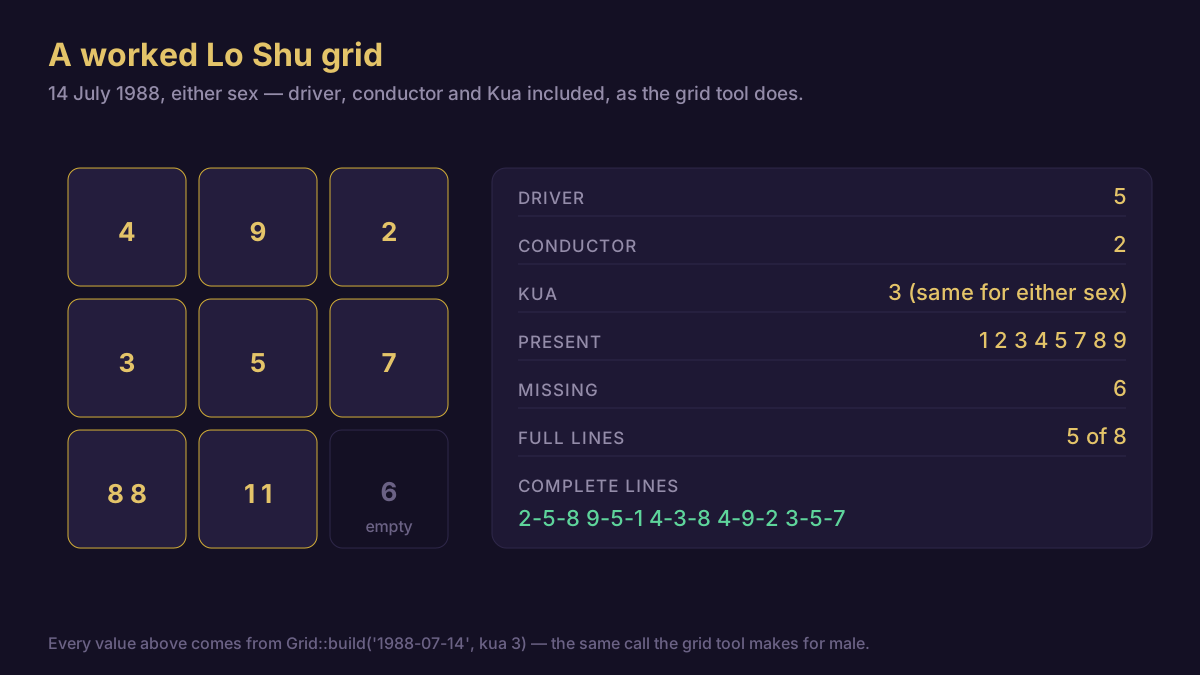
The digits. 14-07-1988 gives 1, 4, 0, 7, 1, 9, 8, 8. Drop the zero: 1, 4, 7, 1, 9, 8, 8.
The driver. The day is 14. 1 + 4 = 5, so 14/5.
The conductor. 1 + 4 + 0 + 7 + 1 + 9 + 8 + 8 = 38. Then 3 + 8 = 11, and 1 + 1 = 2, so 38/2. The 11 is reported as a compound, though the default here reduces to a single digit.
The Kua. 1 + 9 + 8 + 8 = 26, then 8. For a man 11 − 8 = 3; for a woman 8 + 4 = 12, then 3 — the same either way.
The grid. Entries: 1, 1, 4, 7, 8, 8, 9 from the date, plus 5, 2 and the Kua 3.
| Row | Left | Middle | Right |
|---|---|---|---|
| Top | 4 | 9 | 2 |
| Middle | 3 | 5 | 7 |
| Bottom | 88 | 11 | (empty) |
Missing: 6. Doubled: 1 and 8.
One gap is a light chart. Compare an invented co-founder, a man born 30 August 1990: digits 3, 0, 0, 8, 1, 9, 9, 0, so 3, 8, 1, 9, 9 once the zeros go. Driver 30/3; conductor 3+0+0+8+1+9+9+0 = 30, then 3, so 30/3 again. His Kua: 1 + 9 + 9 + 0 = 19, then 10, then 1; 11 − 1 = 10, then 1. Entries: 1, 1, 3, 3, 3, 8, 9, 9. Missing: 2, 4, 5, 6 and 7 — five empty cells and a triple 3. For a woman born that day the Kua would be 5, filling the centre. Same procedure, very different picture, and the second chart is closer to typical than the first.
What each missing number in Lo Shu grid charts is taken to mean
Each cell carries a faculty. What follows is the traditional reading translated into working life, with the cost stated plainly and something to do about it. These are tendencies described by the source material, not verdicts.
Missing 1 — self and voice
1 is the founder standing alone: identity, authorship, saying what you want in your own name. Its absence reads as reluctance to occupy the front of a room — the work gets done and somebody else describes it. The cost is pricing: work worth a number does not get that number, because the person will not say the number out loud. The counter is procedural rather than personal — published rates, a written scope, somebody else in the room when terms are agreed. See number 1 in business.
Missing 2 — the other person
2 is sensitivity to what is not being said: partnership, diplomacy, the pause before a reply. An empty 2 reads as a tin ear rather than unkindness — the person hears the words and misses the temperature. In business that is negotiation conducted purely on logic, which works until the counterparty needs to feel well treated. It shows up between co-founders too, where the missing 2 takes silence for agreement. The cost is renewals that quietly do not renew. The counter is making the unsaid explicit: written check-ins, direct questions.
Missing 3 — expression
3 governs imagination, language and the pleasure of being heard. It is one of the most commonly empty cells, and its absence reads as literal-mindedness: excellent at the thing, uninterested in describing the thing. The commercial cost is specific — the founder whose product is better than the market believes, because the market has never been told clearly, and whose sales page reads like a specification. The counter is to buy the faculty rather than fake it: a writer, a case study, a transcribed conversation. Neither worked example is missing 3 once the Kua is added; the second holds three of them.
Missing 4 — order
4 is method: sequence, records, systems, patience with detail. In this tradition it is also the number attached to technology and to things that work out of sight. An empty 4 reads as improvisation where structure was needed, and the cost lands on the admin. Bookkeeping goes in late, contracts stay informal, and the business runs on the founder's memory. Nothing catastrophic happens for years, and then one thing does. The counter is unglamorous: one system of record, and one person other than you who knows where things are. The number's poor reputation is examined in is 4 unlucky for business.
Missing 5 — the centre
5 sits in the middle of the square, on four of the eight lines through the grid. It is freedom, movement, trade and adaptability. Its absence reads as a lack of anchoring — decisions that swing between extremes, a plan held too long and then dropped abruptly. In business that shows as a plan followed past the point where the market changed, so pivots come late and hurt. Selling — movement, exchange, talking to strangers, all 5 activities here — feels like an imposition rather than the job. The counter is a scheduled review: a fixed date on which the plan is allowed to change, so changing it needs no crisis.
Missing 6 — care
6 is service, comfort, aesthetics and responsibility for people and premises. An empty 6 reads as detachment from the human surface of a business, and the cost is retention and finish. The work is sound and the experience around it neglected: the office functional and grim, the handover abrupt, the aftercare whatever the client chases for. Nobody complains loudly, they simply do not come back. The counter is to treat the surface as a deliverable with an owner and a budget.
Missing 7 — reflection
7 is analysis, specialism, and the tolerance for being alone with a problem. Its absence reads as a missing loop: experience accumulates without becoming knowledge. In practice this is the business that runs the same failed campaign in a new colour and never holds a post-mortem, because there is always the next thing. The cost is repetition, expensive precisely because it looks like activity. The counter is a written review after anything that mattered, won or lost — half a page, filed where it can be found.
Missing 8 — weight
8 is accumulation: system, endurance, property, the slow compounding of things held rather than spent. The tradition treats 8 as heavy and late rather than unlucky, and its asset class is land and buildings. An empty 8 reads as difficulty holding on, and the cost is a balance sheet that never thickens. Revenue arrives and leaves, good years produce a better car rather than a reserve, and the business rents everything and owns nothing, including its customer list. The counter is automatic and boring: a fixed percentage moved out of reach on the day money lands. See is 8 a good number for business.
Missing 9 — scope
9 is breadth, completion, and the ability to let a finished thing go. Like 1, it is almost never missing for 19xx births, for reasons the next section explains. Where it does appear, the reading is a horizon problem: a business competent and small by default, serving the same twelve clients for a decade because expanding was never considered rather than considered and declined. A second reading is trouble finishing. The counter for both is externally imposed scope: a date, a launch, somebody waiting.
Why a missing number in Lo Shu grid charts is normal
Here is the arithmetic that makes gaps ordinary. A date supplies eight digits, several of them zeros or repeats — the century digits are the same for everybody in an era, and a day like the 22nd contributes the same digit twice. Driver, conductor and Kua bring the maximum to eleven, and all three derive from those same digits, so they frequently duplicate what is there. Six sample dates:
| Date of birth | Driver | Conductor | Kua (man) | Cells filled | Missing | Count |
|---|---|---|---|---|---|---|
| 14-07-1988 | 14/5 | 38/2 | 3 | 1,2,3,4,5,7,8,9 | 6 | 1 |
| 30-08-1990 | 30/3 | 30/3 | 1 | 1,3,8,9 | 2,4,5,6,7 | 5 |
| 22-11-1975 | 22/4 | 28/1 | 7 | 1,2,4,5,7,9 | 3,6,8 | 3 |
| 05-05-2001 | 5 | 13/4 | 8 | 1,2,4,5,8 | 3,6,7,9 | 4 |
| 19-12-1984 | 19/1 | 35/8 | 7 | 1,2,4,7,8,9 | 3,5,6 | 3 |
| 26-03-2011 | 26/8 | 15/6 | 7 | 1,2,3,6,7,8 | 4,5,9 | 3 |
Average across those six: just over three missing, and the same for women born on those dates, though the cells differ. A chart with one or two gaps is the less common one, and a chart with none is rare — about one date in eight hundred. If a reading tells you your empty cells explain your difficulties, ask what it would have said had those cells been full. A framework producing a finding for every input is producing description, not diagnosis.
The century problem nobody mentions
The year of birth decides part of every grid before anything personal is considered.
| Born | Guaranteed present | Effect |
|---|---|---|
| 1900–1999 | 1 and 9 | Two cells filled for the whole century |
| 2000–2009 | 2 | Two zeros discarded, fewer usable digits |
| 2010–2019 | 1 and 2 | One zero discarded |
| 2020–2029 | 2, twice | A corner cell doubled for a decade |
Every founder born in a 19xx year has a filled 1 and a filled 9. That is not a shared quality of a generation, it is a shared quality of the numeral 19. Any interpretation leaning on those cells for someone born in 1978 is reading the calendar rather than the person, which is why the honest version of the technique weights the cells that vary: 3, 4, 5, 6 and 7.
Repeats and compensation
Two ideas soften a bare reading, and both belong to the traditional method. Repeats: a doubled digit reads as emphasis, a tripled one as excess. The 88 in the first example reads as a pull towards durable, property-shaped assets; the 333 in the second reads as expression running ahead of execution. Compensation: where a cell is empty but its neighbours on the same line are strongly occupied, the tradition treats the gap as partly carried, so the missing 6 above, whose row holds 88 and 11, reads softer than an isolated empty 6.
The grid is fixed by a birth date. A trading name is not, and a name whose Chaldean total lands on a missing number is one of the few deliberate adjustments the tradition offers; the business name analyser gives a name's compound and reduced totals, and the Lo Shu grid tool populates a full grid. Whether that counts as a correction or a prompt is a judgement the method cannot make for you.
What a founder actually does about a gap
Very little, directly. Treat an empty cell as a hypothesis about where your business will leak, then check it.
- Fill the grid and note the gaps.
- For each, write out the cost sentence above.
- Look for that cost in your figures from the last two years — the churn, the late filings, the flat reserve, the campaign you ran twice.
- Where you find it, fix the system rather than the self: hire it, schedule it, or hand it to a partner whose grid fills that cell.
- Where you cannot find it, discard the reading. It did not apply.
Step 5 is the one people skip, and it separates a planning prompt from a horoscope.
Frequently asked questions
What does it mean if a number is missing in my Lo Shu grid?
It means that digit appears nowhere in your date of birth, nor in your driver, conductor or Kua number. The tradition reads it as a faculty that develops through deliberate effort rather than arriving naturally — expression for a missing 3, order for a missing 4. It is a tendency, not a deficiency, and predicts no outcome.
Is it bad to have a lot of missing numbers in the Lo Shu grid?
No, and it is normal. A birth date supplies eight digits, several repeating, with zeros discarded, so three to five empty cells is the ordinary result. Across the six sample dates above the average was just over three. A crowded grid is not a better chart.
Can a missing number in the Lo Shu grid be added later?
Not to the birth grid, which is fixed by a date that cannot change. Practitioners work instead with numbers you can choose: a trading name, a registration date, premises numbers. The tradition treats these as supporting the birth grid rather than replacing it, and no careful reading claims a name total erases an empty cell.
Which missing number is worst for business?
The source material does not rank them, and the answer depends on what the business does. A missing 3 costs a marketing-led firm far more than a subcontractor with one client. A missing 8 matters most where the plan involves building assets. Judge a gap against the work in front of you.
Do you include the driver and conductor when filling the Lo Shu grid?
This site includes the driver, the conductor and the Kua number, and says so wherever a grid is shown. Some lineages use the raw date digits only, and some stop at the driver and conductor. The convention changes which cells appear empty, so any reading should state which one it used.
Where this reading runs out
The method cannot tell you whether a business will work. It has nothing to say about your market, your unit economics, your competitors or your funding. Nothing here is financial, legal or medical advice, and no reading in this system promises an outcome. It is a prompt for reflection and planning, and earns its place only if the prompts describe something you can verify. Three limits deserve stating plainly.
The convention problem. Because lineages disagree about driver, conductor and Kua, the same person legitimately has different missing numbers depending on who reads the chart. There is no neutral authority to settle it, and a reading is only as stable as its stated convention.
The century artefact. Two of the nine cells are effectively decided by the era you were born in. Any interpretation leaning on them for a whole generation is describing a numeral.
Unfalsifiability. The nine readings above are broad enough that most founders will recognise themselves in three or four, and recognition is not evidence. The only honest test is step 3 above: does the predicted cost appear in your figures? If not, the gap told you nothing, and the correct response is to say so rather than look harder for a match.
Used within those limits, the grid does one thing well. It hands you a short, fixed list of places to look for weakness in a business you are too close to see clearly. That is worth something, and not worth more than that. For the wider frame, what is business numerology sets out how the birth grid sits alongside name and date work.