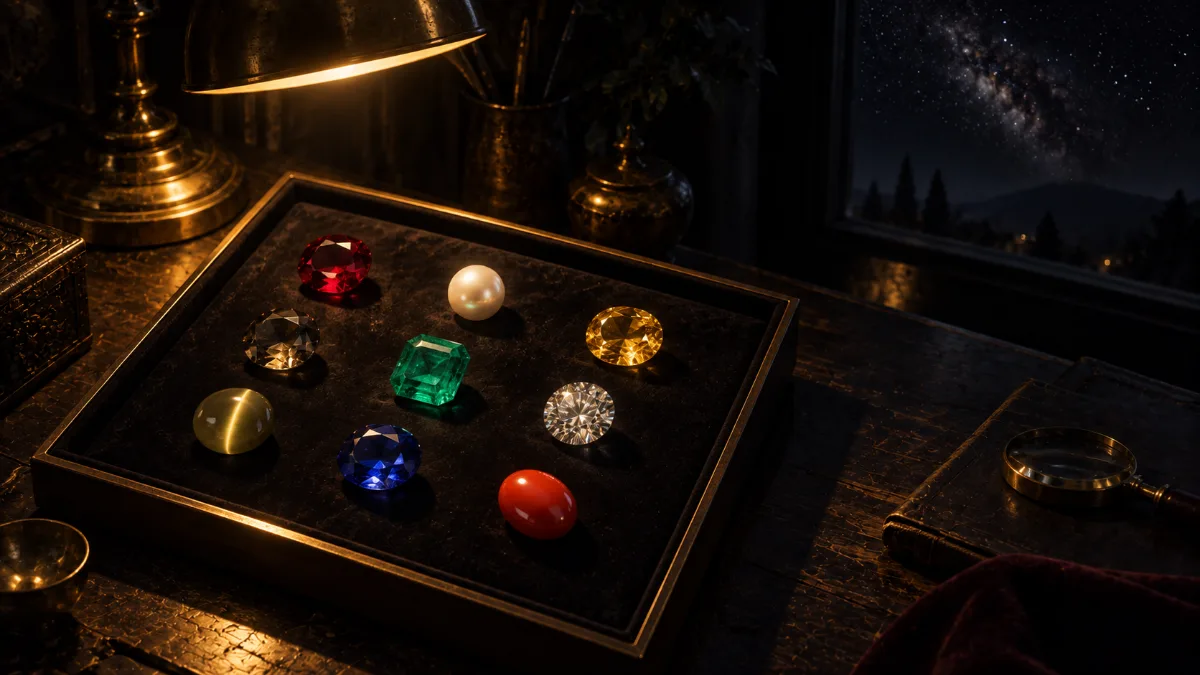
Which gemstone is good for business, under this tradition, depends on one number: your birth number, the day of the month you were born reduced to a single digit. Each digit carries a planet, and each planet a stone. One is the Sun and ruby, five is Mercury and emerald, eight is Saturn and blue sapphire.
The full map is below, with the arithmetic that produces the number, the wearing conventions, and — the part most pages leave out — what the stones cost. Take it all as inherited association. Nothing here promises a result, no stone has been shown to change a commercial outcome, and the right amount to spend on one is an amount you would be content to lose.
The short answer: which gemstone is good for business
Find your birth number and read across.
| Number | Planet | Primary stone | Cheaper substitutes the tradition allows | Trade character the number carries |
|---|---|---|---|---|
| 1 | Sun | Ruby | Red spinel, red garnet, sunstone | Founder-led, single owner, authority |
| 2 | Moon | Natural pearl | Moonstone | Service, partnership, anything mediated |
| 3 | Jupiter | Yellow sapphire | Citrine, yellow topaz | Teaching, publishing, advisory, expansion |
| 4 | Rahu (north node) | Hessonite garnet | Orange zircon, brown agate | Technology, data, logistics, the unseen |
| 5 | Mercury | Emerald | Green tourmaline, peridot, green onyx | Trade, broking, media, quick turnover |
| 6 | Venus | Diamond | White sapphire, white zircon, opal | Hospitality, interiors, fashion, beauty |
| 7 | Ketu (south node) | Cat's eye chrysoberyl | Cat's eye quartz | Research, specialism, solitary craft |
| 8 | Saturn | Blue sapphire | Amethyst, iolite, blue spinel, lapis lazuli | Property, land, long holds, heavy industry |
| 9 | Mars | Red coral | Carnelian | Engineering, metal, groundworks, contest |
Two things about that table undercut much of what is sold around it. There is no gemstone for a business. There is a gemstone for a person. A limited company cannot wear a ring, and the tradition as written prescribes for an individual. A stone sold "for your company" is somebody's extension, not something the source material contains.
And the substitutes column does more work than it looks. If green tourmaline stands in for emerald, the school has conceded that the claimed effect does not live in the price — worth remembering when a prescription arrives with a large invoice.
From a birth date to a planet to a stone
The number that decides the stone is the driver, or birth number: the day of the month, reduced. Take a founder born 23 July 1986.
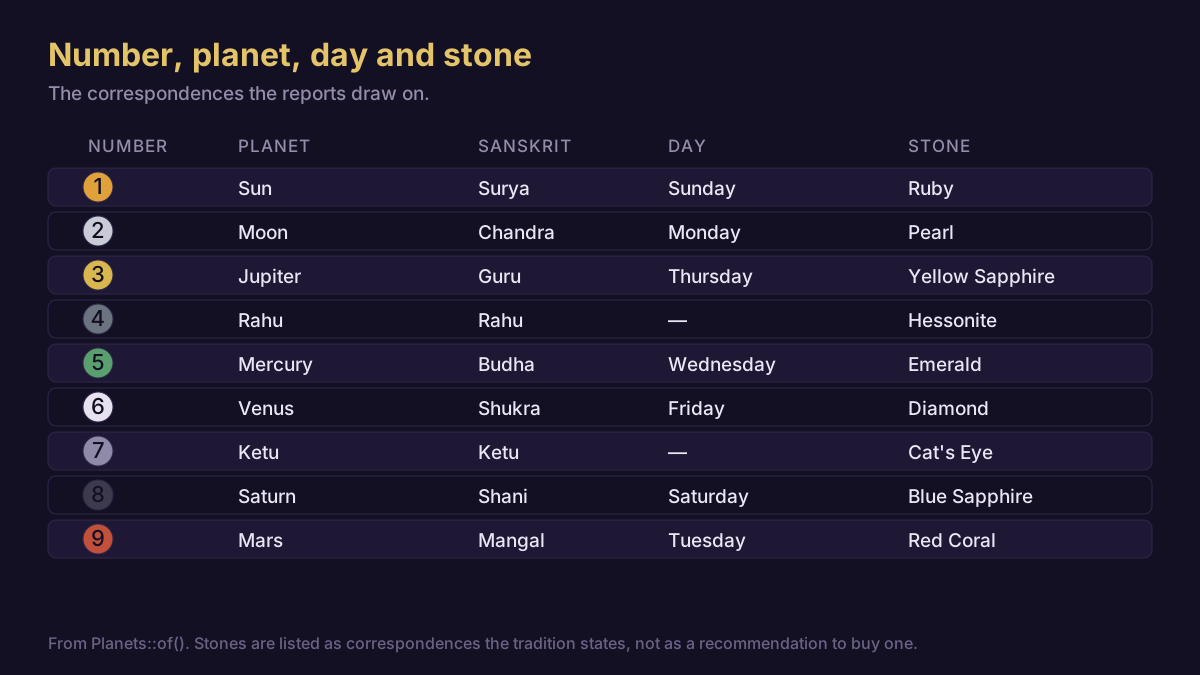
Driver. The day is 23. Add the digits: 2 + 3 = 5. Driver 5 — Mercury, emerald.
Conductor. The whole date, reduced. 2 + 3 + 0 + 7 + 1 + 9 + 8 + 6 = 36, and 3 + 6 = 9. Conductor 36/9 — Mars, red coral.
Report both parts, compound first and reduced digit second: 36/9, never plain 9. The compound carries information the digit discards.
A second founder, born 4 December 1990. The day is 4, already single, so the driver is 4 — Rahu, hessonite. Conductor: 0 + 4 + 1 + 2 + 1 + 9 + 9 + 0 = 26, and 2 + 6 = 8. Conductor 26/8, Saturn.
The first founder's two stones fall on opposite sides of the gem-wearing split set out below, even though the site's compatibility table reads 5 and 9 as friendly in both directions; the second founder's Rahu and Saturn share a gem camp, yet the table reads 4 and 8 as adverse to each other and lists them as a forbidden pair. That difference decides how awkward the prescription becomes, and it is invisible until both calculations are done. The core calculators produce both from a date, and the methodology page covers how the site reduces dates elsewhere.
One caveat about the map. Nine numbers are matched to seven visible planets plus two lunar nodes, Rahu and Ketu, which are calculated points rather than bodies — so four and seven are attached to something that is not a planet at all, and some schools decline to prescribe for them on that ground.
Which gemstone is good for business, number by number
1 — Sun, ruby
Sole ownership and visible authority. The tradition asks for a natural, untreated stone set in gold. Fine untreated ruby is among the most expensive material on earth by weight, and the market is full of glass-filled composites sold at natural prices. Red spinel is the usual substitute, at a fraction of the price.
2 — Moon, natural pearl
Partnership and service, where the product is a relationship. The tradition specifies a natural pearl, formed without human intervention. Almost every pearl sold today is cultured, a different thing and vastly cheaper. Some practitioners accept cultured pearls; others insist they are inert. Moonstone is the usual substitute.
3 — Jupiter, yellow sapphire
Expression, teaching and expansion. Jupiter is widely welcomed in the scheme — five of the nine numbers count 3 a friend — so yellow sapphire is the stone most commonly prescribed to founders. That popularity is itself the objection: a stone recommended to almost everyone is not matched to anyone. Citrine and yellow topaz are the accepted substitutes.
4 — Rahu, hessonite garnet
Technology and the unseen: software, data, infrastructure. The stone is hessonite, a brownish-orange garnet known as gomed, and one of the cheaper stones here. The tradition treats Rahu as volatile, and several schools advise against wearing its stone without a full chart reading. If you take one caution from this article, take it here.
5 — Mercury, emerald
Trade, movement and quick turnover. Mercury is the merchant's planet, the number most directly associated with commerce. Emerald is expensive and almost universally treated, usually with oil or resin filling the fissures nearly all emeralds carry. That is normal and disclosed by honest sellers, and it is why a laboratory report matters more here than anywhere else. Green tourmaline and peridot are the substitutes. The number 5 in business reference covers the trade character in depth.
6 — Venus, diamond
Comfort, beauty and negotiation. Diamond is the one case where the prescription collides with an enormous commercial market that has nothing to do with numerology, and prices follow that market rather than any tradition. White sapphire and white zircon are the substitutes. If a prescription specifies diamond and the person prescribing also sells diamonds, that is the moment to walk.
7 — Ketu, cat's eye chrysoberyl
Research and specialism, work that goes deep rather than wide. Cat's eye chrysoberyl is striking, with a single bright line of light across the dome, and good examples are not cheap. Cat's eye quartz shows the same effect for very little. As with 4, several schools decline to prescribe node stones.
8 — Saturn, blue sapphire
Slow, heavy and accumulating, with property and land as its asset class. The tradition's date, name and premises rules put 8 on the avoid list, but its character reading is late rather than unlucky: returns arrive on Saturn's schedule rather than yours. The full read on 8 for business explains why that matters. Blue sapphire carries more folklore than any stone here — fast-acting and equally fast to go wrong, with a trial period almost always specified. Untreated material in a prescribed size runs to serious money; amethyst, iolite and lapis lazuli cost almost nothing.
9 — Mars, red coral
Force applied to material: engineering, groundworks, metal. Red coral is set in gold or copper. Being organic rather than mineral, it is soft and easy to fake — dyed reconstituted material is common. It is also the cheapest primary stone in the list, which makes 9 the number where the tradition asks for the least money.
Worked example: a founder whose two numbers point different ways
Return to the founder born 23 July 1986, running an invented freight-booking platform. Driver 5 (Mercury, emerald). Conductor 36/9 (Mars, red coral). Those two stones sit on the tradition's own list of combinations not to be worn together, so a straightforward question produces three defensible answers, and taking both is ruled out.
- Stone for the driver. The common default in numerology-led practice: emerald, or green tourmaline.
- Stone for the conductor. Preferred by practitioners who read the conductor as the number governing working life: red coral, or carnelian — the cheapest primary stone in the list, which is a happy accident here.
- Stone for what is missing. A third school ignores both and prescribes for the digit absent from the birth grid, on the argument that you support what is weak rather than reinforce what is strong. The Lo Shu grid tool shows which cells a date leaves empty.
Three schools, three answers, one date. Anybody offering one without mentioning the others is not telling you the whole position.
A fourth answer deserves saying plainly: in the older Indian system, stones are prescribed from a full astrological chart — planetary strength, house placement, current period — not from a birth number at all. The number-to-planet shortcut is a defensible simplification, but it discards nearly all the information the original method used.
Stones the tradition says not to wear together
The classical rule splits the planets into two camps: stones from opposing camps should not be worn at once.
| Group | Numbers | Stones |
|---|---|---|
| Luminaries and their allies | 1 Sun, 2 Moon, 3 Jupiter, 9 Mars | Ruby, pearl, yellow sapphire, red coral |
| The others | 5 Mercury, 6 Venus, 8 Saturn, 4 Rahu, 7 Ketu | Emerald, diamond, blue sapphire, hessonite, cat's eye |
Named clashes include ruby with blue sapphire, pearl with diamond, red coral with emerald, and yellow sapphire with diamond.
The rule is not applied consistently. Mercury's relationship with the Sun is friendly in some texts and neutral in others, so emerald with ruby is forbidden by one school and permitted by the next. Combination rings holding five or nine stones at once are sold widely, contradicting the principle.
Wearing conventions, and how much they vary
| Number | Metal usually specified | Finger | Day first worn |
|---|---|---|---|
| 1 | Gold | Ring finger | Sunday |
| 2 | Silver | Little finger | Monday |
| 3 | Gold | Index finger | Thursday |
| 4 | Lead; some schools use silver or a mixed-metal alloy | Middle finger | None — Rahu carries no weekday, though some schools use Saturday |
| 5 | Brass; some schools use gold or silver | Little finger | Wednesday |
| 6 | Silver, white gold or platinum | Middle or little finger | Friday |
| 7 | Mixed-metal alloy, or silver | Middle finger | None — Ketu carries no weekday, though some schools use Saturday |
| 8 | Silver or iron alloy | Middle finger | Saturday |
| 9 | Gold or copper | Ring finger | Tuesday |
Weight is specified in ratti, and here the imprecision becomes impossible to ignore. The ratti is not standardised: depending on the market it is quoted at 0.12 to 0.18 grams, roughly 0.6 to 0.9 carat. "Five ratti" therefore means between three and four and a half carats, and on an expensive stone that spread is a great deal of money. A system that specifies the finger and the weekday but not the weight to within fifty per cent is telling you something about its own precision.
Most schools require the stone to touch the skin through an open back, and many specify a trial period before it counts as accepted. The trial is sensible, but it builds in an unfalsifiable exit: bad results mean the stone was rejected, good ones mean it worked.
What this actually costs
Show the arithmetic, because here it is the argument.
Five ratti of untreated blue sapphire is roughly 3.0 to 4.5 carats. Certified untreated material in that size sits in a wide band — call it £300 to £2,000 per carat depending on origin, colour and clarity. At the bottom, 3 carats at £300 is £900. At £1,200 per carat for good colour, 3.5 carats is £4,200. Add setting and certification and a mid-quality prescription is comfortably four figures. Ruby and emerald run higher again.
The substitute for the same number, amethyst, might be £5 to £30 per carat. Same weight, same finger, same day, same claimed mechanism, roughly one per cent of the cost. Three practical points follow, offered as consumer information rather than advice.
Never buy the stone from the person who prescribed it. A prescriber who also sells has an obvious reason to prescribe expensive stones, heavy stones and frequent replacements. Separate the two transactions.
Insist on an independent laboratory report. A report from a laboratory with no connection to the seller identifies the stone and discloses treatment. It does not certify that the stone will do anything; "certified" means identified. Expect heat in sapphire, oil or resin in emerald, glass filling in ruby, dye in coral, and cultured pearls described in language that blurs the line with natural.
Do not treat a stone as an investment. Retail gem margins are large, resale markets for individual stones are thin, and a stone bought at retail generally cannot be sold near its purchase price. Nothing here is financial advice, and this is a case where the plainest warning is the right one.
Frequently asked questions
Which gemstone is good for business success in general?
There is no general answer, because the tradition prescribes to a person, not a business. The stone follows your birth number: ruby for 1, pearl for 2, yellow sapphire for 3, hessonite for 4, emerald for 5, diamond for 6, cat's eye for 7, blue sapphire for 8, red coral for 9. None has been shown to affect a commercial outcome.
What stone is good for business if I do not know my birth number?
Take the day of the month you were born and add its digits until one remains. Born on the 23rd, 2 + 3 = 5. Born on the 4th, it is already 4. Born on the 29th, 2 + 9 = 11, then 1 + 1 = 2. That gives the driver; the whole date gives the conductor, a separate number that sometimes points at a different stone.
Can a company or a shop have a lucky stone?
Not in the original method. Stones are prescribed to individuals, worn against the skin. Placing crystals in premises belongs to other traditions, and combining the two is something modern practitioners do rather than something the source material supports. A stone sold for your office is an extension, and the seller should say so.
Are cheaper substitute stones as good as the primary ones?
The tradition says yes, which is the interesting part. Every primary stone here has an accepted substitute costing a small fraction of the price, and no school explains why the expensive version should work better. Accepting the substitute undermines the case for spending heavily on the primary.
Should I change my gemstone every year?
Some practitioners rotate stones with the personal year; there is no basis for it in the older material, and a yearly change means a yearly sale. The personal year number is useful for planning what you attempt and when, but it is a poor reason to buy jewellery on a schedule.
How much should I spend on a lucky stone for business by birth number?
An amount you would be untroubled to write off entirely. If a prescription would take money you need for stock, wages, rent or runway, you cannot afford it, and no reading changes that. Substitute stones exist so the practice is available without a large outlay.
Where this runs out
This is the part of business numerology with the weakest foundation and the strongest commercial incentives attached. Both facts should shape how you treat it.
The evidence position is simple: there is none. No controlled study shows that wearing a stone changes a business outcome, and the trial-period convention is built so that a bad result and a good result are both consistent with the stone working. A claim that cannot fail cannot inform.
The tradition also disagrees with itself where it matters most. Driver, conductor or missing number — three schools, three stones from one birth date. Node stones for 4 and 7 are prescribed enthusiastically by some and refused outright by others. The compatibility rules forbid combinations the same market sells in a single ring. The ratti varies by half between markets. None of this is hidden; it is simply not mentioned by people selling stones.
What survives is narrow. The number-to-planet map is a coherent piece of inherited symbolism, and reading your number's character — Saturn slow and accumulating, Mercury quick and transactional, Mars forceful and finishing — against the work you actually do is a reasonable prompt for reflection and planning. That prompt costs nothing. The stone is the part that costs money and has least behind it. The industry pages apply the same characters to sectors, a more useful place to spend attention.
If you want to wear a beautiful object because you like it, that needs no justification from any tradition. Buy it as jewellery, at a price you are happy with, from someone who did not tell you that you needed one.