A Chaldean numerology calculator runs on eight values, not nine. Every letter of the English alphabet takes a number from 1 to 8, and 9 is never given to a letter at all — though it still turns up as a total. This page gives the full table, the reason for the gap, and the arithmetic worked by hand.
That last part matters. Most tools hand you a number without showing how they reached it, which means you cannot tell a typo from a method. Everything below is checkable on paper.
The Chaldean letter values in full
Grouped by value:
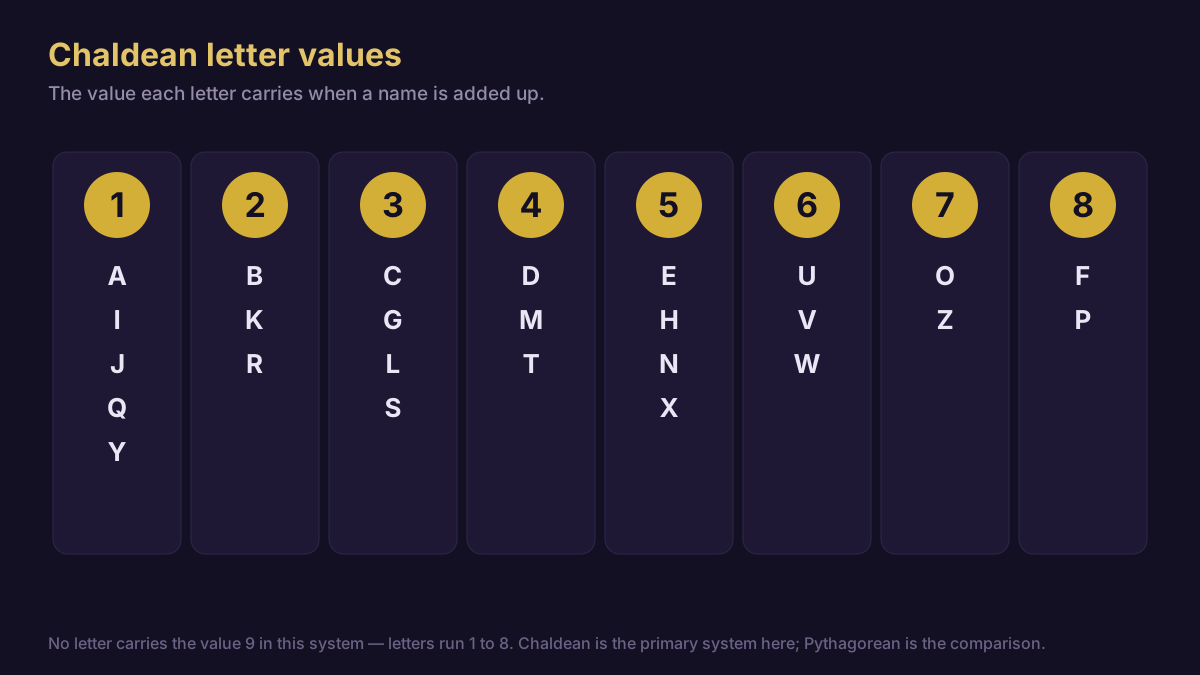
| Value | Letters | How many |
|---|---|---|
| 1 | A, I, J, Q, Y | 5 |
| 2 | B, K, R | 3 |
| 3 | C, G, L, S | 4 |
| 4 | D, M, T | 3 |
| 5 | E, H, N, X | 4 |
| 6 | U, V, W | 3 |
| 7 | O, Z | 2 |
| 8 | F, P | 2 |
| 9 | — none — | 0 |
Alphabetically, which is faster for converting a name letter by letter:
| A | B | C | D | E | F | G | H | I | J | K | L | M |
|---|---|---|---|---|---|---|---|---|---|---|---|---|
| 1 | 2 | 3 | 4 | 5 | 8 | 3 | 5 | 1 | 1 | 2 | 3 | 4 |
| N | O | P | Q | R | S | T | U | V | W | X | Y | Z |
|---|---|---|---|---|---|---|---|---|---|---|---|---|
| 5 | 7 | 8 | 1 | 2 | 3 | 4 | 6 | 6 | 6 | 5 | 1 | 7 |
Twenty-six letters, eight values, no nine. The distribution is uneven: five letters carry the value 1, only two carry 7 and only two carry 8. That imbalance decides how easily you can hit a particular total.
For the wider vocabulary — driver, conductor, compound, reduction — the numerology glossary defines the site's terms in one place.
Why there is no 9
Two answers are usually given, one traditional and one arithmetic. They are not in competition, and the second is the more interesting because you can verify it yourself.
The traditional answer
The source material holds 9 apart. It is treated as complete in itself, a number of endings and totality, and therefore not spent on an ordinary letter. Where the other eight values were mapped onto sounds and characters, 9 was reserved.
Be honest about the standing of that claim. It is what the tradition says about itself. There is no auditable manuscript trail, no dated source you can check the way you would check a legal citation. It is an inherited convention, not a historical fact you can look up.
The arithmetic answer
Reduction is a modulo-9 operation. Add a total's digits repeatedly until you have a single figure. That digital root is the remainder when the total is divided by 9, with multiples of 9 reported as 9 rather than 0. The consequence is direct.
Adding 9 to any total leaves the reduced digit completely unchanged.
Take a name totalling 25. Reduce: 2 + 5 = 7. Now add 9. The total is 34. Reduce: 3 + 4 = 7. Add 9 again: 43. Reduce: 4 + 3 = 7. The compound has moved three times and the digit has not moved at all.
So a letter worth 9 would be silent. Put it in a name, take it out, and every reduced result stays the same: it would carry no information. Whether the people who built the table knew that is not knowable from here, but the gap is arithmetically coherent, which is more than can be said for most inherited conventions.
This is also why a 9 shows up constantly as a total even though no letter produces one. Names totalling 18, 27, 36 and 45 all land on 9 without a single 9-valued letter in them.
Compound number first, reduced digit second
This habit separates Chaldean practice from the reduced-digit shorthand you see everywhere else. A result is a pair: the compound total, then the single digit it reduces to. Fifty is not "a 5". It is 50/5.
Reduction throws information away, and once thrown it cannot be recovered. Consider three names, each reducing to 9:
| Compound | Reduction | Reported as |
|---|---|---|
| 18 | 1 + 8 = 9 | 18/9 |
| 27 | 2 + 7 = 9 | 27/9 |
| 45 | 4 + 5 = 9 | 45/9 |
All three are 9s, yet they are not read alike: 18 is treated as a brand-killer, while 27 and 45 are both favoured, and the read attaches to the compound, not the digit. Collapse them and you have discarded the only thing that separates 18 from the other two. The compound numbers reference sets out the individual readings.
One further wrinkle catches people out. Reduce each word first, then add the reduced digits, and you get the same final digit as summing everything and reducing once — always, because both routes are the same arithmetic. What differs is the compound. Take a name whose halves come to 25 and 25:
- Summed then reduced: 25 + 25 = 50, and 5 + 0 = 5. Result 50/5.
- Reduced then summed: 7 + 7 = 14, and 1 + 4 = 5. Result 14/5.
Same digit, different compound, and the compound carries the reading. Sum everything first. Reduce once, at the end.
Three business names converted by hand
All names below are invented, and none should be assumed available to register.
Worked example: Halcyon Forge
Take the trading name letter by letter. Spaces are not counted.
| Letter | H | A | L | C | Y | O | N |
|---|---|---|---|---|---|---|---|
| Value | 5 | 1 | 3 | 3 | 1 | 7 | 5 |
5 + 1 + 3 + 3 + 1 + 7 + 5 = 25
| Letter | F | O | R | G | E |
|---|---|---|---|---|---|
| Value | 8 | 7 | 2 | 3 | 5 |
8 + 7 + 2 + 3 + 5 = 25
Total: 25 + 25 = 50. Reduce: 5 + 0 = 5.
Halcyon Forge = 50/5. The reading attaches to compound number 50 first and to the 5 second.
Worked example: Nova
| Letter | N | O | V | A |
|---|---|---|---|---|
| Value | 5 | 7 | 6 | 1 |
5 + 7 + 6 + 1 = 19. Reduce: 1 + 9 = 10. Reduce again: 1 + 0 = 1.
Nova = 19/1. Note the two-step reduction: nineteen does not reach a single digit in one pass, so you keep going. The compound reported is the first total, 19, not the intermediate 10.
Worked example: Cedarworks
| Letter | C | E | D | A | R | W | O | R | K | S |
|---|---|---|---|---|---|---|---|---|---|---|
| Value | 3 | 5 | 4 | 1 | 2 | 6 | 7 | 2 | 2 | 3 |
3 + 5 + 4 + 1 + 2 + 6 + 7 + 2 + 2 + 3 = 35. Reduce: 3 + 5 = 8.
Cedarworks = 35/8.
Three names, three totals, no tool involved. If a calculator gives you something different for any of these, it is using a different table or counting something it should not.
What a Chaldean numerology calculator must get right
Most disagreements between two tools are not about letters but about what counts as part of the name. Six rules cover nearly all of it.
Legal suffixes are not counted. Pvt Ltd, LLP, Inc, GmbH, LLC and the rest are conferred by a registrar. They describe a filing status, not the entity as the world knows it. Two identical businesses in different jurisdictions would otherwise score differently. Leave them out.
Spaces, hyphens and apostrophes have no value. "Marlowe's" is counted as MARLOWES: 4 + 1 + 2 + 3 + 7 + 6 + 5 + 3 = 31, so 31/4. The apostrophe contributes nothing, and neither does a hyphen.
An ampersand is not a letter. Practitioners differ on whether "Smith & Co" should pick up the word "and". The defensible position is to count what is written, and to say which you did.
Digits inside a name count as themselves. "Studio 8" picks up an 8 from the numeral — a convention rather than an inherited rule, and not universally applied.
Case is irrelevant. Upper, lower and mixed convert identically.
Use the name the business actually trades under. This matters most and gets skipped most often. If the registered entity is one thing and the sign, the invoices and the website say another, the tradition takes the name in use. The methodology page sets out the conventions the site's tools apply.
Where a Chaldean numerology calculator and a hand count disagree
Assume both are working correctly. There are still four places where two honest results diverge.
Variant tables circulate. The version above is in common use and is what the tools here apply, but printed alternatives shift a few letters. If two tools disagree slightly on a long name, this is the usual reason, and there is no arbiter. Pick a table, state it, stay with it.
Spelling versus sound. Some practitioners convert a name as pronounced rather than spelled, which changes silent letters. "Knightley" is nine letters written and fewer spoken. The site converts as written, because spelling is unambiguous and pronunciation is not.
Names outside the Latin alphabet. A trading name in Devanagari, Arabic or Han characters has no defined mapping here. Transliterating first is usual, but different romanisations produce different totals. That is a real limitation.
Repeated letters. They count every time. You will occasionally see a claim that repeats count once. They do not, in any standard reading of this system.
Chaldean and Pythagorean side by side
The other common system assigns 1 to 9 across the alphabet in sequence: A–I as 1–9, J–R as 1–9, S–Z as 1–8. It uses the 9, and gives different answers. Run Halcyon Forge through both:
| System | Halcyon | Forge | Total | Reduced |
|---|---|---|---|---|
| Chaldean | 25 | 25 | 50 | 5 |
| Pythagorean | 33 | 33 | 66 | 3 |
Same name, same letters, 50/5 against 66/3. Neither is a mistake. They are different tables, and because both are internally consistent the choice between them cannot be settled by calculation. This site treats Chaldean as primary and Pythagorean as the comparison, with the reasoning set out in the comparison of Chaldean and Pythagorean numerology.
Never compute both and take whichever you prefer. Commit to a table before you see the answer.
The arithmetic hiding in the table
Because the values are uneven, the table has properties you can use. Add all twenty-six letter values and you get 103. Divide by 26 and the average letter is worth 3.96. Weight that by how often letters occur in English and the figure barely shifts. That gives a rule of thumb worth having before you brainstorm names:
Expected total ≈ 4 × the number of letters.
A ten-letter name lands near 40, a fifteen-letter name near 60, a six-letter name near 24. Length does most of the work, so if you are hunting for a specific total you are mostly choosing a length and then tuning.
The tuning is done with heavy and light letters:
| Weight | Letters | Value |
|---|---|---|
| Heaviest | F, P | 8 |
| Heavy | O, Z | 7 |
| Heavy | U, V, W | 6 |
| Lightest | A, I, J, Q, Y | 1 |
Vowels are the sharpest lever, because their values span almost the whole range: A = 1, E = 5, I = 1, O = 7, U = 6. Two invented names, six letters each, one vowel apart:
- NAVARA — 5 + 1 + 6 + 1 + 2 + 1 = 16, and 1 + 6 = 7. 16/7
- NOVARA — 5 + 7 + 6 + 1 + 2 + 1 = 22, and 2 + 2 = 4. 22/4
One letter changed. The total moved six and the digit moved from 7 to 4.
Whole words work the same way. Halcyon Forge is 50/5. Add the definite article and "The Halcyon Forge" is 64/1 — T, H and E contribute 4 + 5 + 5 = 14, taking 50 to 64. Pluralise instead and "Halcyon Forges" is 53/8, because S adds 3.
Three readings from what a customer hears as one business, which says something about how much weight this method asks a spelling to carry. Working through a shortlist, the business name analyser runs the sums for a batch at once, and the guide on how to choose a business name covers the commercial checks that sit alongside the arithmetic.
Frequently asked questions
What is a Chaldean numerology calculator?
A tool that converts a name's letters into numbers using the Chaldean table, sums them, and reduces the total to a single digit while reporting the compound. A good one shows the letter-by-letter working and states whether it counted the legal suffix. If it returns a single number with no arithmetic, you cannot audit it.
Why is there no 9 in Chaldean numerology?
The tradition treats 9 as complete in itself and reserves it rather than assigning it to a letter. There is an arithmetic reading too: reduction is a modulo-9 operation, so adding 9 to any total leaves the reduced digit unchanged and a 9-valued letter would be invisible. A 9 still appears frequently as a total.
Is Chaldean numerology more accurate than Pythagorean?
Neither can be shown to be more accurate, because neither makes predictions testable against outcomes. They are different tables. Chaldean is the older and preserves compound numbers rather than reducing immediately, which is why this site uses it as primary — a preference for how the system is structured, not a claim about accuracy.
Do you count Pvt Ltd or LLC in a business name?
No. Legal suffixes are conferred by a registrar and describe a filing status, not the business as it is known. The same shop with the same sign would otherwise score differently in two countries. Count the trading name — the door, the invoice, the website.
What if my business name has numbers or an ampersand in it?
A numeral is normally counted as its own value, so "Studio 8" picks up an 8. An ampersand is not a letter and contributes nothing, though practitioners differ on whether to substitute the word "and". Both are conventions rather than inherited rules. Whichever you choose, apply it to every name on the shortlist.
Which is more important, the compound number or the single digit?
The compound. The digit tells you which broad family a name belongs to; the compound tells you which member of it. Names totalling 18 and 27 both reduce to 9 and are read quite differently. Reporting only the digit discards that distinction, which is why results here are written as a pair.
Where this runs out
The table is arithmetic and the arithmetic is sound. Everything built on top of it is convention, and convention is a weaker thing.
There is no primary source you can audit. The claim that 9 was held sacred and reserved is what the tradition says about itself, repeated across many hands over a long period. It may be true. It is not evidence that would satisfy a sceptical reader. Variant tables exist too, and no authority settles between them: if two published sources put a letter in different columns, both are simply published sources.
More fundamentally, the method reads a spelling. It knows nothing about whether the market wants what you sell, whether the price is right, whether the domain is free, whether the name is already a registered trade mark, or whether your customers can pronounce it. A name that computes beautifully and is unusable commercially is a bad name, and no number produced here forecasts how a business will do.
Then there is sensitivity. Adding a "The" or pluralising shifts the result, sometimes across two or three bands. A method whose output moves that much on a typographic decision is telling you something about its own precision. It is a structured prompt for thinking about a name, not a measurement.
Used for what it is, it is genuinely useful: a consistent, transparent tiebreak when four candidate names appeal equally and you need a reason to pick. Used as a substitute for commercial judgement, it will let you down. Treat the number as one input among several, keep the working visible, and make the decision yourself.