
Is 9 a good number for business? Only for a narrow band of them. The tradition reads 9 as force, contest and completion — strong for engineering, land, metal, sport and anything whose product is an ending, weak for calm repeat trade. And no Chaldean letter is worth 9. It appears only as a total.
That last point is where people trip, so it is worth settling first.
The short answer: is 9 a good number for business?
Nine is not a general-purpose business number. It is a specialist one.
Where the tradition puts 8 as slow and accumulating and 4 as technical and unseen, it puts 9 as active, forceful and finishing. A 9 is not a bad result. It is a narrow one, and the useful question is not whether 9 is good but whether it matches what you actually sell.
Three things decide the answer for any given business:
- Which compound produced the 9. 18, 27, 36, 45 and 81 all reduce to 9 and are read very differently. This matters more than the digit.
- What the business does. A steel fabricator and a nursery school get the same reading from the tradition and should not treat it the same way.
- How it sits against the founder's own numbers. A name total is read against the person running the business, not in isolation.
None of this predicts revenue. It is a structured way of thinking about a name, and should be held that way.
What the tradition attaches to 9
The source material links each number to a planetary character, and 9 is given to Mars. From that come the associations that run through every later reading of the number:
| Association | How it reads in a business context |
|---|---|
| Energy and drive | Fast execution, appetite for hard work, tolerance for pressure |
| Conflict and contest | Competitive trades, tendering, litigation-adjacent services |
| Fire, metal and tools | Fabrication, engineering, machining, cutting, welding |
| Land and property | Site work, groundworks, development, boundary disputes |
| Surgery and intervention | Anything that cuts in, fixes decisively and leaves |
| Completion and endings | Work whose deliverable is that something is finished |
Two of these do most of the work. The first is contest: 9 businesses are read as suited to environments where somebody wins and somebody does not — competitive tenders, adversarial markets, sport. The second, more overlooked, is endings.
A fair reading includes the cost side. Nine is read as impatient, prone to friction, quick to burn through people, inclined to start fights a calmer number would have avoided. Under this system a strong number and a difficult one are frequently the same number. The number 9 in business reference sets out the fuller character read.
No letter is worth 9, but a name total can be
In Chaldean the alphabet runs 1 to 8. A, I, J, Q and Y are 1; B, K and R are 2; C, G, L and S are 3; D, M and T are 4; E, H, N and X are 5; U, V and W are 6; O and Z are 7; F and P are 8. That is all twenty-six letters accounted for, and none of them is a 9.
The tradition's reason is that 9 is complete in itself and reserved rather than spent on a letter. There is also an arithmetic reason, and that one you can verify.
Reduction is a modulo-9 operation, so adding 9 to any total leaves the reduced digit exactly where it was. Take a name totalling 25: 2 + 5 = 7. Add 9 to get 34: 3 + 4 = 7. Add 9 again to get 43: 4 + 3 = 7. Three different compounds, one unchanged digit. A letter worth 9 would therefore be silent — add it or remove it and the reduced result never moves.
Nine absorbs under multiplication too. 9 × 2 = 18, which reduces to 9. 9 × 4 = 36, which reduces to 9. 9 × 7 = 63, which reduces to 9. Every multiple of 9 comes back to 9.
So the number that appears in no letter turns up constantly as a total, and it is the only digit that behaves this way. Whether you find that meaningful or merely tidy is a fair question. It is at least consistent with what the tradition claims about the number: something that takes in whatever is added and returns unchanged. The Chaldean and Pythagorean comparison covers the other common system, which does assign a 9.
Which 9 you actually got: the compound matters
Reporting a name as "a 9" throws away the part carrying the reading. Written properly, a result is the compound first and the digit second — 27/9, not 9.
| Compound | Reduces to | How the tradition reads it | Weight of source material |
|---|---|---|---|
| 18 | 9 | The sharpest warning in the series: quarrels, division, gain achieved through strife, position undermined from inside | Heavy — the most discussed 9 |
| 27 | 9 | Among the best regarded, with 45: authority, command, reward arriving for work already done | Heavy |
| 36 | 9 | Classically read like 27; the business sources advise against it, reading 3 and 6 as enemies, and move it to 37 | Moderate |
| 45 | 9 | Well regarded: read with 27 and favoured for a company name | Moderate |
| 54, 63, 72 | 9 | Little classical material | Very light |
| 81 | 9 | No reading of its own; mentioned only as a total to move off, with 86 the recorded correction | Very light |
Be straight about that right-hand column. The tradition is unevenly distributed: a great deal about 18 and 27, progressively less the further up the series you go, and where the source material is thin practitioners fill the gap with their own inference. Anyone giving you a confident, detailed reading of 72 is extending the tradition rather than reporting it, and should say so.
The upshot: if your name lands on 9, find out which 9 before deciding anything. The gap between 18 and 27 is wider than the gap between most different digits.
Sectors where 9 is a good number for business
Grouping by what the number is read to do, rather than by industry code, makes the pattern clearer.
Force applied to material. Structural steel, fabrication, machining, foundry work, tooling, welding, metals trading, mining services. The most direct reading and the least contested.
Ground and land. Groundworks, civil engineering, demolition, site clearance, plant hire, development. Land is shared territory with 8, but the tradition splits them by tempo: 8 holds and accumulates it, 9 acts on it.
Contest. Competitive tendering, sports businesses, coaching, motorsport, litigation support, recovery and enforcement — work that is adversarial by design.
Intervention. Emergency services support, fire safety, security, pest control, restoration, urgent repair. Businesses that arrive when something has gone wrong, fix it decisively and leave.
Endings as the product. The cluster most people miss and the most distinctive thing about 9. Some businesses exist to finish things: decommissioning, insolvency and administration, estate and house clearance, probate, secure data destruction, exit advisory, wind-down consultancy, asset disposal. If the deliverable is that something is now definitively over, the tradition reads 9 as unusually well matched — a firm whose whole proposition is a clean ending is doing exactly what the number describes.
Where a 9 business name is a poor fit
The same character that suits a demolition contractor works against several common business models.
Anything built on renewal. Subscriptions, memberships, retainers, maintenance contracts, managed services. Their commercial promise is that nothing ends, and the tradition reads 9 as the number that closes things. Whether that is a real effect or a pleasing metaphor is worth keeping open, but between two names it is a reasonable tiebreak.
Calm, repeat, low-drama trade. Neighbourhood retail, groceries, everyday services, which live on quiet reliability and thin margins. Contest and intervention are not what a customer wants from a corner shop. The tradition attaches 5 to quick repeat turnover and 6 to comfort and service.
Care and reassurance. Childcare, elder care, therapy, veterinary practice, hospitality where the offer is warmth. The Mars association is not what you want on the sign — though the sector map does favour 9 for clinical healthcare.
Long-hold, slow-compounding businesses. Where the model is patience — property portfolios, funds, anything returning from years of holding — the tradition points at 8. The comparison piece on whether 8 is a good number for business works through that reading.
Partnerships of equals. Nine is read as self-sufficient and inclined to lead rather than share. It is not read as a partnership number.
None of this is a prohibition. Plenty of caring, calm, subscription businesses trade under names totalling 9 and do perfectly well. It is a mismatch between number and work, and mismatches are worth noticing rather than obeying.
Is 9 a good number for business? Two worked examples
Both names below are invented, using the Chaldean values set out above.
Ironbeam — a structural steel fabricator
| Letter | I | R | O | N | B | E | A | M |
|---|---|---|---|---|---|---|---|---|
| Value | 1 | 2 | 7 | 5 | 2 | 5 | 1 | 4 |
1 + 2 + 7 + 5 + 2 + 5 + 1 + 4 = 27. Reduce: 2 + 7 = 9.
Ironbeam = 27/9.
About as clean a fit as the method produces. The compound is 27, the best regarded of the 9 series. The trade is metal, force and structure. And the work is project-shaped: it starts, it finishes, it ends. Nothing here fights the number.
Alders — a homeware and soft furnishings shop
| Letter | A | L | D | E | R | S |
|---|---|---|---|---|---|---|
| Value | 1 | 3 | 4 | 5 | 2 | 3 |
1 + 3 + 4 + 5 + 2 + 3 = 18. Reduce: 1 + 8 = 9.
Alders = 18/9.
Same digit, and the reading could hardly be more different. The compound is 18, the one the tradition warns about most sharply. The trade is comfort, texture and repeat custom, which the system associates with 6 rather than 9. Two mismatches stacked: the wrong member of the family, and a family that does not suit the work.
Note what this does not mean. It is not a prediction that the shop will fail. It means that if the owner had three names on a shortlist and wanted a reason to prefer one, this arithmetic argues against this one.
Moving off 18
To shift Alders out of the 18, use the heaviest letters. "Alders" at 18 plus "Home" — H5 + O7 + M4 + E5 = 21 — gives 39, and 3 + 9 = 12, then 1 + 2 = 3. That is 39/3, which the tradition attaches to expression and retail display. One word, an entirely different reading.
Three more names in the 9 series, computed the same way:
| Name | Arithmetic | Result |
|---|---|---|
| Northgate | 5+7+2+4+5+3+1+4+5 | 36/9 |
| Vanguard Civils | (6+1+5+3+6+1+2+4) + (3+1+6+1+3+3) = 28 + 17 | 45/9 |
| Palladium Construction | 31 + 50 | 81/9 |
Five names, one digit between them, five different compounds and five different readings. The business name analyser will run a shortlist and return both figures for each.
9 as a founder's number versus 9 as a name total
These are different things and get conflated constantly.
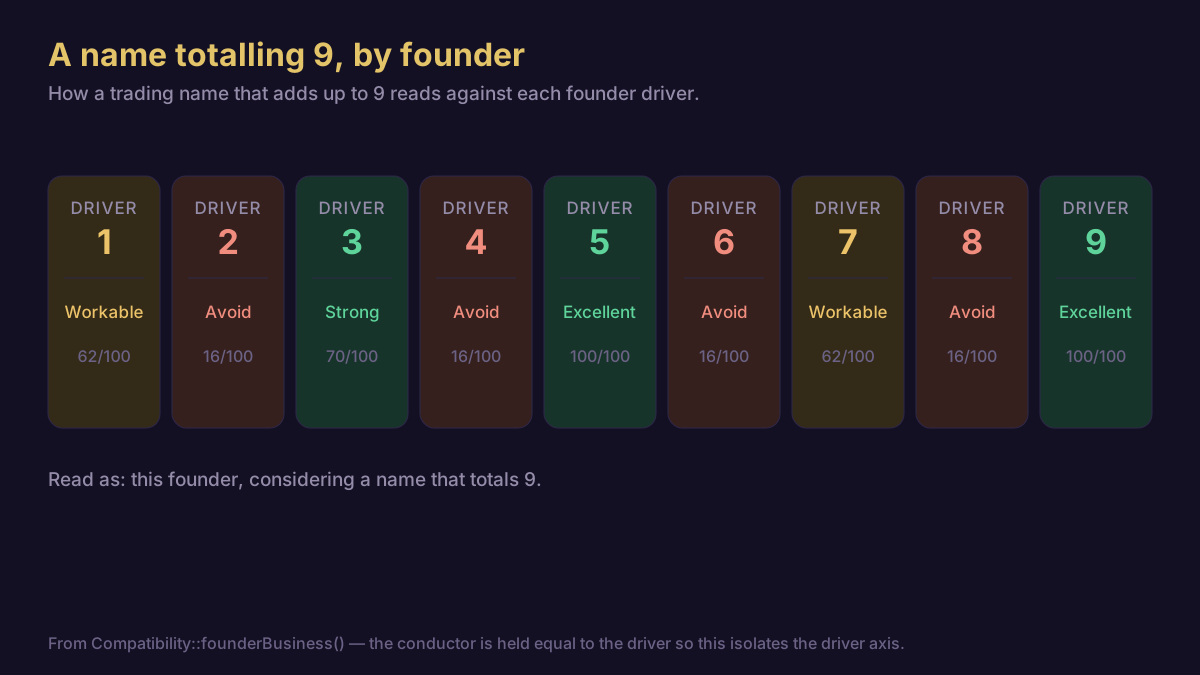
The driver is the day of the month you were born, reduced. Born on the 9th, 18th or 27th and your driver is 9. The conductor is the whole date reduced.
Take a founder born on 27 March 1988. Driver: 27 reduces to 9. Conductor: 2 + 7 + 0 + 3 + 1 + 9 + 8 + 8 = 38, and 3 + 8 = 11, and 1 + 1 = 2. So driver 9, conductor 38/2 — the 11 is noted in passing, though the default here reduces it.
A second founder, born 18 November 1990. Driver: 18 reduces to 9. Conductor: 1 + 8 + 1 + 1 + 1 + 9 + 9 + 0 = 30, and 3 + 0 = 3. Driver 9, conductor 30/3.
Both are 9 drivers with quite different conductors, which is the point. The tradition reads the conductor as softening or sharpening the driver, so a 9 driver with a 2 conductor reads differently from one with a 3.
A 9 driver is generally read as compatible with a 9 name total — like reinforcing like. Whether that is desirable is a separate question, because doubling down on a forceful number amplifies both halves of its character, the drive and the friction. Some practitioners prefer a name supplying what the founder's numbers lack. That is a real disagreement in the field, not a settled rule.
Frequently asked questions
Is 9 a lucky number for business?
The tradition does not use "lucky" in this way, and neither should a serious reading. Nine is read as forceful, competitive and finishing — an asset in engineering, land and contest trades, a liability in calm repeat custom. Calling it lucky or unlucky skips the only question worth asking, which is whether the number matches the work.
Which business name number is best, 9 or 8?
They suit different models rather than being ranked. Eight is slow, heavy and accumulating, with property and land as its asset class — the tradition treats it as late rather than unlucky. Nine is fast, forceful and finishing. A long-hold portfolio business points at 8; a fabrication or demolition business points at 9.
Why is there no letter worth 9 in Chaldean numerology?
The tradition holds 9 apart as complete in itself and does not assign it to a letter. There is an arithmetic reading too: reduction is a modulo-9 operation, so adding 9 to any total leaves the reduced digit unchanged and a 9-valued letter would make no difference. Nine still appears constantly as a name total.
Is 18 a bad number for a business name?
It draws the sharpest warning of the 9 series in the source material — quarrels, division and gain achieved through conflict. Treat that as a flag rather than a verdict: a reason to prefer another name on a shortlist, not a reason to rename a trading business that is working. Nothing about the number determines what happens.
Can I change my business name if it comes to 9?
You can, and the arithmetic is easy to shift: adding or removing a single heavy letter such as O, F or P moves a total by seven or eight. Whether you should is a commercial question about goodwill, signage, domains and registrations, and those costs usually outweigh any expected benefit from moving a number.
Is 9 good for a shop or restaurant?
Generally the tradition points elsewhere. Retail turnover is associated with 5, hospitality warmth with 6. Nine's contest-and-intervention character is a poor match for a business selling comfort and repeat visits. If a 9 name is already established and trading well, that is the better evidence.
Where this runs out
Everything above is an inherited association, and it should be held loosely.
There is no controlled evidence that a business name totalling 9 performs differently from one totalling 5. Nobody has run that study, it would be hard to run well, and the pattern-matching that stands in for evidence — pointing at successful firms whose names happen to total 9 — is survivorship bias. The failed firms with the same total are in nobody's list of examples.
The tradition is uneven, too. It says a great deal about 18 and 27 and very little about 54 or 72, and where it says little, practitioners supply their own material. Confidence in a source is not the same as knowledge.
The method reads a spelling. It does not know your margins, your market, your competition or whether you can execute. A name computing to 27/9 does not make a fabrication business good at fabrication, and 18/9 does not stop a homeware shop being excellent. The number is one input for reflection when you are choosing between options you already like. It is not a forecast, and nothing here is financial advice.
Practitioners also disagree on a question that matters: whether a name should reinforce the founder's own numbers or compensate for them. Anyone claiming one right answer is overstating what the tradition supports.
The reasonable use is narrow. You have a shortlist of names that all pass the commercial tests — available, pronounceable, not already trade marked, domain obtainable. The arithmetic gives you a consistent, transparent way to order them, and a reason to think for another hour about a decision most founders make in ten minutes. Held that way it costs nothing and occasionally surfaces something worth noticing. Held as prediction, it will mislead you. The best name numbers for business piece sets out the comparison across all nine.