
Brand name numerology converts a company's name to a number using Chaldean letter values and reads that total as character. Scored honestly, the famous names land everywhere: Apple is 25/7, Google 28/1, Nike 13/4, Toyota 24/6. Across 96 well-known brands the results spread almost evenly across all nine digits — and the brands that failed spread the same way.
That last clause is the finding, and most articles omit it. This one is built around it: arithmetic shown for every claim, the failures listed beside the survivors.
What brand name numerology actually measures
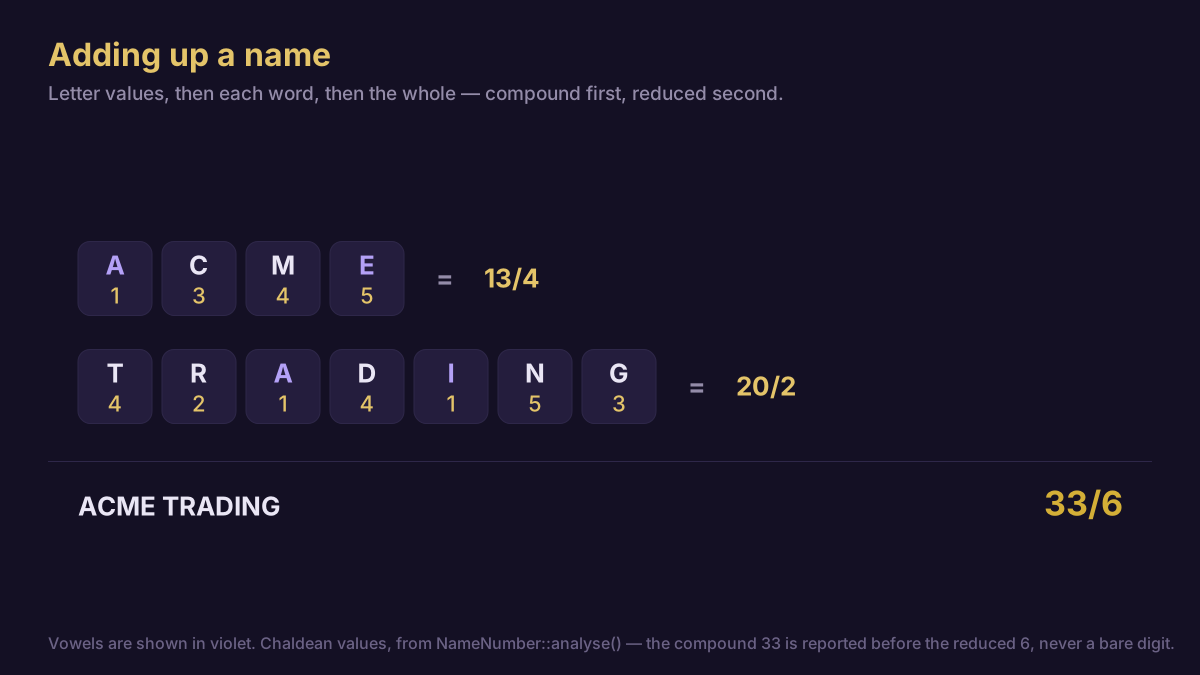
The method is mechanical. Each letter carries a value, you add the values, and you report the result as a compound number over its reduced digit — 25/7, 28/1, 16/7. The compound is the raw total. The reduced digit is that total added down to a single figure. The tradition reads both: the compound describes the texture of the thing, the digit its basic drive.
Chaldean is the primary system here. Its letter values are these:
| Value | Letters |
|---|---|
| 1 | A, I, J, Q, Y |
| 2 | B, K, R |
| 3 | C, G, L, S |
| 4 | D, M, T |
| 5 | E, H, N, X |
| 6 | U, V, W |
| 7 | O, Z |
| 8 | F, P |
No letter is assigned 9 in Chaldean. Nine can appear as a total, never as a letter value. Pythagorean, the other common system, runs A–I as 1–9, J–R as 1–9 and S–Z as 1–8, and produces different totals for the same word. The argument for choosing one over the other is set out in Chaldean and Pythagorean numerology side by side.
One rule matters before scoring. Entity suffixes — Ltd, Pvt Ltd, LLP, Inc, GmbH — are conferred by a registrar, not chosen by the founder, and are not counted. So we score Apple, not Apple Inc. It is not a small point: a method with an optional switch will always produce the answer you wanted.
The worked example, letter by letter
Take an invented tableware brand, Verrow Ceramics.
Verrow: V=6, E=5, R=2, R=2, O=7, W=6. 6 + 5 + 2 + 2 + 7 + 6 = 28. 2 + 8 = 10, 1 + 0 = 1. Verrow is 28/1.
Ceramics: C=3, E=5, R=2, A=1, M=4, I=1, C=3, S=3. 3 + 5 + 2 + 1 + 4 + 1 + 3 + 3 = 22. 2 + 2 = 4. Ceramics is 22/4.
The whole name: 28 + 22 = 50. 5 + 0 = 5. Verrow Ceramics is 50/5.
Notice what the descriptor did. The coined word alone was 28/1, the tradition's number for initiative. Adding one plain category word pushed it to 50/5, a trading number about turnover. Same brand, different reading, one word apart. That becomes the central problem later.
Brand name numerology across 96 well-known names
Here is the arithmetic in full for a sample of survivors and casualties, so you can check the method rather than trust the list.
| Brand | Chaldean sum | Result |
|---|---|---|
| 3+7+7+3+3+5 | 28/1 | |
| Apple | 1+8+8+3+5 | 25/7 |
| Microsoft | 4+1+3+2+7+3+7+8+4 | 39/3 |
| Tesla | 4+5+3+3+1 | 16/7 |
| Starbucks | 3+4+1+2+2+6+3+2+3 | 26/8 |
| Nokia | 5+7+2+1+1 | 16/7 |
| Myspace | 4+1+3+8+1+3+5 | 25/7 |
| Napster | 5+1+8+3+4+5+2 | 28/1 |
| Blockbuster | 2+3+7+3+2+2+6+3+4+5+2 | 39/3 |
| Enron | 5+5+2+7+5 | 24/6 |
Now the complete set of 96, grouped by compound total. The left column holds brands still trading at scale; the right holds brands wound down, sold at a loss, overtaken into irrelevance, or collapsed outright. Suffixes stripped, spaces ignored, names as commonly written.
| Total | Still trading | Failed or faded |
|---|---|---|
| 9/9 | Ikea | — |
| 10/1 | Tata | — |
| 11/2 | Zara, Visa, Bayer | Digg, Quibi |
| 12/3 | Slack | — |
| 13/4 | Nike, Airbnb | Kmart |
| 14/5 | Adidas, Meta, Amul | Sears |
| 15/6 | Uber, Airbus | — |
| 16/7 | Tesla, Sony, Gucci, Prada | Nokia, Kodak, Palm, Bebo, Fyre |
| 17/8 | — | Zynga |
| 18/9 | Intel, Paytm, Cartier, Lego | — |
| 19/1 | Shell, Adobe, Target, Disney | Segway |
| 20/2 | Bosch | Vero |
| 21/3 | Ford, Oracle, Canon, Walmart | Yahoo, Orkut |
| 22/4 | Honda, Chanel, Rolex | Betamax |
| 23/5 | Stripe, Mahindra, Boeing | Blackberry |
| 24/6 | Toyota, Wipro | Xerox, Enron, Compaq |
| 25/7 | Apple, Amazon, Samsung, Nestle, Pepsi, Zoom, Reliance | Myspace, Juicero, Webvan, Borders |
| 26/8 | Twitter, Siemens, Starbucks | Solyndra, Nortel |
| 27/9 | Costco | Jawbone |
| 28/1 | Google, Infosys | Napster, WeWork |
| 29/2 | Flipkart, Philips | — |
| 30/3 | Zomato | — |
| 31/4 | Netflix, Pfizer | — |
| 32/5 | Spotify | Theranos |
| 33/6 | Unilever | — |
| 34/7 | McDonalds | — |
| 35/8 | — | |
| 36/9 | Nintendo | — |
| 38/2 | — | Groupon |
| 39/3 | Microsoft | Friendster, Blockbuster |
| 40/4 | Salesforce | — |
| 50/5 | — | Woolworths |
Read down the right-hand column before reading anything else into the left.
Counting the results properly
Sixty-three names still trading, thirty-three gone. Here is how the reduced digits fall in each group.
| Digit | Still trading (n=63) | Failed or faded (n=33) |
|---|---|---|
| 1 | 7 (11%) | 3 (9%) |
| 2 | 6 (10%) | 4 (12%) |
| 3 | 7 (11%) | 4 (12%) |
| 4 | 8 (13%) | 2 (6%) |
| 5 | 7 (11%) | 4 (12%) |
| 6 | 5 (8%) | 3 (9%) |
| 7 | 12 (19%) | 9 (27%) |
| 8 | 4 (6%) | 3 (9%) |
| 9 | 7 (11%) | 1 (3%) |
The two columns are the same shape. Seven is the commonest digit among the survivors, and it is also the commonest among the failures, by a wider margin. If a 7 name caused success, the second column should not look like that.
It also helps to know the background rate. Run the Chaldean reduction across an ordinary English dictionary — 103,788 lower-case words of four to nine letters — and the digits come out at 11.1%, 11.2%, 11.1%, 11.1%, 10.9%, 11.1%, 11.1%, 11.2%, 11.1%. Flat. One in nine, right across the board. Any English word you pick at random has an even chance of landing on any digit, so "this famous brand is a 7" carries about as much information as "this famous brand starts with a consonant".
Against that baseline, is twelve sevens out of sixty-three surprising? The expected count is seven, and chance alone moves it about two and a half either way, so twelve sits roughly two steps high. That sounds like something until you remember we tested all nine digits at once. Finding one of nine categories two steps off expectation is close to what chance produces unaided. And the failure column, which nobody prints, has the same digit at the top.
The survivorship problem in brand name numerology
This objection decides the subject, so it gets a section rather than a footnote.
The sample is chosen after the outcome is known. Every "look at these brand numbers" piece starts from a list of companies that already worked. The list was assembled by success, not by number. The failures share the numbers and never appear. Print both columns, as above, and the pattern dissolves.
The denominator is invisible. For every Nike there are thousands of shoe companies that also scored 13/4 and closed within five years. Nobody wrote them down. A claim about which numbers work needs the full population of names that were tried, and nobody has it.
The name has several legitimate forms. This is the part that does the most damage, and it is arithmetic rather than opinion. Apple is 25/7 in Chaldean. The company's registered name for its first thirty-one years was Apple Computer, which is 64/1. In Pythagorean, Apple is 23/5 and Apple Computer is 62/8. So one brand, using nothing but defensible readings, yields 7, 1, 5 and 8 — four of the nine possible digits. Facebook is 35/8; Meta is 14/5; Meta Platforms is 54/9. Google is 28/1; the parent name Alphabet is 29/2. Between the trading name, the legal name, the name with and without a descriptor, and two letter systems, most well-known brands carry four or more honest numbers. When a commentator picks one, they pick the one that fits the story they already wanted to tell.
The readings stretch to fit anything. Compound 16 is treated in the classical material as a warning number: sudden reversal, a structure that falls. Look who sits on 16 above. Tesla, Sony, Gucci and Prada on the left; Nokia, Kodak, Palm, Bebo and Fyre on the right. You can tell a persuasive story either way. Sony nearly failed and recovered; Gucci came close to collapse in the 1990s; Tesla's history has been volatile. All true — and also true of nearly every large company that has lasted thirty years. A reading that fits winners and losers equally well is not predicting anything. The classical note is at compound number 16; read it with this paragraph in mind.
The famous collisions cut both ways. Compound 28 is described in the tradition as promise that does not hold: trust extended and lost, a start that must be made again. Google is 28/1. So is Infosys. So are Napster and WeWork. Compound 26 carries a warning about loss through partnership and poor counsel, and it belongs to Starbucks, Siemens, Twitter, Nortel and Solyndra. Compound 39 belongs to Microsoft, Blockbuster and Friendster. These are not cherry-picked embarrassments. They are what happens when you score a list you did not choose for the result. The full note is at compound number 28.
Anyone selling you a brand reading who has not addressed these five points has not thought about the subject.
What the numbers do describe
Having said all that, the exercise is not empty. It is measuring something other than success.
A Chaldean total is a compressed description of a name's letter texture. Names heavy in O and Z run high, because both carry 7. Names heavy in A, I, J, Q and Y run low, because all carry 1. F and P are 8, the heaviest common consonants. So a total is partly a proxy for sound: hard, plosive names accumulate, light vowel-led names stay small. That is a real property of a name, and it affects how a brand shortens in speech.
Here is a demonstration of what the system is and is not sensitive to. Lyft and Lift are the same number in Chaldean. L=3, Y=1, F=8, T=4 gives 16/7; L=3, I=1, F=8, T=4 gives the same 16/7, because Y and I both carry 1. In Pythagorean they diverge, Lyft to 18/9 and Lift to 20/2. Chaldean treats that vowel swap as no change at all. Yet dropping a silent vowel does change things: Flickr is 19/1 and Flicker is 24/6; Tumblr is 21/3 and Tumbler is 26/8. The method is blind to some spelling choices and sensitive to others — worth knowing before treating its output as precise.
The traditional character attached to each digit is a description to think with, not a forecast: 1 is founder-led and original, 2 diplomatic and paired, 3 expressive and spreading, 4 structural and technical, 5 trading and fast-moving, 6 service-led and comfortable, 7 specialist and researching, 8 slow and accumulating, 9 completing and large in scale. The longer treatment of each is on the number pages, and the argument about which totals the tradition favours for a trading name is in best name numbers for business.
Using this without fooling yourself
If brand name numerology cannot forecast outcomes — and on this evidence it cannot — what is it for?
As a tie-breaker, not a filter. You will usually reach a shortlist of three or four names that all pass the tests that matter: available, pronounceable, spellable, clear of trademarks, not embarrassing abroad. At that point you have no rational way to choose between them, and a reading costs nothing to apply. Using it earlier, to strike out a good name for computing to a digit you disliked, is where it starts costing money.
As a prompt for questions you were not asking. A name totalling 8 invites the question: is this actually a slow, accumulating business, and are we funded for that? A name totalling 5 invites: can we absorb the churn that volume brings? Good planning questions. The number did not answer them. It made you ask.
As a consistency check across a whole chart. A trading name read in isolation says very little. The tradition reads it against the founder's own numbers, the registration date and the premises, and a name that suits one founder may suit another poorly. The business name analyser shows the working for each figure, and the broader argument sits in the guide to choosing a business name.
Nothing here promises anything. A well-numbered name has never rescued a bad product, and there is nothing in the tables above to suggest otherwise.
Frequently asked questions
What is the best number for a brand name?
There is no evidence for a best number, and the tables here argue against there being one. The digits spread evenly across successful brands and evenly across failed ones. What the tradition offers instead is a fit judgement: 8 suits businesses that compound slowly, 5 suits high-turnover trade, 7 suits specialists. The useful question is not which number is best, but which number matches what this business actually is.
Do famous companies use numerology to pick their names?
A few founders have said they consulted the practice, particularly in South Asian business culture where it is common and openly discussed. Most did not. The names above were arrived at by every route imaginable: surnames, mistranslations, misspellings, domain availability and a fair amount of accident. Reading a number back into a name afterwards says nothing about how it was chosen.
Should I count Ltd, Inc or Pvt Ltd in the total?
No. Entity suffixes are conferred by a registrar and shared by millions of companies, so they carry no information about your particular name. Score the trading name only. The practical reason matters as much as the traditional one: allowing the suffix in or out gives you two totals for the same business, and a method you can toggle is not a method.
Does changing a brand name change its numerology?
Arithmetically, yes, immediately. Facebook is 35/8 and Meta is 14/5, a completely different reading. Whether that shift means anything is the open question this article exists to raise. What can be said is that the number the world transacts with is the name on the invoices, the signage and the search results, not the one on a certificate in a drawer.
Where this runs out
This method cannot tell you whether a business will succeed. Nothing in the ninety-six names above supports that claim, and the failure column actively undermines it. Anyone who shows you only winners is not showing you the evidence.
It cannot settle disputes between practitioners either. Some count the legal name, some the trading name, some both. Some reduce every compound to a digit; some hold 11, 22 and 33 back; some preserve the compound throughout. Some include the entity suffix. Each choice changes the answer, and no authority resolves them, only convention and preference. This site's conventions are stated openly in the methodology so you can see which fork was taken.
It cannot handle the ambiguity of real names cleanly. Ampersands, numerals inside a name, hyphens, acronyms, non-Latin scripts and diacritics all require a ruling, and the rulings differ. A brand written in two alphabets has two numbers, and the tradition does not say which the world responds to.
And it says nothing about what actually decides whether a name works: whether people can spell it after hearing it once, whether the domain and trademark are free, whether it means something unfortunate in a market you intend to enter, and whether it still fits in ten years. Those are checkable. Check them first.
Use it as one input among several: material for reflection and planning, a structured way of thinking about what kind of business you are building, rather than a prediction of how it will turn out. Read that way it can be genuinely useful. Read the other way it is an expensive coin toss with better packaging.