
Domain name numerology totals the letters of a web address on the Chaldean table and reads that total. On the question everyone asks — does the extension count? — this site does not count it. The .com, .in or .co.uk is sold by a registry, not chosen as part of the name. Practitioners genuinely split on this, and the split is not trivial: counting .com changes the reduced digit of every domain there is, without a single exception.
That last claim is arithmetic, not opinion, and the tables below prove it.
The short answer, and why domain name numerology splits on it
Two rules are in circulation, both with a defensible argument behind them, which is why the disagreement has never resolved.
The rule this site applies: count the name, not the extension. The test is the one the tradition already applies to company suffixes — did you choose it, or was it conferred on you? A registrar confers Pvt Ltd, and the method has always excluded it. A registry sells .com on identical terms to anyone who asks. A component that hundreds of millions of businesses hold in common cannot be describing any one of them. On the same reasoning the dot is a separator rather than a character, and www is a hostname the world has largely stopped typing.
The competing rule: count everything a person types. This system attaches a number to a name as it is used, and a customer does not type wrenfield, they type wrenfield.com. If the whole string is what circulates on cards, invoices and vans, the argument runs, the whole string carries the signature.
A minority count the extension only when it is part of the spoken brand: "we're at verrow dot shop" counts, "we're Verrow" does not. Reasonable, and impossible to apply consistently.
The first rule wins here not because the second is absurd, but because a method with an optional switch is not a method. Allow the extension in or out at will and every domain has two honest numbers, and the reader will reach for whichever supports the answer they already preferred. Our domain numerology checker therefore strips the extension every time — for a two-part ending it does not recognise, such as .org.uk, only the last part — and shows you what it removed.
Where a name ends and a public suffix begins is not always obvious: .co.uk is two labels but one suffix, while .in is one label and .co.in two. Software settles it with the published Public Suffix List, which exists because the boundary cannot be guessed from the dots. With more than 1,400 top-level domains now in the IANA root zone database, an extension is no longer one of a familiar handful.
How to work out a domain name numerology total
Four steps, and the first three are bookkeeping.
- Strip the protocol, the
www, and anything after the first slash.https://www.wrenfield.com/teais the domainwrenfield.com. - Strip the public suffix.
wrenfield.combecomeswrenfield. - Reduce what is left to letters and digits. Hyphens fall away. Remaining dots become word breaks.
- Value each character on the Chaldean table and add.
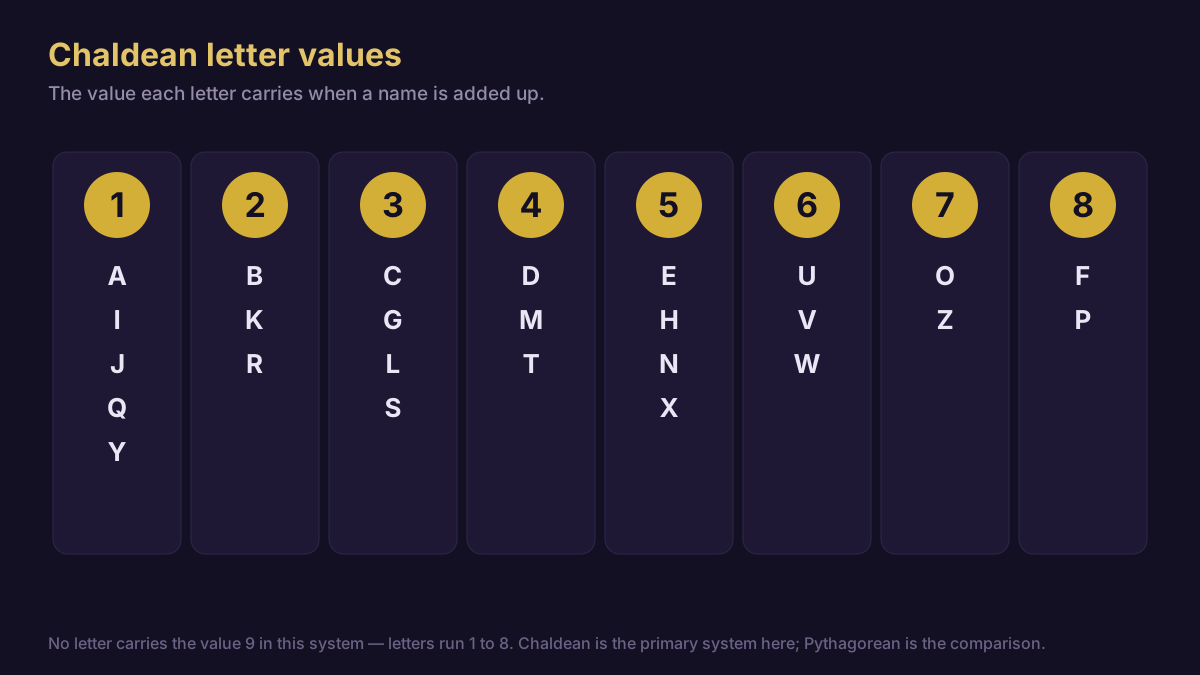
The Chaldean values are these:
| Value | Letters |
|---|---|
| 1 | A, I, J, Q, Y |
| 2 | B, K, R |
| 3 | C, G, L, S |
| 4 | D, M, T |
| 5 | E, H, N, X |
| 6 | U, V, W |
| 7 | O, Z |
| 8 | F, P |
No letter carries 9 in Chaldean; nine appears as a total, never as a letter value. The comparison system, Pythagorean, runs A–I as 1–9, J–R as 1–9 and S–Z as 1–8, and gives different totals for the same domain. The case for each is in Chaldean and Pythagorean numerology side by side.
Report the result as compound over reduced: a domain totalling 39 is 39/3, never a bare 3. The compound is the raw sum, read for texture; the reduced digit is the basic drive.
The same domain, totalled both ways
Nine invented brands, one on each reduced digit, totalled by both rules. The left figure counts the name alone; the right counts .com too.
| Domain | Name only | With .com counted | Does the category change? |
|---|---|---|---|
| wrenfield.com | 39/3 | 53/8 | Yes |
| lumenweave.com | 46/1 | 60/6 | No |
| thistlebay.com | 29/2 | 43/7 | No |
| emberlane.com | 32/5 | 46/1 | No |
| silverfern.com | 40/4 | 54/9 | Yes |
| olivebrook.com | 42/6 | 56/2 | Yes |
| arborfive.com | 34/7 | 48/3 | Yes |
| duskmill.com | 26/8 | 40/4 | No |
| amberfold.com | 36/9 | 50/5 | Yes |
Three things fall out of that table.
The digit always moves. Every row changes, because .com adds a fixed 14 and 14 is not a multiple of nine. There is no domain for which the two rules agree on the reduced digit.
The category changes for five of the nine starting digits. This system treats totals of 1, 3, 5 and 6 as broadly favourable for anything a business owns, and cautions on 4 and 8, which it reads as slow and prone to delay rather than unlucky. Under that grouping, rows 1, 5, 6, 7 and 9 cross from one category to another when the extension is counted. Wrenfield is the sharpest case: favourable on one rule, cautioned on the other.
The compound changes even when the category does not. lumenweave reads 46/1 or 60/6, and those are not near-neighbours in the tradition's vocabulary.
Pick a rule, write it down, apply it to every domain you assess. What you must not do is check both and keep the better one.
What each extension adds, and the shift it causes
Because the reduction is a modulo-nine operation, an extension shifts the reduced digit by a fixed amount whatever the name is. Work its total out once and you know its effect for good.
| Extension | Chaldean sum | Shift to the reduced digit |
|---|---|---|
.com | 3 + 7 + 4 = 14 | +5 |
.net | 5 + 5 + 4 = 14 | +5 |
.org | 7 + 2 + 3 = 12 | +3 |
.in | 1 + 5 = 6 | +6 |
.co | 3 + 7 = 10 | +1 |
.io | 1 + 7 = 8 | +8 |
.ai | 1 + 1 = 2 | +2 |
.app | 1 + 8 + 8 = 17 | +8 |
.dev | 4 + 5 + 6 = 15 | +6 |
.shop | 3 + 5 + 7 + 8 = 23 | +5 |
.co.in | 3 + 7 + 1 + 5 = 16 | +7 |
.me | 4 + 5 = 9 | none |
.us | 6 + 3 = 9 | none |
.co.uk | 3 + 7 + 6 + 2 = 18 | none |
Read the shift as counting forward and wrapping at nine. A domain reading 6 takes the .com shift of +5 and lands on 2, because 6 + 5 = 11 and 1 + 1 = 2.
The bottom three rows are the interesting part. .me, .us and .co.uk each total to a multiple of nine, and adding a multiple of nine leaves a reduced digit where it was. A British firm arguing about whether .co.uk belongs in the total is arguing about a digit that cannot move. The compound still shifts — 39 becomes 57 — so the argument is not quite empty, but the headline figure is untouched either way. The same holds for www, which is 6 + 6 + 6 = 18.
Two consequences worth carrying. .com and .net both add 14, so they are numerically interchangeable. And the shifts are different under Pythagorean, where .com totals 13 and shifts by +4. A rule about extensions is only valid inside the letter system it was worked out in.
Hyphens, numerals and the characters a domain can hold
A domain is a narrower object than a business name. The permitted characters are letters, digits and the hyphen, and the original specification in RFC 1035 required a label to begin with a letter — relaxed later by RFC 1123 to allow a leading digit. No ampersands to rule on, no apostrophes. That removes several arguments that dog name numerology and leaves two that matter.
Hyphens carry no value at all
A hyphen has no letter value, so it adds nothing. getwrenfield.com and get-wrenfield.com are the same number: G E T = 3 + 5 + 4 = 12, and 12 + 39 = 51, which reduces 5 + 1 = 6. Both read 51/6.
Note what did the damage there, and it was not the hyphen: bolting a three-letter word onto the front moved the domain off 39/3 entirely. Our analyser still marks a hyphenated domain down slightly, and says why — hyphens are hard to dictate over a phone and routinely lost when somebody types an address from memory. That is a usability judgement, not a numerological one.
Numerals count at face value, including the useless zero
Digits inside a domain are counted as themselves, which produces a quirk worth knowing.
wrenfield1.comtotals 39 + 1 = 40, which reduces 4 + 0 = 4, so 40/4.wrenfield10.comtotals 39 + 1 + 0 = 40 — the same 40/4, because a zero contributes nothing.wrenfield24.comtotals 39 + 2 + 4 = 45, which reduces 4 + 5 = 9, so 45/9.
So wrenfield1 and wrenfield10 are numerically identical, and both have moved the domain onto 4, one of the two totals this system cautions on. A numeral appended to get past an unavailable domain is the commonest way a founder accidentally changes their number, and almost nobody checks it. It also has to be spelled out every time the address is spoken. The tradition has no opinion on that. The telephone does.
A worked example in domain name numerology, end to end
Invented founder, invented brand, every step shown.
The founder. Priya Menon was born on 19 March 1988. Her driver is the day of the month reduced: 1 + 9 = 10, then 1 + 0 = 1. Driver 1. Her conductor is the whole date reduced: 1 + 9 + 0 + 3 + 1 + 9 + 8 + 8 = 39, then 3 + 9 = 12, then 1 + 2 = 3. Conductor 3. Both are set out in what the business numerology numbers mean.
The domain. She is launching a tea company called Wrenfield and has wrenfield.com in a cart.
W R E N F I E L D = 6 + 2 + 5 + 5 + 8 + 1 + 5 + 3 + 4 = 39
39 reduces: 3 + 9 = 12, and 1 + 2 = 3. The domain is 39/3.
The reading against her own numbers. The method grades a domain against its owner, not in the abstract. Driver 1 is friendly to 3, so the domain agrees with her driver. It also lands exactly on her conductor of 3, though the domain checker gives no extra credit for that. And 3 is among the totals the tradition calls broadly favourable for an owned asset. Our checker scores that 98 and bands it Excellent — high because the total passed her gate, sits on a recommended total and is friendly to her driver, not because 3 is a magic figure.
The same domain under the other rule. Count the extension. C O M = 3 + 7 + 4 = 14, and 39 + 14 = 53, which reduces 5 + 3 = 8. The domain becomes 53/8.
For this founder that is close to the worst available outcome. A driver 1 reads 8 as adverse, so the owner test fails outright, and 8 is one of the two totals the method already cautions against. The same checker returns 10, banded Poor.
One domain, one founder, 98 or 10 — decided by a convention nobody has settled. That is the honest state of the subject.
A third answer comes from a direction most people never check. Score wrenfield on the Pythagorean table and it is 51/6 — and 6 is the total specifically excluded for a conductor of 3. The choice of alphabet moves the verdict at least as far as the choice about .com. Anyone giving you a single confident domain number without naming both has skipped the two decisions that produced it.
Reading a domain total against the owner, not in isolation
There is no universally best domain number. The tradition offers a fit test with three parts instead.
The owner gate. Certain totals are closed for certain owners. The exclusions come from the compatibility table, which is directional — a driver's relation to a number is not the same as that number's relation back — plus a short list of specific bans, such as a conductor of 3 excluding a total of 6. A total that fails the gate is not slightly worse; the method treats it as shut.
The broadly favourable totals. Across owned assets — the phone line, the premises, the domain — this system treats 1, 3, 5 and 6 as safe ground. The cautions differ by asset: a domain on 4 or 8 is marked down, and a premises total on 2, 4 or 8 is capped. A starting position, not a verdict, and the owner gate overrides it both ways.
The character of the digit. Beyond pass and fail the digit describes a texture: 1 founder-led, 3 expressive, 4 structural, 5 trading and fast-moving, 6 service-led, 8 slow and accumulating. The longer treatment is on the business number pages, the compound behind the digit at compound number 39.
The same three tests run on a business name, and they should agree. A domain reading 3 attached to a trading name reading 8 is a chart arguing with itself, which is what business name correction exists to address; the business name analyser shows the working on the name side.
Frequently asked questions
Does .com count in domain numerology?
Not in the rule this site applies. A registry sells the extension to anyone on identical terms, so it is a common factor across hundreds of millions of names rather than a signature of yours. Practitioners disagree, and it has consequences: counting .com adds 14 and moves the reduced digit of every domain by five places. Whichever rule you adopt, adopt it permanently.
What is the luckiest number for a domain name?
There is no such number, and the framing is wrong. The tradition reads a domain against its owner's driver and conductor, so a total that suits one founder is closed to another. As a starting position this system treats 1, 3, 5 and 6 as favourable for an owned asset and cautions on 4 and 8, but the owner test overrides that both ways.
Do hyphens change a domain's numerology?
No. A hyphen has no letter value, so get-wrenfield and getwrenfield both total 51/6. What changes the number is the extra word you added, not the punctuation between them. The practical objection to hyphens — they are lost when people type an address from memory — has nothing to do with the arithmetic.
How do numbers in a domain name get counted?
At face value. A 7 contributes 7 and a 2 contributes 2, which means appending a numeral to escape an unavailable domain quietly changes your total. A zero is the exception, contributing nothing at all, so wrenfield1 and wrenfield10 compute to the same 40/4. Check the total before you settle for the version with a digit on the end.
Should my domain match my business name numerologically?
Where possible, yes, and for a plainer reason than numerology offers: a domain that differs from the trading name splits how people find you. When the exact name is unavailable and a word must be added, work out the new total rather than assuming it inherited the old one. A prefix of three letters is enough to move the reading to a different digit entirely.
Where domain name numerology runs out
This method cannot tell you whether a domain will do well. Nothing in it measures traffic, memorability or trademark risk. It is guidance for reflection and planning, useful for choosing between options that are otherwise equal. It is not a forecast.
It cannot settle its own central question either, which is where this article started. No authority resolves the extension rule, only convention. The same goes for the letter system: Chaldean and Pythagorean disagree on the same string, as Wrenfield's 39/3 and 51/6 show, and nothing inside the tradition decides between them. This site's choices on both are written down in the methodology, so you can see which fork was taken and reproduce every figure yourself.
It handles some real domains badly. An internationalised domain is stored as an encoded ASCII string bearing no resemblance to what the user sees, and a name written in two scripts has at least two totals, with nothing to say which one the world responds to. Subdomains have no agreed treatment at all.
And it says nothing about what actually determines whether a domain works: whether a person can spell it after hearing it once, whether it survives being read out over a bad phone line, whether it is clear of somebody else's trademark, and whether it still fits the business in ten years. All of those are checkable before you pay. Check them first, and use the number as the tie-breaker it is good at being.