
Your driver and conductor number are two figures taken from your date of birth. The driver is the day of the month reduced to one digit. The conductor is the whole date — day, month and year — reduced the same way. The driver describes how you work. The conductor describes what the work keeps asking of you.
Both are arithmetic. There is nothing to look up and nothing to believe in order to calculate them. What follows is the method, the read this system attaches to each digit, and what the pair cannot tell you.
What the driver and conductor number actually are
These two figures go by other names elsewhere. The driver is also the birth number, the psychic number or the day number; the conductor is also the destiny number, the life path or the fate number. The vocabulary shifts between traditions; the arithmetic does not.
The driver is the near view — what you reach for first, before thinking. Under time pressure, in an argument, on the first day of something new, it is the reflex, and other people usually see it before you do.
The conductor is the far view: the shape a working life keeps taking regardless of preference, the kind of problem that keeps arriving, the terms on which effort converts into result. Many readings in the tradition treat it as the heavier of the two, because you cannot change it by changing your habits.
For founders, the driver is your operating style and the conductor is your business model. When they disagree, you are doing two jobs at once, and the friction is the interesting part.
How to calculate your driver and conductor number by hand
We will use 14 November 1979 throughout.
The driver
Reduce the day of the month, and nothing else. Month and year are ignored.
Day = 14
1 + 4 = 5
Driver = 14/5
Report it compound first, reduced digit second: 14/5. Someone born on the 5th also has a driver of 5, but their compound is simply 5. The tradition treats these as related rather than identical: a 14/5 reaches five by way of 1 and 4; a plain 5 has no such history.
Days 1 to 9 are their own driver. The rest reduce like this:
| Day | Driver | Day | Driver | Day | Driver |
|---|---|---|---|---|---|
| 10 | 10/1 | 18 | 18/9 | 26 | 26/8 |
| 11 | 11/2 | 19 | 19/1 | 27 | 27/9 |
| 12 | 12/3 | 20 | 20/2 | 28 | 28/1 |
| 13 | 13/4 | 21 | 21/3 | 29 | 29/2 |
| 14 | 14/5 | 22 | 22/4 | 30 | 30/3 |
| 15 | 15/6 | 23 | 23/5 | 31 | 31/4 |
| 16 | 16/7 | 24 | 24/6 | ||
| 17 | 17/8 | 25 | 25/7 |
Days 11, 22 and 29 pass through what are usually called master compounds: 29 reduces 2 + 9 = 11, then 1 + 1 = 2. This site reduces to a single digit, so the 29th is written 29/2, with the 11 noted in passing.
The conductor
Add every digit in the full date, then reduce.
14 / 11 / 1979
1 + 4 + 1 + 1 + 1 + 9 + 7 + 9 = 33
3 + 3 = 6
Conductor = 33/6
So a founder born on 14 November 1979 has a driver of 14/5 and a conductor of 33/6.
A wrinkle worth knowing about
Some practitioners reduce each part of the date first, then add the results:
Day   14   → 5
Month 11   → 2
Year  1979 → 1 + 9 + 7 + 9 = 26 → 8
5 + 2 + 8 = 15 → 6
Conductor = 15/6
Same reduced digit, different compound: 33 by one path, 15 by the other. Neither is an error. Reducing digits is the same as taking a remainder after division by nine, and that remainder does not care what order you add in. The single digit is stable; the compound is not. Trust the reduced digit, and say which path produced any compound you quote. Date format makes no difference either — 11/14/1979 and 14/11/1979 hold the same digits.
The nine driver numbers read for business
The tradition assigns each digit a planet, and the working character follows from it.
| Driver | Planet | How it works | Natural fit | What it costs |
|---|---|---|---|---|
| 1 | Sun | Starts things; wants to be the origin point | Founder-led firms, sole practices | Poor at deferring; will not share credit |
| 2 | Moon | Responsive, reads the room, moves in cycles | Retention, service, partnership roles | Avoids confrontation; underprices for peace |
| 3 | Jupiter | Expands scope, teaches, persuades | Publishing, training, advisory, media | Overcommits; starts more than it finishes |
| 4 | Rahu | Systems, contrarian angles, the unseen | Technology, infrastructure, logistics | Erratic with cash; disrupts out of habit |
| 5 | Mercury | Fast, verbal, transactional | Retail, trading, brokerage, agencies | Bores quickly; abandons before compounding |
| 6 | Venus | Negotiates, makes things pleasant | Hospitality, interiors, fashion, brokerage | Confuses being liked with being paid |
| 7 | Ketu | Researches, specialises, withdraws | Consulting, labs, niche craft, analysis | Reluctant to sell; disappears into the work |
| 8 | Saturn | Accumulates slowly, builds structure | Property, land, manufacturing | Late rather than unlucky; punishes shortcuts |
| 9 | Mars | Drives hard, executes under pressure | Operations, competitive sectors, turnarounds | Burns people out, including itself |
Two are worth expanding. Driver 1 is associated with sole authorship: a 1 usually knows what the business should be before there is a business, which is useful in the first eighteen months and difficult afterwards, when the constraint stops being vision and starts being delegation. The failure mode is not arrogance but bottleneck.
Driver 8 is the one most often misread. This system does not treat 8 as unlucky. It treats 8 as slow — heavy, accumulating, attached to land and property and anything that appreciates over decades rather than quarters. An 8 in a business that needs a result this quarter is badly matched; the same 8 running a twenty-year asset is well matched. Our longer piece on whether 8 is a good number for business works the distinction through.
The same nine as conductor numbers
The conductor is the same digit doing a different job. Where the driver describes reflex, the conductor describes terms: the conditions a working life keeps returning to, whatever the person would prefer.
| Conductor | The terms it sets | What converts effort into result | The recurring friction |
|---|---|---|---|
| 1 | You end up responsible whether you wanted it or not | Taking a position and owning it publicly | Authority handed over without support |
| 2 | Results arrive through other people | Alliances, patience, being trusted | Waiting on decisions you do not control |
| 3 | Work spreads outward; audience accumulates | Communicating, publishing, teaching | Too many open fronts, none finished |
| 4 | Progress is structural and unglamorous | Building the system rather than the sale | Long stretches with nothing visible to show |
| 5 | Circumstances change faster than plans | Adaptability, turnover, many small bets | Nothing settles long enough to compound |
| 6 | You are pulled into responsibility for others | Service, quality, relationships that last | Obligation arriving as a cost you absorb |
| 7 | Depth is rewarded, breadth is not | Specialism, research, being rare | Isolation; markets that are too small |
| 8 | Everything takes longer than forecast | Endurance, structure, assets over income | Delay read as failure when it is only delay |
| 9 | Cycles end and must be rebuilt | Finishing properly; closing what is done | Endings arriving before you feel ready |
A conductor is not a verdict on ability. Two founders with a conductor of 8 may end up in very different places; what the tradition says they share is the shape of the road, not the destination.
When the driver and conductor number disagree
This is the most useful part of the pair, and the part most readings skip. A clash is not a defect. Reflex and terms point different ways, so the founder is doing two jobs at once.
| Driver / Conductor | The tension | What it tends to look like |
|---|---|---|
| 5 driver, 8 conductor | Fast operator, slow terms | Frustrated by how long things take; strong instinct, poor forecasting |
| 8 driver, 5 conductor | Slow operator, changing terms | Builds carefully, then the market moves; over-invests in permanence |
| 1 driver, 2 conductor | Wants sole authority, gets results through others | Cannot delegate, but every win came from a partner |
| 7 driver, 3 conductor | Wants depth, is pushed to be public | Excellent specialist who resents having to market |
| 3 driver, 4 conductor | Wants scope, rewarded for structure | Many launches, few systems; revenue that does not stick |
The standard reading is that the driver wins the first decade and the conductor wins the rest. A founder who leads with the driver and ignores the conductor meets the same problem repeatedly in different costumes.
Where the two agree — a 5 driver with a 5 conductor — the tradition warns of the opposite failure. Nothing corrects the tendency, and a double 5 has no brake on its own quickness. Agreement is not balance.
A worked example, end to end
The founder born 14 November 1979 is registering a consultancy called Kestrel Ledger.
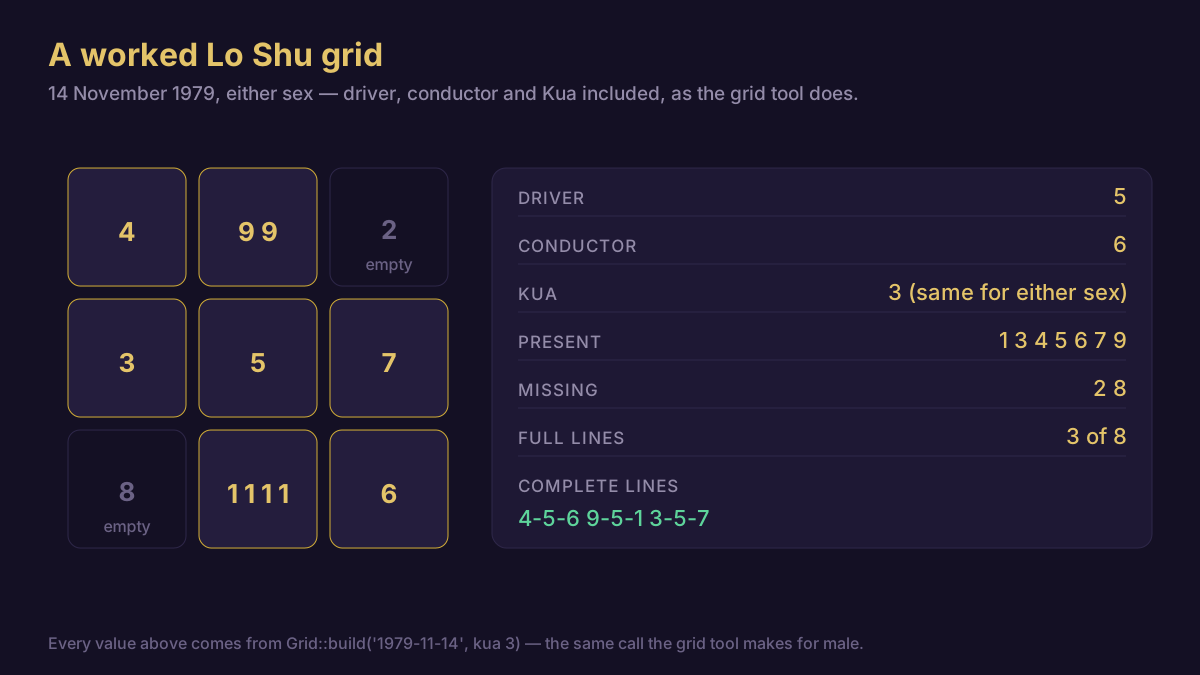
Driver. Day is 14. 1 + 4 = 5. Driver 14/5 — trade, speed, communication.
Conductor. 1 + 4 + 1 + 1 + 1 + 9 + 7 + 9 = 33, and 3 + 3 = 6. Conductor 33/6 — terms built around service and responsibility for others.
So: a quick operator whose life keeps handing them long-term obligations to people. The tradition reads this as someone suited to selling, pulled towards retained client work, and tempted to churn accounts worth keeping.
The trading name. Chaldean values are A, I, J, Q, Y = 1 · B, K, R = 2 · C, G, L, S = 3 · D, M, T = 4 · E, H, N, X = 5 · U, V, W = 6 · O, Z = 7 · F, P = 8. No letter is assigned 9.
K E S T R E L
2+5+3+4+2+5+3 = 24

L E D G E R
3+5+4+3+5+2 = 22

24 + 22 = 46
4 + 6 = 10 → 1
Kestrel Ledger = 46/1
Entity suffixes — Ltd, LLP, Inc — are left out. They are conferred by a registrar rather than chosen, and every company in the jurisdiction carries one.
Reading the three together. A name total of 1 sits comfortably with both figures: 5 and 6 each count 1 as a friend, and the founder-to-name check returns Excellent (100) — initiative paired with communication, on terms that reward accommodation. The friction to watch is temperament rather than arithmetic: a single-authority name for a founder whose conductor asks for service. Run the figures through the business name analyser, or test a shortlist against a founder's numbers with the founder compatibility tool.
This is a reading, not a forecast. It suggests where friction may show up, and says nothing about whether the consultancy will find clients.
Where the driver and conductor number sits in a full chart
The pair is two figures of the five or six a full business reading uses. The others are:
- The Kua number, from year of birth and sex, which this site's grid tool writes into the Lo Shu grid alongside the driver and conductor.
- The Lo Shu grid, the 3×3 square a birth date populates. It shows which digits repeat and which are absent, which the pair cannot; the Lo Shu grid tool draws one from a date.
- The name total, from the Chaldean values above.
- The registration date, the business's own birth date, with its own driver and conductor.
- The premises number, where there is a fixed address.
The core calculators produce all of these from one date, and what business numerology is sets out the wider frame. If you are still choosing between Chaldean and Pythagorean values, the comparison of the two systems covers the difference.
What the pair does not cover is timing: both are fixed for life. The moving figure is the personal year, which changes annually and is what most planning questions turn on — see the personal year number for business.
Frequently asked questions
What is the difference between driver and conductor number?
The driver comes from the day of the month only. The conductor comes from the entire date. Both are reduced to one digit. The driver is read as visible working style, the reflex other people notice; the conductor as the underlying terms of a working life. Where they differ, the tradition treats the driver as dominant early and the conductor as dominant later.
How do I calculate my driver number?
Add the digits of the day you were born until one digit remains. Born on the 7th, your driver is 7. Born on the 23rd, 2 + 3 = 5, so 23/5. Born on the 30th, 3 + 0 = 3, so 30/3. The month and year are not used. Keep the two-digit compound alongside the reduced digit.
Is the conductor number the same as the life path number?
In practice, yes. Life path, destiny number, fate number and conductor all describe one calculation: every digit in the full date of birth, added and reduced to a single digit. The naming differs by tradition, not by method. The only real variation is whether practitioners reduce each part of the date before adding, which changes the compound but never the final digit.
Can your driver and conductor number be the same?
Yes, and it is common. Someone born on 3 June 1990 has a driver of 3, and 3 + 6 + 1 + 9 + 9 + 0 = 28, then 2 + 8 = 10, then 1 + 0 = 1 — a conductor of 28/1, so no match there. Plenty of dates do match. The tradition reads a match as intensity rather than balance: nothing moderates that number's tendencies.
Which is more important, driver or conductor?
Most of this tradition treats the conductor as the heavier figure, on the grounds that habits can be trained and circumstances cannot. The driver suits short-range questions, such as how someone behaves in a negotiation next week; the conductor suits long-range ones. Readings differ on which is heavier; this site's founder-to-name score gives the driver slightly more weight (55 per cent against 45), while many practitioners weight the conductor and use the driver to explain why a founder resists what the conductor asks.
Where this runs out
There is no evidence base. No controlled study supports the claim that a birth date predicts working style or commercial outcome. This is a traditional interpretive framework with a long history and no experimental support. Treat every reading above as a prompt for reflection, not a finding.
Practitioners disagree, including on the arithmetic. The two reduction paths above give different compound conductors from one date. Traditions also split over whether 11, 22 and 33 are reduced or held as master numbers, and over births shortly after midnight. This site reduces to a single digit and says so; others do not. When two readings disagree, the usual cause is method, not insight.
The input is less reliable than it looks. Birth records are wrong more often than people assume, particularly where the registered date was set weeks after the event. Time zones move the day for some births. If the date is wrong, every figure above is wrong with it, and nothing internal would reveal the error.
The read is broad by construction. Nine drivers and nine conductors give eighty-one combinations for the whole population. Any description covering that many people is general, and general descriptions feel accurate to almost everyone.
It cannot tell you the things that decide businesses. Capital, market size, timing, competition, regulation, the quality of a co-founder, and whether anyone wants what you are selling — none of these are in a date of birth. The pair cannot tell you whether to raise money, sign a lease, hire someone or close something down. Nothing here is financial, legal or medical advice, and no outcome is promised.
Used well, the pair does one modest thing: it gives you a vocabulary for tendencies you may already half-know about yourself, and a reason to write them down before deciding under pressure. That is worth having, and not worth more than the evidence supports.