
How to calculate birth number in numerology: add the digits of the day you were born and reduce to one digit. The 29th gives 2+9 = 11, then 1+1 = 2. That is your driver. Add every digit of the full date for your conductor. The Kua comes from the birth year and sex, on a different formula again.
Three numbers, three calculations, no tool required. Each is worked below digit by digit from one date.
The three numbers at a glance
People usually want all three at once, because someone else handed them all three at once. They do not come from the same place.
| Number | Also called | Built from | Read as |
|---|---|---|---|
| Driver | Birth number, root number, psychic number | Day of the month only | The visible working temperament: how you begin things |
| Conductor | Destiny number, life path | Every digit of the full date | The long arc of the working life |
| Kua | Gua, Ming Gua, Eight Mansions | Birth year and sex | On this site, the third number in the Lo Shu grid; in its original school, orientation |
The driver and conductor belong to the number tradition this site works in. The Kua comes from a Chinese school of directional analysis, grafted on later by practitioners who used both; this site uses it as the third number written into the Lo Shu grid beside the other two. Nothing forces the three to agree. The methodology page sets out which parts come from where.
How to calculate birth number in numerology (the driver)
Take the day of the month. Ignore the month and the year. Add the digits and reduce to a single digit between 1 and 9.
Born on the 5th? Driver 5. The 26th? 2+6 = 8. The 29th? 2+9 = 11, then 1+1 = 2.
Report it as this system reports every number: compound first, reduced digit second. For a driver the compound is the day itself. The 29th gives 29/2, passing through 11 on the way. The 26th gives 26/8. Days 1 to 9 stay as they are, with nothing to reduce.
| Day | Driver | Day | Driver |
|---|---|---|---|
| 1–9 | itself | 21 | 21/3 |
| 10 | 10/1 | 22 | 22/4 |
| 11 | 11/2 | 23 | 23/5 |
| 12 | 12/3 | 24 | 24/6 |
| 13 | 13/4 | 25 | 25/7 |
| 14 | 14/5 | 26 | 26/8 |
| 15 | 15/6 | 27 | 27/9 |
| 16 | 16/7 | 28 | 28/1 |
| 17 | 17/8 | 29 | 29/2 |
| 18 | 18/9 | 30 | 30/3 |
| 19 | 19/1 | 31 | 31/4 |
| 20 | 20/2 |
Every day from the 10th carries a compound, and this site writes it beside the reduced digit. The 11th and 22nd — and, in some schools, the 29th, which passes through 11 — are the ones read as master numbers; the calculators reduce them to a single digit by default rather than treating 11 and 22 as a separate class.
Which day counts
Use the day on the document the world transacts with — the birth certificate, or the passport if the certificate is gone. This system is applied to the world as it is recorded.
One genuine disagreement: some practitioners change the day at sunrise rather than midnight, so a birth at 4am on the 5th is read as the 4th. Born in the small hours, you have two defensible drivers and no arithmetic settles which is right. Compute both and notice which description you recognise.
How to calculate the conductor number from the full date
Write the date as DD-MM-YYYY with a four-digit year. Add every digit once. Reduce.
Take 29 November 1985 — 29-11-1985:
2 + 9 + 1 + 1 + 1 + 9 + 8 + 5
= 11 + 2 + 23
= 36
3 + 6 = 9
Conductor: 36/9.
Why you must not reduce the parts first
A common shortcut is to reduce each block and then add: day 29 → 2, month 11 → 2, year 1985 → 23 → 5, giving 2+2+5 = 9. The single digit is always the same, because reducing never changes a number's remainder on division by nine. The compound is not. That route gives 9, not 36, and this system reads the compound first. Add all eight digits once, in a single pass.
Why the year must be four digits
Write 1985 as 85 and the sum becomes 2+9+1+1+8+5 = 26 → 8. The conductor moves from 9 to 8, because the dropped "19" was worth 10. Two-digit years are the commonest cause of a wrong conductor. Four digits, every time.
Checking your own arithmetic
An old schoolroom check works here. Divide the compound by 9 and take the remainder; that remainder is the reduced digit, with 0 read as 9. For 36: 36 ÷ 9 = 4 remainder 0, so the digit is 9. It matches. A disagreement means an addition error, not a discovery. Confirm afterwards with the core calculators if you like, but do the arithmetic by hand first — a number you have not derived yourself is a number you cannot argue with.
How to calculate your Kua number
The Kua uses the birth year and sex only. Day and month are irrelevant. There is one formula, and the only branch in it is the sex.
- Add the four digits of the birth year and reduce to a single digit.
- For a man, subtract that digit from 11. For a woman, add 4 to it.
- If the result is 10 or more, reduce it again.
That is the formula the core calculators apply, and a result of 5 stays 5. Schools working in the eight-direction scheme reassign a 5 — a male 5 to 2, a female 5 to 8 — which is a variant the site's calculators do not apply, so a Kua 5 from here can read as 2 or 8 elsewhere.
A shortcut also circulates that uses only the last two digits of the year, subtracting from 10 for men and adding 5 for women in the 1900s, and using 9 and 6 in the 2000s. It agrees with the full formula for most years but not all: for a man born in 2009 or 2018 it gives 0 where the full formula gives 9. Use all four digits.
The formula worked out
| Birth year | Year digits reduced | Male working | Male Kua | Female working | Female Kua |
|---|---|---|---|---|---|
| 1968 | 1+9+6+8 = 24 → 6 | 11 − 6 = 5 | 5 | 6+4 = 10 → 1 | 1 |
| 1985 | 1+9+8+5 = 23 → 5 | 11 − 5 = 6 | 6 | 5+4 = 9 | 9 |
| 1999 | 1+9+9+9 = 28 → 10 → 1 | 11 − 1 = 10 → 1 | 1 | 1+4 = 5 | 5 |
| 2004 | 2+0+0+4 = 6 | 11 − 6 = 5 | 5 | 6+4 = 10 → 1 | 1 |
Three of those results land on 5 — the 1968 and 2004 men and the 1999 woman — and on this site they stay 5. In the eight-direction scheme 5 sits at the centre with no direction of its own to give, which is why that school reassigns it; the reassignment is a variant the calculators here do not use.
The lunar new year variant
Some schools take the Kua year from the Chinese solar year, which begins in the first week of February, so a birth on 20 January 1985 would count as 1984 — a variant the site's calculators do not use, because they take the calendar year as written, as the source material does.
Under that variant the answer moves: 1984 gives 1+9+8+4 = 22 → 4, so a man would get 11 − 4 = 7 instead of 6, and a woman 4+4 = 8 instead of 9. If a Kua for a January or early-February birth brought in from elsewhere disagrees with this site's, that is usually why. Either way the driver and conductor use the civil date as written.
What the Kua number is used for
On this site the Kua is the third number written into the Lo Shu grid, beside the driver and the conductor: where it supplies a digit the date lacks, it fills that cell, and where the digit is already there it adds a repeat. The calculators produce no directions from it.
In its original Chinese school, and outside this site's calculators, the Kua is directional: that school sorts people into an East group (1, 3, 4 and 9) and a West group (2, 6, 7 and 8) and gives each number a best facing direction for working, called sheng chi — south-east for 1, north-east for 2, south for 3, north for 4, west for 6, north-west for 7, south-west for 8, east for 9.
In that school, two co-founders in the same group can usually both face a compatible direction in one room; partners in opposite groups cannot. Treat it as orientation guidance for a space you already have. It is not a reason to break a lease, and no direction has ever closed a sale.
A full worked example, start to finish
An invented founder, born 29 November 1985, female.
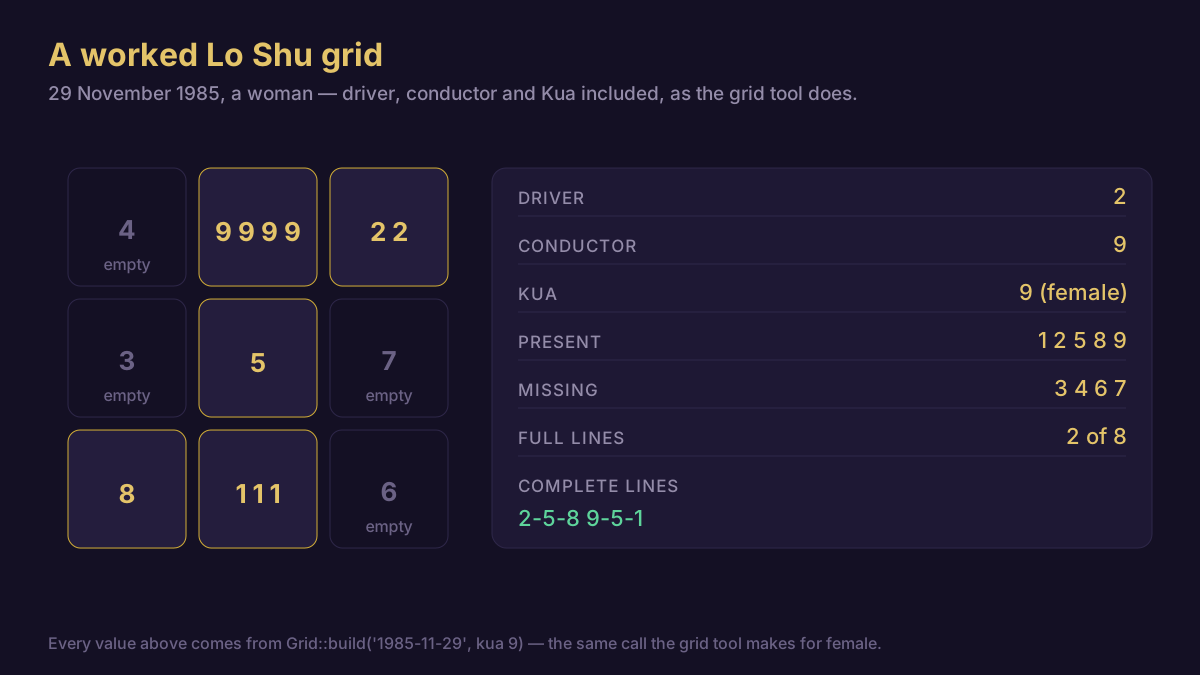
Driver. Day 29. 2+9 = 11, 1+1 = 2. Driver 29/2.
Conductor. 2+9+1+1+1+9+8+5 = 36. 3+6 = 9. Conductor 36/9. Check: 36 ÷ 9 leaves 0, read as 9. Confirmed.
Kua. Born 1985: 1+9+8+5 = 23 → 5. Female: 5+4 = 9. Kua 9. (The directional school would add East group, best facing east; the calculators do not produce that.)
Read together: a driver of 2 is the cooperative, partnership-shaped front end, associated in the tradition with people who work through others rather than over them. A conductor of 9 is a long arc of completion and repeated endings. The source material describes that pair as a diplomat handed large, finite projects. On this site the Kua's job is the grid: a Kua of 9 adds another 9 to that cell, as the figure shows.
Now a contrasting case. A founder born 4 April 2004, male.
Driver. Day 4. Driver 4 outright.
Conductor. 0+4+0+4+2+0+0+4 = 14. 1+4 = 5. Conductor 14/5.
Kua. 2004: 2+0+0+4 = 6. Male: 11 − 6 = 5. The site keeps a 5 as 5; the directional school would move it to 2, a variant the calculators do not use.
Driver 4 ties a temperament the tradition reads as systems, technology and unseen mechanics to a life direction of movement and rapid change. The friction is visible in the arithmetic: the steady builder and the fast mover are the same person. That is what these numbers are for — a prompt for reflection, not a forecast. The number pages, such as what number 4 means in business, give the traditional reading for each digit.
Destiny number by name: a terminology collision
Search "destiny number" and you find two incompatible definitions, both used confidently.
In this system the conductor is the destiny number, taken from the full birth date. In much Western material the destiny number — often called the expression number — comes from the letters of the full birth name. One word, two things, and a reader who does not know that ends up with two numbers and no idea which to trust.
Here is the name-based one in Chaldean values, where no letter carries a 9; 9 is held apart.
| Value | Letters |
|---|---|
| 1 | A, I, J, Q, Y |
| 2 | B, K, R |
| 3 | C, G, L, S |
| 4 | D, M, T |
| 5 | E, H, N, X |
| 6 | U, V, W |
| 7 | O, Z |
| 8 | F, P |
Take an invented name, MEERA KAPADIA:
M E E R A  = 4 + 5 + 5 + 2 + 1 = 17
K A P A D I A = 2 + 1 + 8 + 1 + 4 + 1 + 1 = 18
17 + 18 = 35
3 + 5 = 8
Name total: 35/8.
In Pythagorean values, where letters run 1–9, the same name gives MEERA = 24 and KAPADIA = 25, totalling 49 → 13 → 4. One name, 8 in one system and 4 in the other — these are conventions, not measurements. Pick one and stay inside it; the comparison of Chaldean and Pythagorean explains this site's default. For business work the total that matters is the trading name, and the business name analyser shows the letter-by-letter breakdown.
How to calculate birth number in numerology for a business, not a person
A company has no birthday, but it has a date a registrar stamped on a certificate, and that is treated exactly like a birth date.
An invented company, SILVERTHORN, registered on 6 February 2024:
Driver. Day 6. Driver 6.
Conductor. 0+6+0+2+2+0+2+4 = 16. 1+6 = 7. Conductor 16/7.
Name total. S=3, I=1, L=3, V=6, E=5, R=2, T=4, H=5, O=7, R=2, N=5. Sum: 3+1+3+6+5+2+4+5+7+2+5 = 43. 4+3 = 7. Name total 43/7.
The registration conductor and the trading name both land on 7. The method reads a 7 against a 7 as neutral rather than reinforcing, and 43 is a compound the tradition advises against for a company name — worth noting without being over-read. With nine digits and few slots, agreement is unsurprising.
Two rules specific to businesses. The entity suffix is not counted: Ltd, Pvt Ltd, LLP, Inc and GmbH are conferred by a registrar rather than chosen, so SILVERTHORN LTD is analysed as SILVERTHORN. And there is no Kua for a company, because the formula needs a sex as an input. A directional reading for a company is really the founder's Kua, and should say so.
When the birth date itself is disputed
More common than the neat examples suggest. Documents get transcribed wrongly, dates get adjusted for school admission, and in some records the day is a formality rather than a fact. With two candidate dates, compute both and compare. Where they disagree you have two readings and no way to adjudicate from inside the system, because nothing in the method can reach back and check a registry.
Frequently asked questions
How do I calculate my birth number in numerology?
Add the digits of the day of the month you were born and reduce to one digit. The 7th is 7. The 18th is 1+8 = 9. The 29th is 2+9 = 11, then 1+1 = 2. Ignore the month and the year — those belong to the conductor, not this calculation.
Is the driver number the same as the birth number?
Yes. Driver, birth number, root number and psychic number all name the same thing: the reduced day of the month. Different schools favour different labels, which is why one person can be called "a 5" by three practitioners using three words. The arithmetic never differs.
What if I was born on the 29th — is my number 11 or 2?
Both, in a sense. This site reports it as 29/2: the compound is the day itself, 29, which passes through 11 on its way to 2, and the site reads the 2 while noting the compound beside it. Practitioners who treat 11 as a master number emphasise the 11 instead. The disagreement is about weighting, not arithmetic.
How do I calculate my Kua number if I was born in January?
Use the calendar year you were born in: that is what this site's calculators do, following the source material, so born 20 January 1985 you calculate as 1985. Schools that follow the Chinese solar year, which starts around 4 February, would use 1984 instead — a variant the calculators do not apply, and the commonest reason a January Kua brought in from elsewhere differs by a whole number.
Do I use my legal name or my everyday name for the destiny number?
The date-based conductor needs no name at all. For the name-based total the tradition uses the name in general circulation — what people call you, what appears on your correspondence. For a business it is the trading name, without the suffix. Where the two differ, compute both.
Can a business have a driver and conductor number?
Yes, taken from the registration date: day of month for the driver, all eight digits for the conductor. It has no Kua, because that formula requires a sex as an input. If you are choosing a date rather than reading one you already have, the launch date finder runs the same arithmetic across a range.
Where this runs out
Three things are worth saying plainly.
The first is that these three numbers are not one system. Driver and conductor come from a number tradition; the Kua comes from a directional school with different origins and no shared vocabulary. Combining them is a practitioner habit, and this site's grid tool follows it. When the three appear to conflict, neither tradition has a rule for resolving it, because neither was built to answer the other.
The second is that the arithmetic is exact and the interpretation is not. Adding 2+9+1+1+1+9+8+5 and getting 36 is checkable. What a 36/9 conductor means for a working life is a description handed down in source material, broad enough that most people can find themselves in it. Two very different kinds of claim, sharing one page.
The third is scope. These numbers cannot tell you whether a market exists, whether your pricing is viable, or whether the person opposite you will honour a contract. They describe a temperament and a direction as the tradition frames them — useful for reflection, not a substitute for diligence. Nothing here promises a result of any kind. A reading sold on a promised outcome is a fact about the seller, not the method.
Finally, a limitation nobody advertises: only nine digits exist. Roughly one person in nine shares your driver. The conductor narrows it a little, the Kua a little more, and you are still in a group of millions. Precision here is coarse by construction. Use it as one input among several — the reference tables and the Lo Shu grid tool add detail from the same date — and treat any claim of more resolution than the arithmetic carries with scepticism.