In numerology for jewellery business names, the method names 6 first, then 2, 5 and 1. It is one of the ten sectors out of twenty-six where the map advises against a digit outright: 3 is marked against for jewellery, luxury and fashion. Everything else — 4, 7, 8 and 9 — is neutral, meaning the source makes no statement rather than issuing a warning.
That is the sector half. The founder half, which usually does more to narrow a shortlist, comes after it.
Numerology for jewellery business: the sector row in full
These are the scores the engine returns for luxury, jewellery and fashion, which covers jewellers, goldsmiths, boutiques, designer labels and premium goods.
| Name total | Verdict for jewellery and luxury | Score |
|---|---|---|
| 6 | Excellent | 96 |
| 2 | Strong | 90 |
| 5 | Strong | 84 |
| 1 | Strong | 78 |
| 4 | Neutral | 55 |
| 7 | Neutral | 55 |
| 8 | Neutral | 55 |
| 9 | Neutral | 55 |
| 3 | Advised against | 15 |
You can check this or any other sector in the industry compatibility tool.
Why 6 leads
6 is associated with Venus, and its commercial character in this system is aesthetics, luxury, adornment and comfort. The method reads it as the number of premium margins and relationship-driven custom rather than volume — which is a fair description of how a jeweller actually earns. The product is desirability, the purchase is infrequent and considered, and the margin is made on how the piece looks and feels rather than on turnover.
2 follows, associated with the Moon, bringing the care, discretion and long client relationships that high-value retail runs on. A jeweller's best customers return for decades and expect to be remembered, which is the commercial shape 2 describes. 5 brings trade and negotiation, which suits dealers, wholesalers and anyone whose margin is made on sourcing. 1 suits the founder-led house built around a named designer's authority.
The one the map advises against
3 is the exception, and the entry is blunt: the luxury row simply lists 3 as a digit to avoid, with no condition attached and no explanation recorded. That is worth stating plainly rather than dressing up, because the method does not say why here.
What can be said is that the caution is specific to this sector rather than to the digit. 3 is associated with Jupiter, knowledge and expansion, and the map favours it strongly elsewhere — it leads for education and sits second for travel and hospitality. So a name totalling 3 is not a weak name; it is a name this particular sector row marks down.
So a name totalling 3 is not a weak name. It is a name the map reads as pointed at a different kind of business from the one you are opening. If your jewellery venture is really an education business — a gemmology school, a jewellery-making course — the sector you should be checking is not this one.
The founder half, which usually decides it
A total that suits the sector but clashes with the founder's chart is the common failure. The grading is directional and it is strict.
Take a founder born on 15 June 1987.
- Driver, from the day of the month: the day is 15, so 1 + 5 = 6. Written 15/6.
- Conductor, from the whole date: 1 + 5 + 0 + 6 + 1 + 9 + 8 + 7 = 37, and 3 + 7 = 10, then 1 + 0 = 1. Written 37/1.
Both figures are used, not the driver alone — this is the step most often got wrong, because a table built on the driver by itself gives different answers. For this founder the grading of trading-name totals runs:
| Name total | Verdict for this founder (driver 6, conductor 37/1) |
|---|---|
| 1 | Excellent |
| 2 | Strong |
| 3 | Workable |
| 4 | Weak |
| 5 | Excellent |
| 6 | Excellent |
| 7 | Excellent |
| 8 | Avoid |
| 9 | Weak |
Lay that over the sector row. Totals of 6, 5 and 1 are strong on both counts, and that is where this founder should be looking. A total of 3 is the interesting case: the sector map advises against it, while the founder check returns only Workable — the conductor of 1 is friendly to 3 even though the driver of 6 is not, and the two cancel to a passing grade. So 3 is ruled out here by the sector, not by the founder. The two halves are independent, and they do not always point the same way.
A different founder produces a different answer, and the conductor is why. Take someone born on 8 March 1980 — driver 8, conductor 29/2. Their grading returns Excellent for 3, 5, 6 and 7, Workable for 1 and 2, and Avoid for 4, 8 and 9. Overlaid on the sector row that leaves 6 and 5 as the strong overlap, with 1 and 2 usable — and 3 still out, for the sector reason rather than the founder one. Run both halves together in the business numerology score.
Numerology for jewellery business names, worked end to end
Four invented candidates, computed end to end against the driver-6 founder above. Entity suffixes such as Pvt Ltd are conferred by a registrar and are not counted.
A word on why these particular names. A total has two parts, and both are graded: the reduced digit against the founder, and the compound against the tradition's own table of compounds. A name can reduce to a digit the founder check likes while sitting on a compound the sources call ruinous, and the business name analyser will show you both. All three recommended names below clear on the compound as well as the digit.
Candidate one — JUNIPER JEWELS.
J U N I P E R = 1 + 6 + 5 + 1 + 8 + 5 + 2 = 28
J E W E L S = 1 + 5 + 6 + 5 + 3 + 3 = 23
28 + 23 = 51, and 5 + 1 = 6. The total is 51/6. Excellent for the sector, Excellent for this founder, and the compound 51 is one the tradition reads well. All three agree — which is rare, and the reason to take it seriously.
Candidate two — CEDAR HOUSE.
C E D A R = 3 + 5 + 4 + 1 + 2 = 15
H O U S E = 5 + 7 + 6 + 3 + 5 = 26
15 + 26 = 41, and 4 + 1 = 5. The total is 41/5. Strong for the sector, Excellent for this founder, and 41 is among the better compounds.
Candidate three — AMBER JEWELS.
A M B E R = 1 + 4 + 2 + 5 + 2 = 14
J E W E L S = 1 + 5 + 6 + 5 + 3 + 3 = 23
14 + 23 = 37, and 3 + 7 = 10, then 1 + 0 = 1. The total is 37/1. Strong for the sector, Excellent for this founder, and 37 is a favoured compound.
Candidate four — AMBER HOUSE, which fails on every count.
A M B E R = 1 + 4 + 2 + 5 + 2 = 14
H O U S E = 5 + 7 + 6 + 3 + 5 = 26
14 + 26 = 40, and 4 + 0 = 4. The total is 40/4. Neutral for the sector, Weak for this founder, and the compound 40 is one the tradition advises against for a company name. A pretty name that nothing in the method supports.
Candidates one and four are the instructive pair: the same two halves, pointing the same way in opposite directions. Test your own shortlist in the business name analyser, and if you want the engine to propose totals rather than grade yours, name recommendation only offers totals the founder grading rates Workable or better.
Gold, karat marks and the numbers that are not part of this
One clarification, because jewellers ask it often. Hallmarks, karat marks, purity figures and HUID codes are regulatory identifiers. They are assigned, they are not chosen, and the method has nothing to say about them — no more than it has to say about a VAT number. Treating a purity stamp as a chart figure would be inventing a rule the tradition does not contain.
The same applies to price points. There is a persistent idea that a piece should be priced to a particular digit. This site covers what the method actually supports on that in pricing numerology for business; the short version is that the tradition is far more reticent about price than the internet suggests, and a margin that does not work is not rescued by a total.
The rest of a jeweller's chart
Three other numbered surfaces matter more in this trade than in most.
The shop. Jewellery is a walk-in business and the premises number is graded against the owner's birth number, not the business name, with two blanket rules applied on top: totals of 2, 4 or 8 cap the score, and floors of 2 or 4 are penalised. For a high-street jeweller this is the second check worth running after the name. See the shop number article and the address analyser.
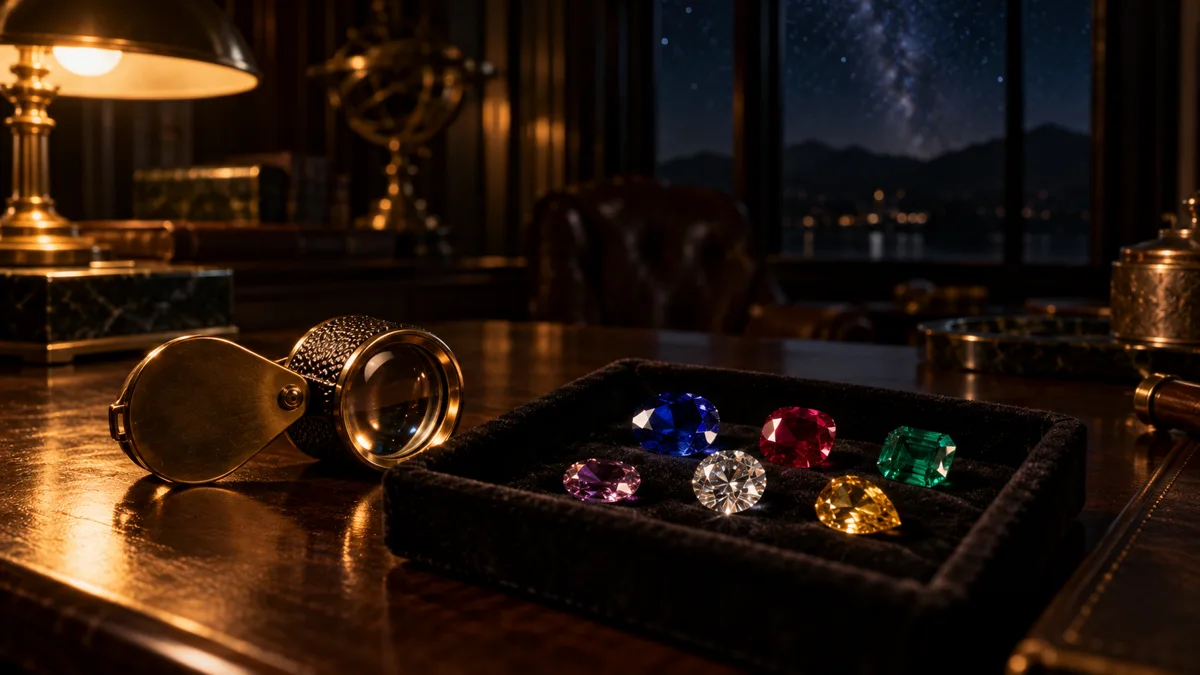
Gemstones, which are a genuine crossover here. Every digit in this system carries an associated stone — ruby for 1, pearl for 2, yellow sapphire for 3, hessonite for 4, emerald for 5, diamond for 6, cat's eye for 7, blue sapphire for 8 and red coral for 9. A jeweller is one of the few business owners for whom that list is also a product range rather than only a remedy. The gemstones by number article sets out the associations; note that the method attaches them to numbers, and makes no claim about what wearing one does.
The opening date. A launch is graded by reducing the date and comparing it with the founder's numbers, with 1, 5 and 6 read as the strongest day-totals and 2, 4 and 8 as the ones to avoid. In this trade the festival calendar will and should outrank the numerology — the shop opening muhurat article covers how the two are usually reconciled.
Where this runs out
The sector row is a summary of what the source material states about luxury and jewellery. It is not market research. It knows nothing about your gold sourcing, your margin, your location or your competition, and those decide whether a jeweller works. Nothing here forecasts a result and nothing here is financial advice.
The caution on 3 is narrower than it first appears — it is aimed at browse-and-buy retail formats, not at the digit — and the same digit is favoured elsewhere in the map. Reading it as "3 is bad" would be the wrong lesson.
And the gemstone associations above are associations, not prescriptions. The tradition links stones to numbers. It does not establish that wearing one produces an outcome, and no reading on this site states or implies a health effect. Use the name analysis to choose between options that already make commercial sense, and treat the rest as a prompt for reflection.
Frequently asked questions
Which numerology number is best for a jewellery business?
The sector map names 6 first for luxury and jewellery, followed by 2, 5 and 1. 6 is associated with Venus, aesthetics and premium margins, which matches how a jeweller earns. The map advises against 3 for this sector, and is silent on 4, 7, 8 and 9. The founder's own driver and conductor then narrow the list further.
Why is 3 advised against for jewellery?
The luxury row lists 3 as a digit to avoid with no condition and no stated reason, so the honest answer is that the method marks it down here without explaining itself. The caution is specific to this sector: 3 is associated with Jupiter, knowledge and expansion, and the map favours it strongly in education and in travel. If your jewellery venture is really a teaching business, you are looking at the wrong sector row.
Does the shop number matter for a jeweller?
Yes, and it is graded differently from the name: against the owner's birth number rather than the business name. Totals of 2, 4 or 8 cap the score and floors of 2 or 4 are penalised, whatever the rest of the reading says. For a walk-in trade this is the check worth running after the name itself.
Should the gemstone I sell match my business number?
The tradition associates a stone with each digit — diamond with 6, emerald with 5, ruby with 1 and so on — and a jeweller is unusual in that this list overlaps with an actual product range. It is an association, not an instruction, and the method makes no claim about what wearing a stone does for anyone.
Do I count Pvt Ltd or Jewellers in the total?
Legal suffixes such as Pvt Ltd or LLP are conferred by a registrar and are not counted. A descriptive word you chose yourself, such as Jewellers, is part of the trading name and is counted — so total the name as customers encounter it on the sign, minus the legal form.