
Numerology for shop opening reads three fixed figures and one you can still choose. The fixed ones are the founder's driver number, the shop's own unit number, and the trading name total. The one you choose is the opening date. The method fits the date to the other three — never the other way round, and never off a list that knows nothing about your shop.
What numerology for shop opening actually decides
A retail unit is a different problem from a company registration: the premises carries a number you cannot change and did not pick, and neither can the founder's driver (day of birth, reduced) or conductor (whole date of birth, reduced) be changed. The trading name total stays open until signage is ordered; the opening date usually stays open to the day.
The working rule: fit the movable figures to the immovable ones, and choose the date last.
A second rule matters more than it sounds. The opening date is read as the shop's birth date, and the tradition takes the birth moment to be the first transaction — not the lease start, not the ribbon. That is the loosest joint in the scheme, and the one that saves you when the calendar will not cooperate.
Reading the shop's own number
Reduce the unit number as you would any number, converting letters with Chaldean values.
A, I, J, Q, Y = 1 · B, K, R = 2 · C, G, L, S = 3 · D, M, T = 4 · E, H, N, X = 5 · U, V, W = 6 · O, Z = 7 · F, P = 8
There is no 9 for letters in Chaldean, so a 9 in a premises reading always comes from digits.
| Address | Working | Result |
|---|---|---|
| Shop 27 | 2 + 7 = 9 | 27/9 |
| Unit 14B | 1 + 4 + 2 = 7 | 7 |
| Shop G-12 | 3 + 1 + 2 = 6 | 6 |
| 3-204 | 3 + 2 + 0 + 4 = 9 | 9 |
Keep the compound. A shop at 27 and one at 18 both reduce to 9, but the tables rate 27 well and 18 poorly — not the same premises. The compound number reference covers what each is held to mean.
Two conventions settle most awkward cases, and practitioners split on both. Count what a customer reads off the door — unit number, block letter, printed floor prefix — and ignore the postcode, the plot number and the landlord's internal reference. This system reads the number the world transacts with, the principle that keeps suffixes like Ltd out of a name calculation. Where a floor is separate, read it separately — in 3-204, some take the whole string, some hold floor 3 against unit 204. This site takes the whole string; the other reading is defensible. Run both on the address analyser and see whether the verdicts differ.
What each shop number is read to mean for trade
| Shop no. | Planet | The trade the tradition attaches to it |
|---|---|---|
| 1 | Sun | Flagship, own-brand, jewellery |
| 2 | Moon | Food, dairy, small repeat custom |
| 3 | Jupiter | Books, stationery, education |
| 4 | Rahu | Repairs, technology, parts |
| 5 | Mercury | The classical shop number: groceries, phones, fashion |
| 6 | Venus | Beauty, interiors, flowers, sit-down food |
| 7 | Ketu | Specialist dealing, workshops, appointments |
| 8 | Saturn | Hardware, furniture, durables, second-hand |
| 9 | Mars | Sport, tools, fast stock turnover |
Three need a note. The 5 is the one people hope for: Mercury governs exchange, so a 5 premises is read as one where stock, money and staff move quickly. Excellent for a newsagent, unhelpful for a gallery — number 5 in business goes deeper.
The 8 deserves the opposite note; calling it unlucky is the commonest error in popular shop-number guidance. The tradition reads 8 as slow and accumulating, with property as its asset class — which is what a shop unit is. An 8 shop builds late and holds value: a cost if you budgeted for a strong first quarter, an asset if you did not. Whether 8 is a good number for business has the argument. The site's premises rule still caps an 8 unit, though: it follows the source that excludes 2, 4 and 8 for any premises number, so the address analyser holds an 8 unit below Strong whatever the founder's numbers. The 7 is the quiet one for retail: the method makes no statement about 7 in retail, which it steers towards 5, 2 and 6, and Ketu is withdrawn and specialist, better suited to appointments than to passing trade.
The opening date and the founder's driver
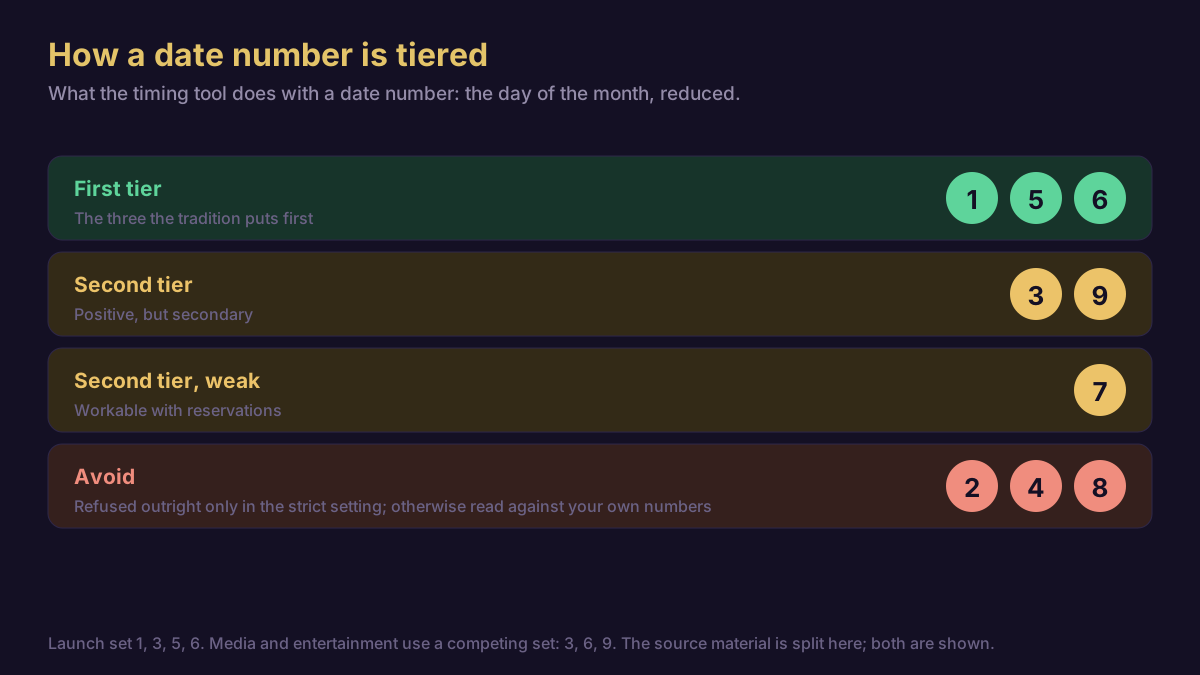
A date carries two numbers. The date number is the day of the month, reduced: for 12 March 2027 it is 1 + 2 = 3, written 12/3. The full-date total is every digit of the date, reduced:
1 + 2 + 0 + 3 + 2 + 0 + 2 + 7 = 17
1 + 7 = 8
A 17/8 total on a 12/3 date. The site's launch date finder works from the date number first; the total counts only in narrower cases, such as a date where both land on 4.
Grade the date number against the founder's figures on the site's standard grid — find the founder's number in the first column and read across to the date number. The grid is directional: the row is the founder, the column is the date, so it cannot be read backwards.
| Founder's number | Friendly | Neutral | Adverse |
|---|---|---|---|
| 1 | 2, 3, 5, 6 | 1, 4, 7, 9 | 8 |
| 2 | 1, 3, 5 | 2, 6, 7 | 4, 8, 9 |
| 3 | 1, 2, 3, 5 | 4, 7, 8, 9 | 6 |
| 4 | 1, 5, 6, 7 | 3 | 2, 4, 8, 9 |
| 5 | 1, 2, 3, 4, 5, 6, 7, 8, 9 | — | — |
| 6 | 1, 5, 6, 7 | 2, 4, 8 | 3, 9 |
| 7 | 1, 5, 6 | 2, 3, 4, 7, 8, 9 | — |
| 8 | 3, 5, 6, 7 | — | 1, 2, 4, 8, 9 |
| 9 | 1, 5 | 3, 7, 9 | 2, 4, 6, 8 |
The launch date finder applies it like this. A date number adverse to the founder's birth number or destiny number is refused outright. A date on the founder's own birth number, or friendly to it, scores highest on the date component — except for 4 and 8, which the grid reads as adverse to themselves. The weekday, the personal year and month, and the name number then add or subtract. The unit number is not an input to that scorer; reading it against the date is a separate cross-check, and where this article does so below it is the article's own check, not the calculator's.
Weekdays and the auspicious day to open shop question
Weekdays carry planetary rulers, and this is the layer most "auspicious day to open shop" advice is built on.
| Day | Planet | No. | Trade it is pointed at |
|---|---|---|---|
| Sunday | Sun | 1 | Flagship, gold, own-brand |
| Monday | Moon | 2 | Food, dairy, consumables |
| Tuesday | Mars | 9 | Tools, sport — avoided by founders to whom 9 is adverse |
| Wednesday | Mercury | 5 | General retail, phones, fast trade |
| Thursday | Jupiter | 3 | Books, education, finance |
| Friday | Venus | 6 | Clothing, beauty, interiors |
| Saturday | Saturn | 8 | Hardware, furniture, second-hand |
Two honest observations. First, 4 and 7 have no weekday at all — Rahu and Ketu are nodes rather than planets, never given days, and a mapping missing two of nine values is loose. Second, the weekday carries less weight than the date number or the personal year — 16 against 28 and 22 in the launch date finder — so use it to break a tie, not to overrule the driver. One commercial fact outweighs the ruler anyway — a Friday or Saturday opening catches a weekend.
Numerology for shop opening, worked end to end
An invented example, every step shown.
The shop. Copper Kettle Home, kitchenware and homeware, taking Unit 14B on a suburban retail park. Lease signed, handover February 2027, fit-out through March.
The founder. Born 23 November 1988:
Driver:    23 → 2 + 3 = 5          (23/5)
Conductor: 2+3+1+1+1+9+8+8 = 33 → 3 + 3 = 6   (33/6)
The unit number. 1 + 4 + B(2) = 7. A 7 premises. Against driver 5 the grid gives friendly; against conductor 6, friendly again, and the address analyser grades Unit 14B Strong, 72, for this founder. The premises agrees with the person in it, which is fortunate, because the lease is signed.
The trading name. In Chaldean:
COPPER  = 3+7+8+8+5+2 = 33
KETTLE  = 2+5+4+4+3+5 = 23
HOME    = 5+7+4+5     = 21
Total   = 33 + 23 + 21 = 77 → 7 + 7 = 14 → 1 + 4 = 5
A 77/5 name, matching the driver exactly, which the name-to-founder verdict grades Excellent. Name, premises and founder all pull the same way here. Where a lease fixes an address adverse to the founder, the ordinary move in this tradition is to lean the movable figures toward the founder instead. Test alternatives on the business name analyser before signage is ordered.
The month. March 2027 sits in an 11/2 universal year, so its universal month number is 2 + 3 = 5. Mercury: trade and turnover, friendly to driver 5 and the 77/5 name.
The date. Rank every date in March 2027 against this founder in the launch date finder, with the name number 5 entered.
Two date numbers are refused outright. The grid reads 3 and 9 as adverse to conductor 6, so the 3rd, 9th, 12th, 18th, 21st, 27th and 30th drop out whatever their totals — including 12 March, a 17/8 total that a reading of compounds alone might have picked. Every date number is friendly to driver 5, so the rest of the ranking turns on the founder's own number, the weekday and the name.
| Date | Weekday | Date no. | Full total | Score |
|---|---|---|---|---|
| Fri 5 March | Venus | 5 | 19/1 | 83 |
| Sun 14 March | Sun | 14/5 | 19/1 | 83 |
| Tue 23 March | Mars | 23/5 | 19/1 | 83 |
| Wed 10 March | Mercury | 10/1 | 15/6 | 72 |
| Wed 24 March | Mercury | 24/6 | 20/2 | 72 |
The three 5-days lead because 5 is the founder's own birth number and also matches the 77/5 name, and each carries a 19/1 total, the compound read as the strongest route to 1. They tie on 83, and the finder breaks the tie by taking the earliest.
As this article's own cross-check, not the calculator's: read the unit number 7 against those date numbers. Row 7 of the grid counts 1, 5 and 6 friendly and every other number neutral, so the leading 5-days also sit friendly to the premises.
The answer: Friday 5 March 2027 — date number 5, the founder's own, on a 19/1 total, scoring 83 (Strong). A Friday opening also catches a weekend.
With the caveat beside it: 2027 is a personal year 18/9 for this founder, which the method reads as a closing year rather than an opening one, and that is part of what holds the score at 83. A quiet first fortnight is not a verdict on the shop, and treating it as one would misuse the method. For dates scored against your own figures, the launch date finder runs the comparison, and choosing a registration date applies it to incorporation.
When the date cannot move
Most of the time it cannot. Landlords hand over on their schedule, mall management dictates opening weekends, franchise agreements fix the day.
Separate the three openings. Lease commencement, the day the shutters first go up and the first recorded sale are three different events, and the tradition takes the first transaction as the birth moment. If handover falls on a poor date, take the keys, fit out, trade nothing, and make the first sale on the date you chose. That is not a loophole — it is the older reading: a shop is born when it first exchanges, not when a document is dated.
Do not falsify the record. Backdating a receipt to land on a better day falsifies a business record, and is self-defeating in the system's own logic, which reads the event and not the paperwork. If the first sale happened on the 9th, the shop's date is the 9th.
If the date is immovable, move down a layer. What remains is the hour: some practitioners place the first sale in a planetary hour friendly to the driver. Honest weighting — much weaker than the date, not decisive, and its strongest argument is that it costs nothing.
Do not break a lease over a unit number. No unit number condemns a shop outright, but the address analyser caps a unit or total on 2, 4 or 8 whatever the founder's numbers; the rest are simply a better or poorer match for a founder or trade. The premises is one figure among four or five, so pull the movable figures toward the founder instead — the trading name, the opening date, which trade goes into which unit. Industry compatibility is the more useful test, because what you sell out of a 7 unit matters more than the 7 does. When a whole month is mediocre, widen the search by a fortnight either side rather than lower the bar.
Muhurat and numerology are not the same system
The two are constantly conflated in shop-opening advice, and they do not agree.
A muhurat is drawn from the panchang: the tithi, the nakshatra the Moon occupies, the yoga and karana, and planetary positions for a specific place and time. It is astronomical, computed for a location, and usually yields a window of an hour or two rather than a day.
Numerology for shop opening is arithmetic on the written date — no location term, no time term, no astronomy. The two ask a similar question with entirely different machinery, so they conflict often, and there is no neutral referee. Where a family, a community or a landlord expects a muhurat, numerology is the junior system in that room. Take the muhurat window first, then choose among the dates it permits.
Frequently asked questions
Which date is best for shop opening?
No date is best in the abstract. The launch date finder scores a candidate against the founder's driver and conductor, the weekday, the personal year and month, and the name number; the shop's unit number is a separate check. For the worked example above the top date was Friday 5 March 2027, a 5-day on a 19/1 total; for a driver 9 the same Friday falls on Venus, number 6, which that founder counts as adverse, so it draws a weekday penalty instead.
What is a lucky number for business opening?
The number most often named for retail is 5, because Mercury governs exchange and a 5 is read as quick turnover. But a lucky number for business opening depends on what you sell: a 5 suits a newsagent and undermines a gallery, a 6 suits a florist, an 8 suits a furniture shop and feels slow anywhere else.
Which day is auspicious to open a shop?
By weekday ruler, Friday (Venus) suits clothing and interiors, Wednesday (Mercury) suits fast general retail, Thursday (Jupiter) suits books and education. Tuesday (Mars, 9) is avoided by founders to whom 9 is adverse — birth numbers 2, 4, 6 and 8. The weekday carries less weight than the date number, though — it breaks ties between equal dates and should not override the date's own number.
Is muhurat for shop opening the same as numerology?
No. A muhurat is calculated from the panchang for a specific time and place using the Moon's position and other astronomical factors. Numerology uses only the digits of the written date, and the two frequently disagree. If a muhurat is being observed, take its window first and use the numbers to choose inside it.
Where numerology for shop opening runs out
Nothing here predicts trade. There is no evidence that an opening date, a unit number or a name total affects footfall or revenue, and no controlled study supports any of it. This is a traditional interpretive framework with a long history and no experimental backing — a structure for reflection and planning. No outcome is promised, and none of it is financial, legal or medical advice.
The premises number is a weaker input than it looks. Unit numbering is assigned by a developer or a council, gets renumbered when a parade is refurbished, and differs between the door, the lease and the postal database. If three sources disagree, the method cannot say which counts. The convention above is a reasonable rule, not a discovered truth.
Practitioners disagree on the arithmetic. Whether to reduce a floor prefix separately, whether to count a block letter, whether to read the day of the month rather than the full date, whether 4 and 7 can be given weekdays at all. Those choices produce different answers from the same shop; where two readings conflict, the cause is nearly always method.
The read is coarse. Nine day numbers means roughly one day in nine shares any given verdict — about forty candidate dates a year. Not a strong enough constraint to justify delaying an opening by a season.
It cannot tell you what decides a shop. Rent per square foot, the footfall on that side of the parade, whether the anchor tenant is leaving, your margin on stock, whether that catchment wants what you sell. A survey of the site on three weekday mornings will tell you more than any number above. What the method does, used honestly, is force those decisions to be made deliberately and written down before the money goes out.