
Business address numerology grades a premises against the owner's birth number — not against the business name. Add each numbered layer: unit, floor, building, street. Sum them, reduce to one digit, and read that total against the founder's birth number. Totals of 2, 4 or 8 are capped whatever else agrees, and floors of 2 or 4 are marked down.
Unit 402, fourth floor, Building 12 gives 6 + 4 + 3 = 13, reported as 13/4 — capped before anything else is considered. What follows is how each layer is counted, which totals your own birth number blocks outright, and what the blanket rules do to a score that would otherwise read well.
What business address numerology actually grades
This is the part people get wrong. A premises reading is not scored against the trading name. It is scored against the numbers of the person who owns the business.
The reason is structural. A name is a thing you chose; the tradition reads it as the business's own identity. A premises is a thing you occupy, and the question asked of it is not "is this a good number" but "is this a good number for the person standing inside it". So the input is the owner's birth number — the day of the month, reduced — with the destiny number as a secondary check.
Run the address analyser and you will see what it asks for: a unit, a floor, a building number, a street number, and the owner's date of birth. There is no field for the company name. The name has its own analyser and its own rules.
One consequence is worth stating plainly. Two businesses in the same unit, owned by two people born on different days, get different premises scores. The door has not changed; the verdict has. A number is always read in relation to something, never in isolation, as the overview of what each business number means sets out.
The four layers, and how the combined total is built
An address is read in layers, each reduced on its own and then added.
| Layer | Counted? |
|---|---|
| Unit / flat / shop number — the number you trade behind | Yes, and weighted hardest |
| Floor, as labelled on the lease | Yes |
| Building or plot number, shared with every tenant | Yes |
| Street number | Yes, where you have one |
| Building name | Scored as a name, not in this total |
| Postcode, survey number, PIN | No — routing data |
Four rules cover almost every real address.
Digits take their face value; letters take their Chaldean value. Unit 9C is 9 + 3 = 12 → 12/3, because C is worth 3. There is no 9 for letters in Chaldean, though a total can reduce to 9. Unit B-14 is 2 + 1 + 4 = 7: the hyphen is typography and contributes nothing.
Reduce each layer, then add the layer compounds. Unit 402 → 4 + 0 + 2 = 6. Floor 4 → 4. Building 12 → 1 + 2 = 3. Combined: 6 + 4 + 3 = 13 → 1 + 3 = 13/4. Report the compound and the digit, never a bare digit — 13 carries a classical reading that a plain 4 does not.
Descriptor words are not counted — so leave them out when you enter the number. "Unit", "Suite", "Shop No." and "Block" are labels a building manager or a postal authority assigned — in the United States, standardised abbreviations set out in the USPS postal addressing standards. None of them was chosen by you, which is why Pvt Ltd and Inc are left out of a company name too. The address analyser values any word typed into a field, so "Unit 402" totals 22/4 where "402" totals 6; the method's remedy for an adverse number uses exactly that, prefixing a word such as UNIT or FLAT on purpose.
Regrouping cannot change the digit. Add 4 + 0 + 2 + 4 + 1 + 2, or add each layer first and then total them: 13 either way. Digit reduction is arithmetic modulo 9, a property of the digital root. Grouping changes only which compound you carry forward.
The gate: which totals your birth number blocks
Before any interpretation applies, the total has to pass a gate. Certain totals are simply closed to certain owners, and a premises that trips the gate cannot read as strong however well the rest of it scores.
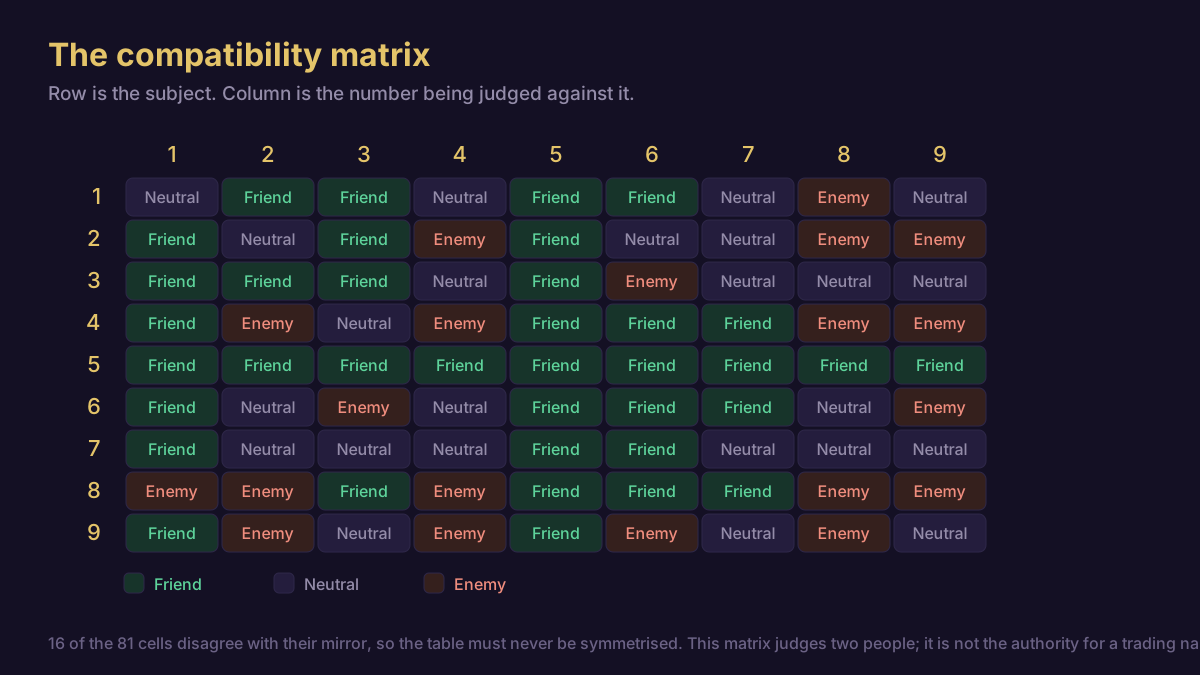
The gate is built from two things: the numbers your birth number counts adverse, and three stated exceptions — an owner on 8 must not take a total of 1, an owner on 6 must not take a total of 3, and an owner on 3 must not take a total of 6.
| Owner's birth number | Totals the gate blocks | Totals neither rule caps |
|---|---|---|
| 1 | 8 | 1, 3, 5, 6, 7, 9 |
| 2 | 4, 8, 9 | 1, 3, 5, 6, 7 |
| 3 | 6 | 1, 3, 5, 7, 9 |
| 4 | 2, 4, 8, 9 | 1, 3, 5, 6, 7 |
| 5 | none | 1, 3, 5, 6, 7, 9 |
| 6 | 3, 9 | 1, 5, 6, 7 |
| 7 | none | 1, 3, 5, 6, 7, 9 |
| 8 | 1, 2, 4, 8, 9 | 3, 5, 6, 7 |
| 9 | 2, 4, 6, 8 | 1, 3, 5, 7, 9 |
The right-hand column has the blanket rule below already applied, which is why a 5 with nothing blocked still shows only six workable totals. An owner born on the 8th, 17th or 26th has exactly four: 3, 5, 6 and 7.
These sets are not symmetric — birth number 6 counts 3 and 9 adverse, birth number 9 counts 2, 4, 6 and 8 adverse. The methodology note explains why the compatibility table is directional: the subject's own number decides how it regards another, and the reverse reading can differ.
The two blanket rules the layers cannot override
Two rules sit above everything else. They are not weights in a scoring formula; they are ceilings.
A combined total of 2, 4 or 8 caps the score. One strand of the source material states this as applying to anything numbered — office, house, floor, vehicle, bank account — in every condition, everywhere. So a premises totalling 13/4 is capped at 44, inside the Weak band, even for an owner whose birth number counts 4 a friend. The cap applies a second time, less severely, when the unit number itself reduces to 2, 4 or 8, because the unit is the number the business is known by.
Floors of 2 or 4 are penalised. The same strand singles out the second and fourth floors. This one is thinner: a second source holds the floor immaterial once the unit number is right. Both are reported rather than one being quietly chosen, and the deduction is small enough to reflect that.
This is where 4 and 8 acquire their reputation, and both are widely misdescribed. An 8 premises is not unlucky; it is late — slow to break even, then durable, a real problem on a short lease and none at all on a long one, as the full treatment of 8 in business sets out. A 4 belongs to technology and to the parts of a business nobody sees; the question of whether 4 is unlucky has a longer answer than the cap suggests. A cap is a rule the method applies, not a claim that the number is worthless.
Scores land in five bands: 85 and above Excellent, 70 Strong, 55 Moderate, 40 Weak, below that Poor.
A worked example of business address numerology, end to end
An invented case, carried through without shortcuts. Tallow & Reed, a small design studio. The founder was born on 14 May 1986. The premises on offer is Unit 402, fourth floor, Building 12, Harrow Mills.
The founder's numbers first, because they are the grading standard. Birth number = day of month, reduced: 14 → 1 + 4 = 5. Report 14/5. Destiny number = every digit of the date: 1 + 4 + 0 + 5 + 1 + 9 + 8 + 6 = 34 → 3 + 4 = 7. Report 34/7.
Note what is not used: the studio's name. It has a name number, and that matters for the brand, but it plays no part in scoring the door.
The layers. Unit 402 → 4 + 0 + 2 = 6. Floor 4 → 4. Building 12 → 1 + 2 = 3. Combined: 6 + 4 + 3 = 13 → 1 + 3 = 13/4.
The gate. Birth number 5 blocks nothing, and destiny number 7 blocks nothing either. The total passes.
The blanket rules. The combined total reduces to 4, so the cap bites: the score cannot exceed the Weak band. The floor also reduces to 4, so a further deduction applies. The unit reduces to 6, friendly to a 5, so no penalty there.
The result. The address analyser returns 36 out of 100 — Poor, with two flags: the capped total and the fourth floor. A reading that would have been ordinary is pulled down twice by the same digit arriving from two directions.
The alternative. The agent offers a second space in the same building: Unit 15, third floor. Unit 15 → 1 + 5 = 6. Floor 3 → 3. Building 12 → 3. Combined: 6 + 3 + 3 = 12 → 1 + 2 = 12/3. A total of 3 is one the method recommends outright, it is friendly to a birth number of 5, and neither the cap nor the floor penalty applies. The same analyser returns 96 out of 100 — Excellent.
Same building, same founder, same lease terms. One different door and one different storey, and the score moves from 36 to 96. That is the whole contribution of an address reading: a preference between two options otherwise decided on rent per square foot.
One honest complication. Harrow Mills also has a street number — 40. Include it and the combined total becomes 12 + 4 = 16 → 16/7, and the score falls from 96 to 72, Strong rather than Excellent. Whether the street number belongs in the total is a real disagreement, and it changes the answer.
The same address, nine different founders
Here is the point of the article in one table. Unit 15, third floor, Building 12 — the good option above — scored for nine owners differing in nothing but their birth number.
| Birth number | Score | Band | Why |
|---|---|---|---|
| 1 | 96 | Excellent | Total 3 open and friendly |
| 2 | 96 | Excellent | Total 3 open and friendly |
| 3 | 78 | Strong | Total fine, but the unit's 6 is adverse to a 3 |
| 4 | 86 | Excellent | Total 3 open, read as neutral |
| 5 | 96 | Excellent | Nothing blocked, everything friendly |
| 6 | 26 | Poor | The gate blocks 3 twice over for a 6 |
| 7 | 86 | Excellent | Total 3 open, read as neutral |
| 8 | 96 | Excellent | Total 3 open to an 8, and friendly |
| 9 | 68 | Moderate | Total neutral, and the unit's 6 is adverse to a 9 |
Seventy points of spread across the same four walls. An owner born on the 6th, 15th or 24th should not take this unit at all on the method's own terms, while an owner born on the 8th, 17th or 26th — the birth number with the most blocked totals — has one of the best premises available to them.
This is also where the method leaves a real gap. Two co-founders with different birth numbers get two verdicts on one lease, and nothing says whose reading wins. Partnership questions use a different calculation entirely, which averages both directions rather than picking a side.
When the address is already signed
Most readers arrive here after the lease. Four responses, ranked by cost.
Change the number you market with, never the number you are registered at. Your statutory address is fixed by the lease and the registration, and must stay accurate everywhere: in the UK a change of registered office is reportable to Companies House. Signage, packaging and website are a different matter. Leading with the building name rather than the door number costs nothing, and on the method's own logic — a number acts through public repetition — it is a coherent response.
Do not invent a unit number. Addresses are administrative records, not preferences. In Great Britain each carries a unique property reference issued by the local authority and held in the national address gazetteer. An invented "15A" creates a real problem at a real counter.
Work on the layer you can still change. The trading name is chosen, not assigned, and the method ranks it above the premises.
Ask whether the reading describes something real. A total of 8 reads as slow to mature. If your cash-flow plan assumes the opposite, testing that assumption is sensible whether or not the numerology means anything. Anyone also reading premises through vastu alongside numerology will find two systems asking different questions about one room.
Nobody should break a lease over an address number. A lease exit costs a known, large amount; a different door digit is worth an unmeasurable one.
Frequently asked questions
How do I calculate my business address number?
Reduce each numbered layer, then add them. Unit 402 → 4 + 0 + 2 = 6; floor 4 → 4; building 12 → 1 + 2 = 3. Total 6 + 4 + 3 = 13, reported as 13/4. Letters take Chaldean values, so Unit 9C is 9 + 3 = 12 → 12/3. Descriptor words and the postcode are not counted, so enter the number alone.
Is my business address graded against my business name or my birth date?
Your birth date. The premises is scored against the owner's birth number, with the destiny number as a secondary check; the trading name plays no part. That is why the same unit produces different verdicts for two owners, and why changing your company name does not change your address score.
Which address numbers should a business avoid?
Combined totals of 2, 4 and 8 are capped by a blanket rule stated as applying to anything numbered, in every condition. On top of that, each birth number blocks its own set — an owner on 8 is left with only 3, 5, 6 and 7. Second and fourth floors carry a smaller mark against them.
Does the floor number matter as much as the unit number?
No. The unit carries most of the weight: it is the number the business is known by, and the one the blanket rule bites hardest on. The floor is a modifier. Second and fourth floors are penalised, but lightly, because one source treats the floor as immaterial once the unit number is right.
Do I count the street number and the postcode?
The postcode is never counted — it is routing data. The street number is counted where you have one, but practitioners disagree and it changes the answer: adding street number 40 to the example above moved a 12/3 total to 16/7 and the score from 96 to 72.
What if two founders have different birth numbers?
The method has no clean answer. The analyser grades one birth number at a time, so two co-founders get two verdicts on one lease. Score it for each of you, treat a wide gap as information about who will feel at home in the space, and use the partnership calculation for the relationship itself.
Where business address numerology runs out
Start with the ranking. This site's business score weights the founder's numbers 26, the trading name 24, industry fit 16, the launch date 14, partnership 10 and owned assets 10 — and the premises shares that last tenth equally with the phone line and the domain. Reading the address before the heavier layers is doing the easy part of the work.
The blanket rules rest on a narrow base. The 2-4-8 exclusion comes from one strand of the source material stating it very firmly; the floor caution is contradicted within the same source material. This site caps rather than zeroes those cases because the score should not imply a consensus that is not there. A premises that reads as capped here would read as ordinary under a different set of sources, honestly applied.
The conventions also conflict in ways that change the digit, not just the flavour: whether the street number counts, whether a suffix letter counts, whether a building that skips its thirteenth storey is read by the label or the physical count. Two competent practitioners can produce two totals for one address without either being careless.
And the method cannot see what actually decides whether premises work: rent per square foot, the break clause, the service charge, parking, how far staff travel, what the landlord is like in year three. None of it appears in a digit, and all of it outranks one. There is a selection problem too — nine digits spread across every commercial address on earth means every total has thriving and failed businesses behind it in enormous numbers, and any list of successful firms at a particular door number was assembled after the fact.
Use an address reading for what it can honestly do: break a tie between two comparable spaces, describe the working character a premises may have, and prompt you to test an assumption you have not tested. It is material for reflection and planning. It forecasts nothing, promises nothing, and should never displace the survey, the lease review or an afternoon spent counting the footfall outside the door.