
How to calculate numerology chart figures for a business, in short: work out five numbers and read them against each other. The founder's driver number and conductor number from the birth date, the trading name total in Chaldean letters, the registration date total, and the premises number. Each is plain arithmetic. The judgement is in how they combine.
Most pages on this subject give you one number and stop. A figure read alone means little: a name totalling 8 says something different behind a founder whose own chart is heavy with 8 than behind one who is a 5. This guide carries one invented company, Verrow Ceramics, through all five calculations.
The five figures in a business numerology chart
| # | Figure | Source | Read as |
|---|---|---|---|
| 1 | Driver | Day of the month of birth | The founder's working temperament |
| 2 | Conductor | The whole birth date | The pattern the founder's life runs in |
| 3 | Name total | Chaldean value of the trading name | How the business presents and is dealt with |
| 4 | Date total | The registration or opening date | The character of the venture's start |
| 5 | Premises | The unit, building or shop number | The ground the business stands on |
Two conventions first, because they change every answer that follows.
Compound first, reduced second. Every result is written as the raw total over its single digit — 35/8, 19/1, 50/5. The compound carries the detail, the digit the drive. Reporting only the digit throws away half the reading.
Entity suffixes are not counted. Ltd, Pvt Ltd, LLP, Inc and GmbH are conferred by a registrar and shared by millions of companies, so they say nothing about your name, and allowing them in or out gives you two totals for one business. If the framework is new, the background is in what business numerology is.
Our worked case: Priya Raghavan, born 19 March 1984, registering Verrow Ceramics, a small-batch tableware maker selling wholesale to restaurants, at Unit 26, Halden Yard, on 14 April 2026. All invented.
How to calculate numerology chart figures for the founder
The founder's two numbers come first because everything else is read against them. Both come from the birth date alone; no name is involved yet.
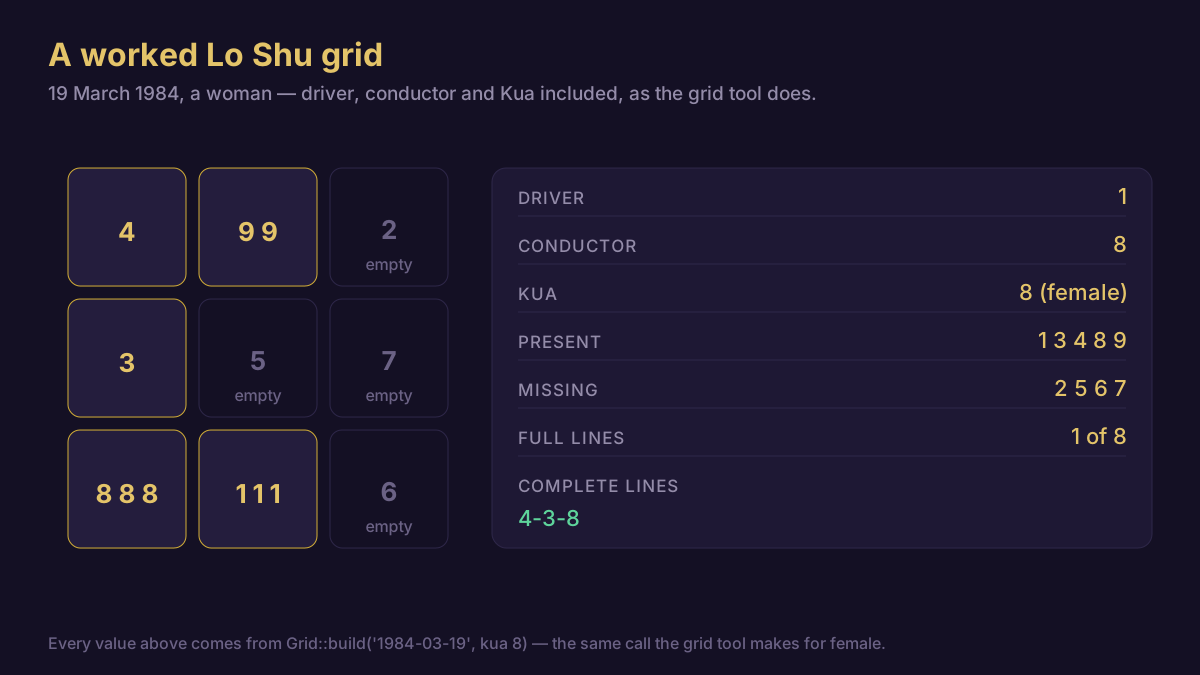
Step 1: the driver number
The driver is the day of the month, reduced to a single digit. Ignore the month and the year.
Priya was born on the 19th, so 1 + 9 = 10, then 1 + 0 = 1.
Her driver is 19/1. Keep the 19 as well as the 1: 19/1, 10/1 and 28/1 all reduce to 1 and all read as initiating and self-directed, but the tradition does not treat them as identical — the compound describes the flavour of that initiative. A single-digit day needs no reduction: born on the 7th, the driver is simply 7.
Step 2: the conductor number
The conductor uses the whole date. Write it out in digits and add every one.
19 March 1984 becomes 1 9 0 3 1 9 8 4.
1 + 9 + 0 + 3 + 1 + 9 + 8 + 4 = 35, then 3 + 5 = 8.
Her conductor is 35/8.
Some reduce each component first instead: day 19 → 1, month 3 → 3, year 1984 → 22 → 4, then 1 + 3 + 4 = 8. Same answer. The two routes always agree, because repeated digit-adding is a remainder operation and regrouping cannot change a remainder.
Which leaves one real trap: the date format. Since you add every digit, 19/03/1984 and 03/19/1984 give the same total. A two-digit year or a dropped zero does not: 19 3 84 sums to 25 → 7, not 8. Use the full four-digit year and keep every zero. The core calculators show the same working on your own date.
What a driver and conductor clash means
Priya's chart already holds a tension, the commonest one in this system. Driver 1 is the person who starts things and prefers to decide alone. Conductor 8 is slow accumulation — weight, endurance, property and land, returns that arrive late. Her instinct is speed; her pattern is patience.
The tradition treats this as friction to expect rather than a fault: someone who starts things faster than the pattern pays them out, and who therefore has to be honest about timelines and funding. The fuller character of an 8 is under the number 8 in business.
How to calculate numerology chart totals for the trading name
Now the business itself, using Chaldean letter values.
| Value | Letters |
|---|---|
| 1 | A, I, J, Q, Y |
| 2 | B, K, R |
| 3 | C, G, L, S |
| 4 | D, M, T |
| 5 | E, H, N, X |
| 6 | U, V, W |
| 7 | O, Z |
| 8 | F, P |
No letter carries 9 in Chaldean; nine appears only as a total. Pythagorean numbers the alphabet 1 to 9 in order and gives different results for the same word — the case for each is in Chaldean and Pythagorean side by side. Never mix them in one chart.
Step 3: totalling the name
Verrow: V=6, E=5, R=2, R=2, O=7, W=6. 6 + 5 + 2 + 2 + 7 + 6 = 28 → 2 + 8 = 10 → 1. Verrow alone is 28/1.
Ceramics: C=3, E=5, R=2, A=1, M=4, I=1, C=3, S=3. 3 + 5 + 2 + 1 + 4 + 1 + 3 + 3 = 22 → 4. Ceramics alone is 22/4.
Verrow Ceramics: 28 + 22 = 50 → 5 + 0 = 5. The name total is 50/5.
Spaces and hyphens are ignored. An ampersand is not a letter and carries nothing; if it is spoken as "and", most practitioners write it out and count A-N-D — one of the places the method quietly forks. Say which convention you used.
Why the descriptor changes everything
Priya had three names shortlisted. Watch what the second word does.
| Candidate | Arithmetic | Result |
|---|---|---|
| Verrow Ceramics | 28 + 22 = 50 | 50/5 |
| Verrow Clay | 28 + 8 = 36 | 36/9 |
| Verrow Studio | 28 + 25 = 53 | 53/8 |
Same coined word, three readings. Clay is C=3, L=3, A=1, Y=1, only 8 in total, because every letter sits low in the table. Studio is S=3, T=4, U=6, D=4, I=1, O=7, which is 25, because U and O are heavy. A name total is not a property of a business but of the exact string you trade under. The business name analyser runs variants side by side, the only sane way to compare a shortlist.
Step 4: the registration date
The date total works exactly like the conductor: every digit of the full date, added and reduced.
14 April 2026 → 1 4 0 4 2 0 2 6.
1 + 4 + 0 + 4 + 2 + 0 + 2 + 6 = 19 → 1 + 9 = 10 → 1.
The date total is 19/1 — the same compound as her driver. More on that shortly.
Two smaller figures sit inside it. The day number is 14 → 5, which the launch date finder weights above the full date, because the day is what people quote. The universal year is 2026 → 2+0+2+6 = 10 → 1, so every date in 2026 sits inside a universal 1 year, read as a year for beginnings rather than consolidation.
Two other dates Priya considered:
| Date | Digit sum | Result |
|---|---|---|
| 14 April 2026 | 1+4+0+4+2+0+2+6 = 19 | 19/1 |
| 8 May 2026 | 0+8+0+5+2+0+2+6 = 23 | 23/5 |
| 23 June 2026 | 2+3+0+6+2+0+2+6 = 21 | 21/3 |
Three defensible dates, three different starts. Note what is not claimed: no date is simply good. The launch date finder applies a few universal rules — 1, 5 and 6 as first-tier date numbers, and a block when the date number and full-date total are both 4 — but weighs most of each date against the founder's own numbers.
Step 5: the premises and the numbers you transact under
Reduce the unit or building number only; the street name and postcode are not counted.
Unit 26: 2 + 6 = 8. The premises figure is 8 — the address analyser adds the digits one by one, so it shows a bare 8.
Letters and punctuation in unit numbers are the usual sticking point. A letter takes its Chaldean value like any other, so Unit 12B is 1 + 2 + 2 = 5. A slash is ignored, so Flat 4/2 is 4 + 2 = 6. A street-facing number is reduced as it stands: 108 High Street is 1 + 0 + 8 = 9.
The reasoning for ignoring the street name: the unit number identifies the space this business occupies, while the street is shared with everyone on it. Some practitioners total the street name too and get a different answer. The address analyser takes the unit, floor, building and street numbers, shows each one's reduction and grades the combined total against the owner's birth number; it does not total a street name.
The telephone number and the domain are sometimes added as a sixth and seventh figure, since these too are strings the world transacts through. Both are optional.
Reading the five figures against each other
| Figure | Input | Result |
|---|---|---|
| Driver | Born on the 19th | 19/1 |
| Conductor | 19 March 1984 | 35/8 |
| Trading name | Verrow Ceramics | 50/5 |
| Registration date | 14 April 2026 | 19/1 |
| Premises | Unit 26 | 8 |
Read it as a shape, not five separate verdicts.
The chart has an axis. Two figures land on 1 and two on 8 — the tension the founder already carries, repeated at the level of the business. The premises reinforce the heavy side, the registration date the quick side. Nothing resolves it, so the tradition would read this as a business that feels the friction of its founder rather than balancing it.
The name is the odd one out, and that is useful. 50/5 is a trading number: movement, turnover, goods changing hands. On the standard friendship tables 5 is treated as broadly compatible with almost everything, so a 5 name over a 1/8 founder reads as a mediating choice, keeping the business commercial while the underlying pattern accumulates slowly. For a wholesaler on repeat restaurant orders, that is a coherent fit.
The repeated compound is worth noting and worth doubting. The registration date came out at 19/1, the same compound as the driver, which the tradition reads as reinforcement. It should be said plainly that this example was constructed to produce it. In real charts an exact match is uncommon, and when it appears it is not evidence of anything beyond arithmetic.
The premises are the weak figure. The address analyser scores Unit 26 at 8, Poor, for this founder: a premises total of 8 is capped, and 8 is adverse to her birth number of 1. Read as a compound, 26 is also one the classical material treats as a warning: loss through partnership, poor counsel, plans that fail late rather than early. Its note is at compound number 26. Whether you take that seriously is a separate question, but a chart reporting only the flattering figures is not a chart.
Which figure outranks the others is disputed. One camp puts the founder first, since the person decides everything and a name is only a label; another puts the name first, since it is what the market repeats daily; a third argues for the date, since start conditions cannot be revised. Almost everyone puts the premises last. The position taken here is that the driver and conductor anchor the chart, because they alone cannot be changed. That is a convention, not a proof.
What to do when one figure comes out badly
The premises reading is the awkward one here: the lease is signed and Unit 26 is Unit 26. This is where the method turns elastic, and you should be sceptical of anyone who pretends otherwise. The traditional suggestions are to use the figure you actually trade under (if invoices and signage say "Halden Yard" with no unit number, some read the site instead); to weight it down, since a premises number is the least chosen of the five; and to change what you can rather than what you cannot.
Notice how much freedom those three suggestions hand you. If a figure can be re-read, re-weighted or set aside whenever it is unwelcome, a chart can be made to say almost anything. The discipline that keeps this useful is fixing your conventions before you calculate and living with the result.
None of this predicts anything. A chart is a structured way of thinking about a business: its temperament, its timing, its fit with the person running it. It is guidance for reflection and planning, and promises no outcome.
Calculating the chart for a business that already trades
The five steps are identical. Use the name the market repeats rather than a dormant legal one, and the first-trading date — usually recoverable from the first invoice or bank credit — rather than an incorporation date sitting months earlier, bearing in mind that the site's calculators ask for the incorporation date.
Take two readings if there are two founders. A second founder born on 6 December 1979 gives 0+6+1+2+1+9+7+9 = 35 → 8 for the conductor and 6 for the driver. A shared conductor with different drivers reads as two people running the same pattern in different ways, and the friendship tables count 1 and 6 as mutual friends, so the pair reads Excellent. Two founders also means a seven-figure chart, and more figures means more room to find the answer you wanted.
Frequently asked questions
How do I calculate my business numerology number?
Total the trading name in Chaldean values, ignoring the entity suffix, and report the compound over its reduced digit. Verrow Ceramics totals 50, which reduces to 5, so it is written 50/5. That single figure is not a chart. To read it you need the founder's driver and conductor, the start date and the premises alongside it.
Do I use the registered name or the trading name?
The trading name — the string on invoices, signage, packaging and search results. This tradition reads what the world repeats, and nobody repeats a dormant legal name. If the two match, the question does not arise. If they differ, calculate both and note which you treat as primary.
Does the incorporation date or the first trading day count?
There is no settled answer. This site's calculators take the incorporation date as the company's date of birth; others use the date of the first transaction, as the moment the business engaged with the world. If the two fall in different months they usually give different numbers, so record which you chose rather than switching to whichever reads better.
What if my business name adds up to a number I do not like?
First check whether it is genuinely poor or simply poorly matched to your own numbers, which are different questions. A total also shifts easily: changing one word moved Verrow from 36/9 to 53/8 above. But renaming a business customers already know carries a real commercial cost, and no reading here is worth paying it.
Where this runs out
The arithmetic is exact. Everything after it is convention, and the conventions are not agreed.
You have met several forks here: incorporation date or first trading day, street name counted or ignored, how to treat an ampersand, whether the founder or the name anchors the chart, whether to add the phone number and domain. Each changes the result. No governing body or canonical text settles them; practitioners answer differently and in good faith. What you can reasonably ask of any reading — including this site's — is that it states its choices in advance rather than after seeing the totals.
It also cannot compare across scripts. A business trading under a Devanagari or Arabic name has one number in that script and another in Latin transliteration, and the tradition does not say which the world responds to. Nor can it handle numerals inside a name, initialisms, or a name that is legally one thing and colloquially another, without a further ruling from you.
And it says nothing about what determines whether a business works: the quality of what you make, whether anyone wants it at the price you need, whether you are funded long enough to reach the point where it pays, and whether you can keep good people. A chart will not tell you any of that, and no honest reading claims to.
Use the five figures as a prompt instead. A conductor of 8 is a reason to ask whether your funding matches a slow-compounding business. A name totalling 5 is a reason to ask whether your model depends on turnover. Those are good questions, and they are the value here. The numbers did not answer them. They made you ask.