
A business name numerology calculator by date of birth does one thing: it compares the Chaldean total of a trading name against the two numbers drawn from the founder's birth date — the driver, from the day of the month, and the conductor, from the whole date. A name is not graded good or bad. It is graded by how it sits with the person who has to carry it.
Why a business name number is never read in isolation
A name total on its own describes the name. It says what kind of enterprise the word is asking to be: a 5 name is quick and transactional, an 8 name heavy and accumulating, a 3 name visible and talkative. None of that tells you whether you should be the one running it.
The tradition treats a trading name as worn rather than owned. The founder says it aloud dozens of times a week and other people use it to describe what they do. So the question is not "is this a good number" but "will this person and this name pull in the same direction".
That is why lists of the best name numbers answer a different question. A 5 name is well regarded in the source material, and attached to a founder whose chart is slow and structural it is still a poor match. The reference list of name numbers describes what each number wants; it is not a shortlist.
This is an interpretive choice, not a discovery: a minority of practitioners read the name against the industry alone, on the grounds that companies outlive their founders.
What a business name numerology calculator by date of birth actually compares
Three numbers, and no more than three.
| Input | Where it comes from | What it is read as |
|---|---|---|
| Driver | Day of the month, reduced | How the founder works day to day — the reflex, the pace |
| Conductor | Whole date, reduced | What the work keeps asking of them — the long arc |
| Name total | Chaldean values of the trading name | What the business is being asked to be |
Two things are deliberately excluded.
Entity suffixes are not counted. Ltd, LLP, Inc and GmbH are conferred by a registrar and nobody says them aloud. Only the trading name is read.
The Kua number is not used here. A founder's Kua, from the year of birth and sex, is written into the Lo Shu grid and, in its original school, read for orientation. It has no role in matching a name to a person, and the name calculator does not use it.
A calculator does this and nothing else. It does not know your sector, your capital or your competitors, and treating its output as a verdict rather than one input is the commonest misuse.
How business name numerology with date of birth is calculated
Step one: the driver and conductor
This article uses 26 March 1985 throughout, for a founder starting an industrial design and tooling consultancy. The driver is the day of the month, reduced.
Day = 26
2 + 6 = 8
Driver = 26/8
The conductor adds every digit in the whole date, then reduces.
26 / 03 / 1985
2 + 6 + 0 + 3 + 1 + 9 + 8 + 5 = 34
3 + 4 = 7
Conductor = 34/7
Compound first, reduced digit second, always. A 26/8 is not the same as a 17/8, and the compound carries a reading of its own.
One wrinkle: some practitioners reduce each part of the date separately first — 26 → 8, month 3 → 3, year 1985 → 23 → 5, then 8 + 3 + 5 = 16 → 7. Same answer. The paths usually agree, but not always, and a disagreement is real rather than an error. The core calculators use the single sum.
So: driver 26/8, conductor 34/7.
Step two: the business name total in Chaldean
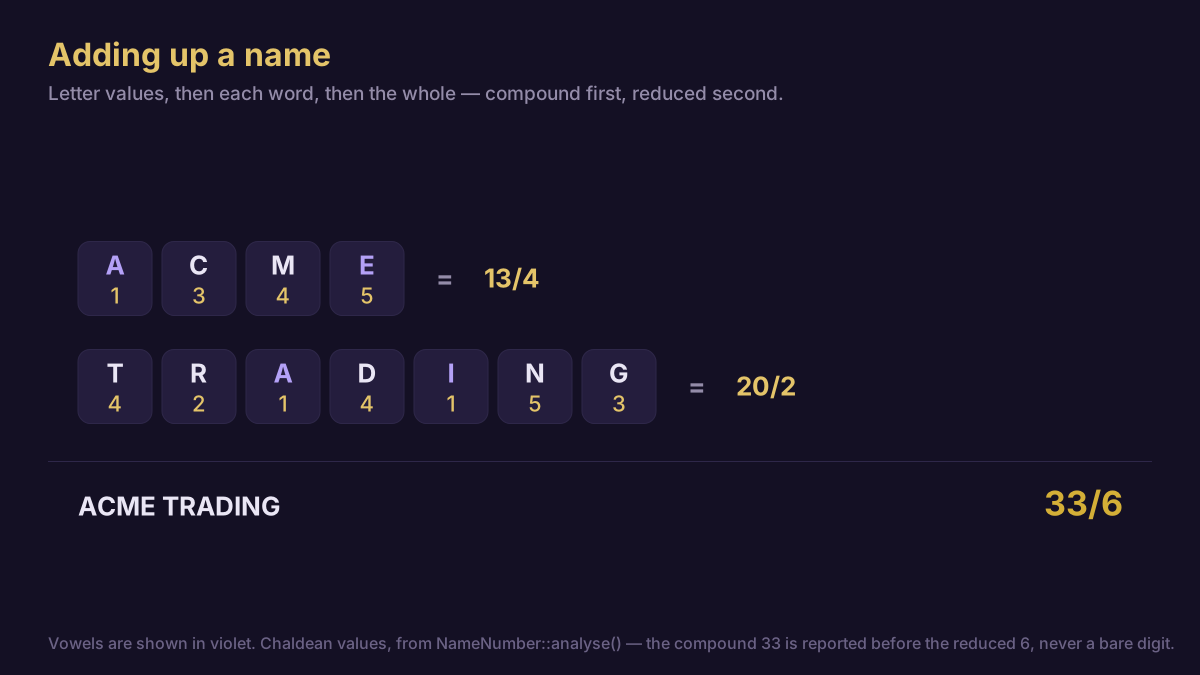
Chaldean values, the primary system here:
| Value | Letters |
|---|---|
| 1 | A, I, J, Q, Y |
| 2 | B, K, R |
| 3 | C, G, L, S |
| 4 | D, M, T |
| 5 | E, H, N, X |
| 6 | U, V, W |
| 7 | O, Z |
| 8 | F, P |
No letter is worth 9, though a name total can still reduce to 9. The tradition treats a 9 name as unusual for that reason.
Take the first candidate, Foldcraft:
F  O  L  D  C  R  A  F  T
8  7  3  4  3  2  1  8  4

8 + 7 + 3 + 4 + 3 + 2 + 1 + 8 + 4 = 40
4 + 0 = 4
Name total = 40/4
Three rules. Spaces, hyphens and apostrophes carry no value. Numerals are added as digits, so "24" contributes 2 + 4. An ampersand has no letter value, so "Hale & Roe" reads as Hale Roe; if the business says "and", spell it out and count it. That last one matters — "and" adds 10, which reduces to 1 and can move a total across a band.
The friendly, neutral and adverse pairings
Every comparison resolves to one of three grades, drawn from the friendship relations the tradition assigns between the numbers. This is the raw number-to-number table the calculator reads each axis from; the verdict on a name then adjusts it, as the next section sets out.
| Number | Friendly with | Neutral | Adverse |
|---|---|---|---|
| 1 | 2, 3, 5, 6 | 1, 4, 7, 9 | 8 |
| 2 | 1, 3, 5 | 2, 6, 7 | 4, 8, 9 |
| 3 | 1, 2, 3, 5 | 4, 7, 8, 9 | 6 |
| 4 | 1, 5, 6, 7 | 3 | 2, 4, 8, 9 |
| 5 | 1, 2, 3, 4, 5, 6, 7, 8, 9 | — | — |
| 6 | 1, 5, 6, 7 | 2, 4, 8 | 3, 9 |
| 7 | 1, 5, 6 | 2, 3, 4, 7, 8, 9 | — |
| 8 | 3, 5, 6, 7 | — | 1, 2, 4, 8, 9 |
| 9 | 1, 5 | 3, 7, 9 | 2, 4, 6, 8 |
The table is not symmetric, and reading it the wrong way round is the commonest error made with it. The row is the subject and the column is the number being judged against it: a founder number of 9 counts 1 a friend, while a founder number of 1 counts 9 merely neutral. Nor are there tidy clusters — 5 is friendly to everything, 7 has no adverse column at all, and 8 is adverse to more numbers than any other.
Two features matter before any scoring. The 8 has no neutrals at all — every total is either friendly or adverse to it — which makes founders born on the 8th, 17th or 26th the ones this method answers most sharply. And the 5 is friendly to every number, so a founder on a 5 is never blocked by the name total; for them the conductor does all the deciding.
Should the name match the driver or the conductor?
Practitioners disagree, and substantively. The case for the driver is that a name is spoken and worn daily, so it should suit the founder's working style. The case for the conductor is that a business is a long project, and the conductor describes the terms on which effort converts into result.
This site weights the driver more heavily, but only slightly: the driver carries 0.55 of the score and the conductor 0.45, close enough to even that the conductor is never a rounding error. Three adjustments sit on top of the two axes. A name landing on the founder's own number is treated as the strongest reading available, not the neutral the raw table shows — that neutral describes two people in partnership, not a name matching its owner. A total on the founder's recommended list adds a little. And a total of 4 or 8 is penalised whatever the axes say, because the method treats those as difficult trading-name numbers in their own right. Two smaller rules complete it: a small bonus when the total suits both figures, and a cap near the floor when both read it as adverse.
The result is a single 0–100 score, banded Excellent (85+), Strong (70+), Workable (55+), Weak (38+) and Avoid below that.
Business name matching birth date: five candidates, one founder
The founder is born 26 March 1985: driver 26/8, conductor 34/7. She has five names for her tooling consultancy that she would be happy to trade under.
FOLDCRAFT          F8 O7 L3 D4 C3 R2 A1 F8 T4                  = 40 → 4

HALDEN WORKS       H5 A1 L3 D4 E5 N5                = 23
                   W6 O7 R2 K2 S3                   = 20        = 43 → 7

LOOMWRIGHT         L3 O7 O7 M4 W6 R2 I1 G3 H5 T4                = 42 → 6

MAREK STUDIO       M4 A1 R2 E5 K2                   = 14
                   S3 T4 U6 D4 I1 O7                = 25        = 39 → 12 → 3

NORTHBOUND STUDIO  N5 O7 R2 T4 H5 B2 O7 U6 N5 D4    = 47
                   S3 T4 U6 D4 I1 O7                = 25        = 72 → 9
Each total is graded against the driver 8 and the conductor 7. A driver of 8 is friendly with 3, 5, 6 and 7 and adverse to everything else, which does most of the sorting.
| Candidate | Name total | vs driver 8 | vs conductor 7 | Verdict |
|---|---|---|---|---|
| Loomwright | 42/6 | friendly | friendly | Excellent, 100 |
| Halden Works | 43/7 | friendly | same number | Excellent, 100 |
| Marek Studio | 39/3 | friendly | neutral | Excellent, 91 |
| Northbound Studio | 72/9 | adverse | neutral | Weak, 38 |
| Foldcraft | 40/4 | adverse | neutral | Avoid, 16 |
Foldcraft is the instructive row. It is the shortest, cleanest name of the five and it comes last: 4 is adverse to a driver of 8, and it is also one of the two totals the method penalises for any trading name, so it collects the problem twice. Two names tie at the top, so the tie breaks on something other than the score.
The compound. Loomwright reaches 6 as 42; Halden Works reaches 7 as 43, which the source material treats as one of the more difficult compounds, a 7 arrived at through friction. For a consultancy whose product is precision rather than mystique, the 42 is the more comfortable of two equal scores.
The Pythagorean cross-check. The two systems will often disagree, and where they split the reading rests on which one you trust. Where they agree they are usually agreeing about something robust in the letters. The comparison of Chaldean and Pythagorean sets out why Chaldean is primary here.
The recommendation is Loomwright, and it is a narrow claim: of five names the founder already likes, it is the only one friendly on both axes, and 6 is on the short list of totals this driver is best served by. It is a tie-breaker among options that have already passed the tests that matter. Run a shortlist through the founder compatibility tool.
When the name you want scores badly
Northbound Studio scores 38 here — Weak, on a 9 total that is adverse to this driver. The standard remedy is a spelling adjustment that moves the total off the offending number:
| Variant | Total | Reduces to | vs driver 8 | vs conductor 7 | Verdict |
|---|---|---|---|---|---|
| Northbound Studio | 72 | 9 | adverse | neutral | Weak, 38 |
| Marek Studio | 39 | 3 | friendly | neutral | Excellent, 91 |
| Marek Studios | 42 | 6 | friendly | friendly | Excellent, 100 |
A single trailing S moves Marek Studio from 39/3 to 42/6 and from 91 to 100 — a real but small gain on a name that was already strong. Respelling has a long history and an obvious cost: a doubled consonant existing only to satisfy an arithmetic rule is a name customers mistype and search engines split across two spellings. The guide to changing a company name covers what a rename involves once a business is trading.
When the driver and conductor pull in opposite directions
The founder above had it easy: driver 8 and conductor 7 are friendly. Now take a founder born 23 June 1988. Driver: 2 + 3 = 5, so 23/5. Conductor: 2 + 3 + 0 + 6 + 1 + 9 + 8 + 8 = 37 → 10 → 1, so 37/1.
Her driver of 5 is friendly to every total, so it rules nothing out; her conductor of 1 is friendly to 2, 3, 5 and 6. The conductor therefore does all of the deciding:
| Name total | vs driver 5 | vs conductor 1 | Verdict |
|---|---|---|---|
| 2, 3, 5, 6 | friendly | friendly | Excellent, 100 |
| 1 | friendly | same number | Excellent, 100 |
| 7, 9 | friendly | neutral | Excellent, 91 |
| 4 | friendly | neutral | Workable, 61 |
| 8 | friendly | adverse | Weak, 41 |
Only 8 is genuinely poor, and 4 is merely middling — both because of the blanket penalty on 4 and 8 rather than anything about this founder. Seven of the nine totals score 91 or above.
The practical reading is not "pick a 2, 3, 5 or 6". It is that for this founder the method has very little to say: it rules out one total, marks another down, and calls the rest fine. The decision belongs to the ordinary criteria — meaning, memorability, availability. A method that admits when it is not discriminating is more trustworthy than one that always produces a favourite.
Frequently asked questions
How do I calculate my business name numerology with my date of birth?
Three sums. Reduce the day of your birth month for the driver. Add every digit of the full date and reduce for the conductor. Add the Chaldean values of the trading name, excluding any legal suffix, and reduce. Then grade that total against both numbers using the friendship table above.
Should my business name number match my birth number?
Not necessarily. The method looks for a name total Friendly rather than Adverse to your driver, and ideally to your conductor too. A name on your own driver is the strongest reading the analyser gives, for every driver except 4 and 8: those totals are penalised as trading names, so a 4 name for a driver 4, or an 8 name for a driver 8, grades Avoid. It also carries the same tendency doubled, which is not always an advantage.
What if my business name number is adverse to my date of birth?
Adverse means the tradition expects friction between how you work and what the name asks for, not that the business will fail. The responses available are to change the spelling until the total moves, pick another name, or note the friction and carry on. Most businesses trading under adverse names are doing the third.
Whose date of birth do I use when there are two founders?
The person whose decisions set the direction of the business — usually the majority shareholder or operating principal, not whoever is listed first at the registry. Where two founders are genuinely equal, score the name against both charts and take the lower result, since the name has to be carried by both. The partnership compatibility tool shows each grade and averages them; the lower of the two is the safer one to go by.
Should I use Chaldean or Pythagorean to match a name to a birth date?
Chaldean is primary here, with Pythagorean as a cross-check. The systems assign different values to the same letters, so they routinely disagree, and a name they both grade the same way is on firmer ground than one they split on. Mixing them inside one calculation is not a legitimate option.
Can I use my date of birth to generate a business name from scratch?
You can use it to define a target. Work out your driver and conductor, read off which totals would be Friendly to both, and use those as a filter on names generated by ordinary means. The guide to choosing a business name covers the non-numerical part, which is the larger part.
Where a business name numerology calculator by date of birth runs out
Three numbers cannot describe a business. Nine name totals, nine drivers and nine conductors give 729 combinations for every enterprise that has ever traded. Whether a business succeeds depends on the market, the capital, the timing, the people and a great deal of luck, none of which is in the arithmetic.
The weighting is a choice and it decides most cases. Weighting the driver at 0.55 against the conductor's 0.45 is defensible and it is not derived from anything. Since it only affects names Friendly to one number and Adverse to the other — the majority of real shortlists — many of the verdicts rest on a decision the method cannot justify.
The friendship table varies between sources. The table above is directional and internally consistent, which is more than many published versions manage, but it is still one version. Some sources read 2 and 7 as Friendly where this one reads them Neutral, and a founder with a 2 driver looking at a 7 name would get a different answer from each.
The method sometimes has nothing to say. A founder whose driver and conductor want different totals cannot always be given a clean answer, and when the realistic options are two points apart the honest output is "this does not discriminate". Respelling to move a total costs something too: names harder to spell, find and protect.
No outcome is promised. Nothing here predicts revenue, growth or survival, and none of it is financial, legal or trademark advice. Registering a name is a legal act, and it should be checked with a solicitor and a trademark search whatever any number says. The assumptions behind the tables above are set out on the methodology page, and you can run any name through the business name analyser to see the same working reproduced.