
How to choose a phone number for business, when an operator has handed you a shortlist and wants an answer today: read each candidate as nine overlapping digit pairs, weight the closing four digits heaviest, check the whole-number total against your own birth and destiny numbers, then rank the list. If nothing clears, ask for a different series.
That is the short version. The longer version is an order of operations, because the checks are not equal and two of them are pass/fail. This system weights a number roughly as follows.
| Block | Share of the verdict | What it looks at |
|---|---|---|
| Digit pairs | 42% | Every adjacent pair, with the closing ones counted three times over |
| Closing four digits | 33% | The block people actually remember and dial |
| Structure | 20% | Zeros, repeats, endings, named sequences |
| Whole-number total | 5% | The sum of all ten digits, reduced |
The lopsidedness is deliberate, and it is the first thing worth understanding.
What actually gets read, and in what proportion
Your leading digits were never your choice. The country code and the operator series are assigned under an international numbering plan — the framework is ITU-T Recommendation E.164, and national regulators such as Ofcom in the UK allocate ranges underneath it. A founder picking from a list of 98331-series numbers has no say over the 98331. They have a say over the last five digits, and that is where the method looks.
So the number is first reduced to the digits actually dialled. The plus sign, spaces, brackets and hyphens are dropped, and the country code is stripped: twelve digits beginning 91 become the trailing ten, eleven beginning with a zero become the trailing ten, and anything longer than ten keeps its final ten.
Ten digits make nine adjacent pairs — first with second, second with third, and so on. A pair falling anywhere from the sixth digit onward, which is the last four of the nine, counts three times as heavily as one nearer the front. That is the largest single lever in the calculation, and the part of a number an operator will actually negotiate.
How to choose a phone number for business: the order of checks
Run the checks in this order. The first two can disqualify a candidate outright, so doing them first saves reading nine pairs on a number that was never eligible.
- The total gate. Sum all ten digits, reduce, and test the result against your own numbers. Fail here and the number is capped at 48 out of 100 however good the rest looks.
- Named sequences. Scan for the three- and four-digit runs this system names outright. The severe ones cap the score at 42.
- The nine pairs. Count how many read favourably; the stated benchmark is seven of nine.
- The closing four digits. Total them, reduce, and check that digit against your birth number.
- Structure. Zeros, a zero ending, and any discouraged digit appearing three or more times.
Only then compare candidates. The bands are 85 and above Excellent, 70 Strong, 55 Moderate, 40 Weak, and below that Poor. The phone number analyser will show you the same breakdown, but do the first one by hand so you know what the second is telling you.
Reading the nine pairs
Each adjacent pair is read as a relationship between two planetary numbers. The source material gives a dedicated reading for most of the eighty-one combinations and is silent on a few, which are treated as neutral rather than invented. A pair containing a zero is void: it carries no reading and scores as an empty slot, so it pulls the pair score down, and a number full of zeros is a number with little to say.
These are the pairs the method reads most favourably, with the weight it attaches to each.
| Pair | Weight | Reading |
|---|---|---|
| 13 and 31 | 10 | Knowledge, leadership and money; suits consulting and teaching |
| 12 | 8 | Presence and savings — money that stays put |
| 51 | 8 | Money and movement together |
| 29 and 92 | 8 | Opportunity and steady flow; 92 is singled out for retail and sales |
| 37 and 73 | 8 | Adaptable and growth-oriented; favoured for a new venture |
| 19 and 91 | 7 | Ambition and completion |
| 69 and 96 | 7 | Standing, taste and planning; management, design, marketing |
| 11 | 6 | Authority; recommended in the closing positions |
And these are the ones it reads as adverse.
| Pair | Weight | Reading |
|---|---|---|
| 14 and 41 | 10 | The heaviest exposure to debt and unexpected expense |
| 48 and 84 | 10 | Energy drain and recurring health complaints |
| 44 | 10 | Named as an absolute avoid |
| 16 and 61 | 9 | Income that arrives and does not stay |
| 18 and 81 | 9 | Friction with authorities, notices, reputational damage |
| 45 and 54 | 9 | Delay and entanglement; rounds of courts and hospitals |
| 28 and 82 | 9 | Stagnation — a machine that was running seizes |
| 46 and 64 | 8 | Distraction, excess, scattered attention |
| 68 and 86 | 8 | Chronic complaints and disputes |
A few of these flip by profession. The method states that 45 and 54 bring clients rather than trouble to doctors, lawyers and judges, since those trades already work in courts and hospitals; the same logic applies 68 and 86 to surgeons, and 89 is treated as acceptable in law, medicine and technology. Outside those fields the adverse reading stands.
Note the direction problem. Some pairs read identically both ways and the source says so — 13 and 31 carry the same meaning. Others do not: 12 accumulates where 21 disperses. Look each pair up in the orientation it actually appears.
The closing four digits
This is the block that decides most shortlists, for a reason that is practical rather than mystical: it is the part of the number a customer repeats back, and the part an operator will actually swap for you.
Two separate things are checked. First, the four pairs falling in that region carry triple weight in the pair score above. Second, the four closing digits are summed and reduced on their own, and that reduced digit is checked against your birth number. If it is one of the four totals this system recommends universally — 1, 3, 5 or 6 — the block scores highly. If your birth number reads it as a friend, it scores highly. If your birth number reads it as adverse, the block drops to 24 out of 100 and a flag is raised.
A worked instance. A closing block of 9519 totals 9 + 5 + 1 + 9 = 24, reducing to 24/6. Six is a recommended total, so that block scores 92 out of 100 before anything else is considered. A closing block of 2951 totals 2 + 9 + 5 + 1 = 17, reducing to 17/8. Eight is not recommended, and for a founder whose birth number is 6 the matrix reads 6 as neutral to 8 — no bonus, no penalty. That block scores 62. Same pair score in both cases — 95 — so the ten-point swing in the final score comes from the closing total alone.
The whole-number total, and your own numbers
The total of all ten digits carries only 5% of the score, and yet it is the first thing to check, because it does not work like the other blocks. It is a gate.
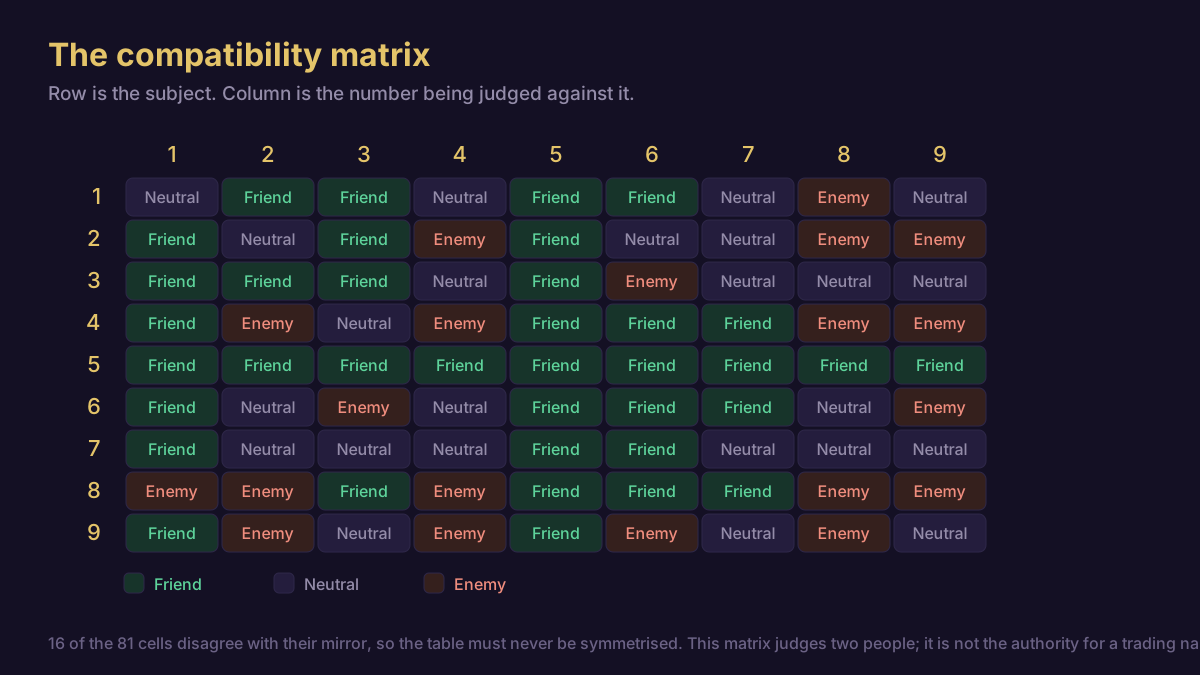
The method names four totals as broadly recommended: 1, 3, 5 and 6. Against that sit two kinds of exclusion, both drawn from the owner's chart rather than from the number.
The first is the compatibility matrix. A total that your birth number or your destiny number reads as adverse is excluded. This is where people go wrong most often, because the matrix is directional — the subject is your number, the column is the number being judged against it, and the reading one way does not always match the other.
The second is a short list of named exceptions the source states outright, cutting across the matrix:
| If your number is | The method excludes a total of |
|---|---|
| 8 | 1 |
| 6 | 3 |
| 3 | 6 |
The last two rows are not the same rule stated twice; they are two separate exclusions that happen to mirror.
This gate is graded against the owner, not the trading name. The line belongs to a person who answers it. A business name total has its own separate reading against the founder — that is what the business name analyser is for — and importing one into a phone reading produces confident nonsense. If you have not worked out your two numbers, the birth number is the day of the month reduced and the destiny number is the whole date reduced; the core calculators will do both, and what the business numbers mean covers what each digit signifies.
Structure, and the sequences the method names outright
Three structural rules apply after the pairs are counted.
Zeros. Two zeros cost a little; three or more cost a great deal, on the stated reasoning that a zero hollows the digit beside it. A number ending in zero is penalised separately.
Repetition of 2, 4 and 8. One school avoids these digits anywhere in a phone number. This site does not treat their presence as disqualifying — that would rule out most numbers on offer — but any one of them appearing three or more times is deducted and flagged.
Named sequences, checked as substrings anywhere in the number.
| Sequence | Weight | Note |
|---|---|---|
| 1881 | 10 | Named the worst sequence for a business line |
| 4114 | 10 | Named among the worst |
| 2772 and 1441 | 9 | Named among the worst; 1441 intensifies the 14 signature |
| 5445 and 545 | 9 and 8 | Intensify the 45 signature |
| 2882 and 2442 | 8 | Intensify the 28 and 24 signatures |
| 999 | 7 | Excess of Mars |
| 363 and 663 | 6 | Amplify the opposition between 3 and 6 |
The heaviest of those act as a ceiling rather than a deduction. Diluted through a weighted average they would barely move the score, misrepresenting how firmly the method rejects them, so a number containing one is capped at 42 out of 100.
On the other side, the strongest claim in this material is about endings: 319 is named the best closing sequence for money, growth and opportunity, and 517 is given as the alternative. Also listed are 1551 for name and recognition, 5775 for weak communication, and 456 and 369 as general lifts.
Those four-digit targets are what turn this from a judgement into a request. You can ask an operator for a number ending in 319. You cannot ask for one that feels right.
A worked example: how to choose a phone number for business from a shortlist
An invented founder, carried end to end. Nandita Bose is registering a same-day courier firm and needs a line for the business. She was born on 15 August 1986.
Her two numbers. The birth number is the day of the month reduced: 15 → 1 + 5 = 6. Report 15/6. The destiny number is the whole date: 1 + 5 + 0 + 8 + 1 + 9 + 8 + 6 = 38 → 3 + 8 = 11 → 2. Report 38/2.
The gate that follows. A 6 treats 3 and 9 as adverse, and the named exception shuts a total of 3 for a 6 in any case. A 2 treats 4, 8 and 9 as adverse. Combine them and four totals are closed to her: 3, 4, 8 and 9. What remains open is 1, 2, 5, 6 and 7 — of which 1, 5 and 6 also sit on the universally recommended list. Note that 3 is on that general list and is still shut for her. A general rule loses to the owner's own chart.
Her operator offers five numbers from the 98331 series.
| Candidate | Total | Closing four | Pairs (good / adverse / void) | Score | Band |
|---|---|---|---|---|---|
| 98331 50274 | 42/6 | 13/4 | 4 / 1 / 2 | 69 | Moderate |
| 98331 48106 | 43/7 | 15/6 | 2 / 3 / 2 | 66 | Moderate |
| 98331 51775 | 49/4 | 20/2 | 6 / 0 / 0 | 48 | Weak |
| 98331 64820 | 44/8 | 14/5 | 2 / 4 / 1 | 48 | Weak |
| 98331 72236 | 44/8 | 13/4 | 3 / 2 / 0 | 48 | Weak |
Three of the five score exactly 48, which is not a coincidence: each fails the total gate, and a number that fails the gate is capped at 48 whatever else it has going for it. The third row shows that cap doing real work.
98331 51775 is, by every other measure, the prettiest number on the list. Its digits total 9 + 8 + 3 + 3 + 1 + 5 + 1 + 7 + 7 + 5 = 49. Its nine pairs are 98, 83, 33, 31, 15, 51, 17, 77 and 75 — six read favourably, three are neutral, and not one is adverse. It contains 517, one of the two closing sequences named as best, and on pairs alone it scores 87 out of 100. It is still capped at 48, because 49 reduces to 49/4, and 4 is shut for a founder whose destiny number is 2. The gate is not a tiebreaker applied at the end; it is an eligibility test applied at the start.
The best eligible number is 98331 50274, at 69 — the top of the Moderate band. Its total is 9 + 8 + 3 + 3 + 1 + 5 + 0 + 2 + 7 + 4 = 42, reducing to 42/6, which is recommended and matches her birth number. But its closing block is hollow: the pairs 50 and 02 are void on their zeros, 27 is adverse, and the four closing digits total 0 + 2 + 7 + 4 = 13, reducing to 13/4. Four of nine pairs read favourably against a benchmark of seven.
Moderate is not a disaster. It is also not what the exercise was for.
What to do when none of the options is good
This is the part most articles leave out, and the part a founder standing at a counter actually needs. There are four moves, in descending order of usefulness.
Ask for a different series, and be specific about the ending. Operators hold blocks of numbers and will usually search a range on request. Because the closing four digits carry a third of the verdict outright and triple weight in the pair score, a request framed as "anything in this series ending 19, 51 or 319" is both easy to run and the highest-value thing you can ask. Nandita went back with exactly that. Three numbers came back.
| Candidate | Total | Closing four | Pairs (good / adverse / void) | Score | Band |
|---|---|---|---|---|---|
| 98331 52319 | 44/8 | 15/6 | 6 / 1 / 0 | 48 | Weak |
| 98331 12951 | 42/6 | 17/8 | 7 / 0 / 0 | 85 | Excellent |
| 98331 29519 | 50/5 | 24/6 | 7 / 0 / 0 | 95 | Excellent |
The first contains 319, the best closing sequence the method names — and totals 9 + 8 + 3 + 3 + 1 + 5 + 2 + 3 + 1 + 9 = 44, reducing to 44/8, which her destiny number shuts. Capped at 48 again. A famous ending does not override the gate.
The other two clear it, and comparing them shows where the last ten points live.
| Block | 98331 12951 | 98331 29519 | Weight |
|---|---|---|---|
| Digit pairs | 95 | 95 | 42% |
| Closing four digits | 62 | 92 | 33% |
| Structure | 100 | 100 | 20% |
| Whole-number total | 100 | 100 | 5% |
Identical on three of the four blocks. Both run seven favourable pairs out of nine with none adverse; both pass the gate on a recommended total. The difference is entirely the closing block: 2951 totals 17/8, which earns a 6 neither bonus nor penalty, while 9519 totals 24/6, landing on a recommended total and on her own birth number. She takes 98331 29519, at 95.
Keep looking for a fortnight. Numbers return to the pool constantly. If the shortlist is poor and the business is not yet trading, waiting costs nothing.
Take the best eligible number and stop. A Moderate number that passes the gate is a defensible choice. The tradition does not hold that a middling number blocks a business; it holds that a good one gives a little less friction. Operators in many markets sell chosen numbers at a premium, and paying it is a decision about your own confidence, not a purchase of an outcome.
Change what the number is used for. If a poor number is already on ten thousand printed labels, the cheapest correction is to route it rather than replace it: it becomes the accounts line while a new number goes on the storefront and the invoices. That is the same reasoning applied to premises in business address numerology, where the number a customer uses outranks the one on the tax record.
Frequently asked questions
Does the country code count in a business phone number?
No. The country code is stripped before anything is calculated, along with the plus sign, spaces and brackets. A twelve-digit number beginning 91 is reduced to its trailing ten, and a number written with a leading zero loses it. The reasoning is that these digits identify a country or a network, not you — nobody chose them and nobody says them aloud.
Is it worth paying extra for a premium phone number?
That is a budget question, not a numerology question, and this system does not answer it. What the method can tell you is which candidate on a list reads better and why, in arithmetic you can check yourself. Whether that difference is worth the premium depends on what the premium is and what else the money would do.
Should the phone number match the business name or the owner?
The owner. The reading is graded against the birth number and destiny number of whoever the line belongs to, not against the trading name's total. The name has its own separate reading against the founder. If the line is registered to a company with two founders, read it against the person who will actually answer it.
Do letters in a vanity number count as Chaldean letters?
No. In a number like 1-800-FLOWERS the letters are keypad positions, and what is dialled is digits. This system reads the digits actually keyed. That is a real difference from name work, where letters carry their Chaldean values: the domain name reading works on letters, and a phone reading does not.
What if the business already has a number everywhere?
Then read it, note what it says, and decide whether anything is worth changing. The method is for reflection and planning, not for forcing an expensive reprint. The guide to reading a number you already own covers that backward question in more detail than this article does.
Where this runs out
Four honest limits.
The pair table is a tradition, not a measurement. Every reading above comes from source material that states its verdicts without showing how they were arrived at, and parts of it contradict other parts — 38 is favourable for property and banking in one reading and much harsher in another; 21, 24 and 95 each carry two opposed accounts. Where the sources split, this site reports the split rather than picking a winner, and the methodology page sets out which rule is applied and why.
The weighting is a judgement dressed as a percentage. The 42, 33, 20 and 5 split renders the source material's own emphasis as arithmetic so it can be applied consistently. It is not an empirical finding. Two practitioners weighing the same five candidates would plausibly rank them differently, and 69 against 66 is not a meaningful gap.
Digit reduction cannot be argued with, and is doing less than it seems. Adding a number's digits and reducing gives its digital root — arithmetic modulo 9. Regrouping the same digits cannot change the result, which is why anyone whose method yields a different total from the same ten digits has made an error. It also means a great many numbers share a total, which is why the total is only 5% of the reading.
None of this predicts anything. Choosing a number well will not bring customers, and choosing one badly will not drive them off. What the exercise is good for is making a fast, low-information decision at a counter in a structured way instead of by gut — and, more usefully, telling you what to ask the operator for. For a founder whose birth number is 6, the reading of 6 in business says more about how the firm is likely to be run than any phone number will.