
There is no single best date to start business in 2027, because a date is only good relative to a founder. 2027 is a universal 11/2 year: 2 + 0 + 2 + 7 = 11, then 1 + 1 = 2. The tradition reads a 2 year as favouring partnerships, second entrants and consolidation over solo launches. What follows is the arithmetic behind that, every month of 2027, and one company taken end to end.
The universal year number for 2027
The universal year is the crudest figure in the system and the easiest to compute. Add the digits and reduce.
2 + 0 + 2 + 7 = 11
1 + 1 = 2
Report it the way this site reports every number: compound first, reduced digit second. 11/2.
Two things follow, and they pull in different directions.
The reduced digit is 2, ruled by the Moon in this system. A 2 is read as receptive rather than initiating: it waits, it responds, it works through other people, and it accumulates by increments. Applied to a year, the tradition takes that to favour joint ventures, buying into something already running, taking on a partner, licensing, distribution, and second products from an existing base. It reads the same year as awkward for a founder who intends to appear from nowhere and take a market by force.
The compound is 11, and the old tables do not treat 11 as a soft number at all. They mark it as a number to avoid: hidden dangers, trials, and trouble that arrives through other people rather than through your own errors. Held together with the 2, the character the tradition gives 2027 is a year of visible partnership, where the deal is watched and the weaker party is the one that gets found out.
For contrast, 2026 was a 10/1 year: 2 + 0 + 2 + 6 = 10, then 1 + 0 = 1. A starting year. A plan built for a 1 year does not transfer.
The best date to start business in 2027 is not a single date
Every "lucky dates 2027" list shares one flaw: it recommends dates to nobody in particular. In this system a date has a number, a founder has a number, and the question is whether the two agree. A date that is friendly for a driver 1 can be adverse for a driver 4.
So you need two figures before any date is useful.
- Your driver — the day of the month you were born, reduced. Born on the 23rd,
2 + 3 = 5, driver 23/5. - Your conductor — every digit of your full date of birth, reduced. The driver carries slightly more weight in the site's name and date readings.
The core calculators produce both from one date, and the personal year number for business covers the moving figure that sits underneath the universal year.
Then read the date's number against your driver using the site's standard grid. It has three grades, not five: F friendly, N neutral, A adverse. The grid is directional — the row is you, the column is the date — so it is not symmetric and cannot be read backwards.
| Your driver | 1 | 2 | 3 | 4 | 5 | 6 | 7 | 8 | 9 |
|---|---|---|---|---|---|---|---|---|---|
| 1 | N | F | F | N | F | F | N | A | N |
| 2 | F | N | F | A | F | N | N | A | A |
| 3 | F | F | F | N | F | A | N | N | N |
| 4 | F | A | N | A | F | F | F | A | A |
| 5 | F | F | F | F | F | F | F | F | F |
| 6 | F | N | A | N | F | F | F | N | A |
| 7 | F | N | N | N | F | F | N | N | N |
| 8 | A | A | F | A | F | F | F | A | A |
| 9 | F | A | N | A | F | A | N | A | N |
Read across from your driver to the day's number. A driver 1 looking at a 6-day gets F. The same 6-day for a driver 9 gets A. Same date, opposite verdict, and that is the point. Note the two extremes: a driver 5 reads every date as friendly, and a driver 8 reads five of the nine as adverse.
How to work out any date in 2027 by hand
The universal day number is the digit sum of the whole date, reduced. No lookup table, no software.
Take 18 March 2027:
1 + 8 + 0 + 3 + 2 + 0 + 2 + 7 = 23
2 + 3 = 5
A 23/5 day. Trade, movement, negotiation, quick turnover.
There is a shortcut that lets you scan a whole month at a glance. The universal month number is the universal year plus the reduced month; the universal day number is then the universal month plus the reduced day of the month. March 2027: 2 + 3 = 5. The 18th reduces to 1 + 8 = 9. So 5 + 9 = 14, then 1 + 4 = 5. Same answer.
Keep the compound. Two dates that both reduce to 5 are not equivalent if one is a 23 and the other a 14 — the old tables rate 23 among the most fortunate compounds and read 14 as favourable but carrying marked risk, and the compound number reference sets out what each is held to mean.
Because month digit sums run 1 to 9 and then repeat, January and October share a universal month, as do February and November, and March and December. The dates differ, the weekdays differ, the numbers do not.
Month by month: best date to start business in 2027
Each month's universal number, the character the tradition gives it, and the dates carrying the day numbers most often chosen for a start. Compounds are in brackets. The day numbers in this table are full-date totals; the site's launch date finder, and the worked example below, judge the date number — the day of the month reduced — instead. A date is a candidate, not a recommendation, until you have checked it against your own driver.
| Month | UM | Character | Strongest day candidates | Handle carefully |
|---|---|---|---|---|
| January | 3 | Expansion, visibility, funding talk | 1-days 7, 16, 25 (19); 3-days 9, 18, 27 (21); 6-days 3, 12, 21, 30 (15) | 4-days: 1, 10 (13); 19, 28 (22) |
| February | 4 | Systems, technology, back-office builds | 1-days 6, 15, 24 (19); 6-days 2, 11, 20 (15) | 8-days 4, 13, 22 (17); 4-days 9, 18, 27, all at 22 |
| March | 5 | Trade, movement, quick turnover | 5-days 9, 18, 27 (23); 6-days 1, 10 (15), 19, 28 (24) | 8-days 3, 12, 21, 30 (17); 9-days 4, 13, 22, 31 |
| April | 6 | Contracts, clients, hospitality, design | 1-days 4, 13, 22 (19); 3-days 6, 15, 24 (21); 6-days 9, 18, 27 (24) | 8-days, and the 29th at 26 |
| May | 7 | Research, specialism, withdrawal | 1-days 3, 12, 21, 30 (19); 3-days 5, 14, 23 (21); 6-days 8, 17, 26 (24) | 8-days 19, 28 (26); the 7-days |
| June | 8 | Property, land, plant, long payback | 1-days 2, 11, 20 (19); 3-days 4, 13, 22 (21); 5-days 6, 15, 24 (23) | 9-days 1, 10, 19, 28 |
| July | 9 | Completion and endings | 1-days 1, 10 (19); 3-days 3, 12, 21, 30 (21); 6-days 6, 15, 24 (24) | Most of the month |
| August | 1 | Beginnings, sole authority | 5-days 4, 13, 22, 31 (23); 3-days 2, 11, 20 (21); 1-days 9, 18, 27 (28) | 9-days 8, 17, 26; 2-days 19, 28 (29) |
| September | 2 | Partnership, the year doubled | 5-days 3, 12, 21, 30 (23); 6-days 4, 13, 22 (24); 3-days 1, 10 (21) | 2-days, all carrying 29 |
| October | 3 | January's grid, new weekdays | 1-days 7, 16, 25 (19); 3-days 9, 18, 27 (21); 6-days 3, 12, 21, 30 (15) | 4-days: 1, 10 (13); 19, 28 (22) |
| November | 4 | February's grid; quiet builds | 1-days 6, 15, 24 (19); 6-days 2, 11, 20 (15) | 8-days 4, 13, 22 (17); 4-days at 22; consumer launches |
| December | 5 | March's grid; retail turnover | 5-days 9, 18, 27 (23); 6-days 1, 10 (15) | 8-days 3, 12, 21, 30 (17); 9-days 4, 13, 22, 31 |
Three things in that table are worth pulling out.
Eight months are 19-months: January to May, and October to December. Every 1-day in them carries compound 19, which the old tables rate among the better numbers. If the business is founder-led and has to be announced, that is where the tradition points first.
August is the trap. Universal month 1 in the Sun's month looks like the obvious answer for a solo founder, but every 1-day there carries 28, a compound the tables mark as a caution about arrangements made on trust. The digit says begin; the compound says get the paperwork right first.
July is the month to move out of, and September the one to move into. July's universal month 9 is completion, read as closing rather than starting. September doubles the year's own 2, so a joint venture or co-founder signing belongs there before anywhere else — noting that its 2-days all carry 29, the shadow side of partnership rather than its promise.
Choosing the best date to start business in 2027 for one founder
Here is the method applied to an invented company, Halcyon Field Systems, a two-person B2B software business incorporating in the UK.
Step one — the founder. Born 4 August 1991.
Driver:    4
Conductor: 4 + 8 + 1 + 9 + 9 + 1 = 32 → 3 + 2 = 5
Driver 4, conductor 32/5.
Step two — the year. 2027 is 11/2. Read against driver 4, the grid gives A. A 4 founder builds by rearranging things nobody asked them to rearrange, and a 2 year rewards waiting for a counterparty. That is not a reason to delay to 2028. It is a reason to expect the year to demand a co-founder agreement, a channel partner or an anchor customer first. And the universal year is background: the site scores the founder's personal year, which for 2027 is 4 (day) + 8 (month) + 2+0+2+7 (year) = 23/5, friendly to a driver 4, so the year component is at its maximum.
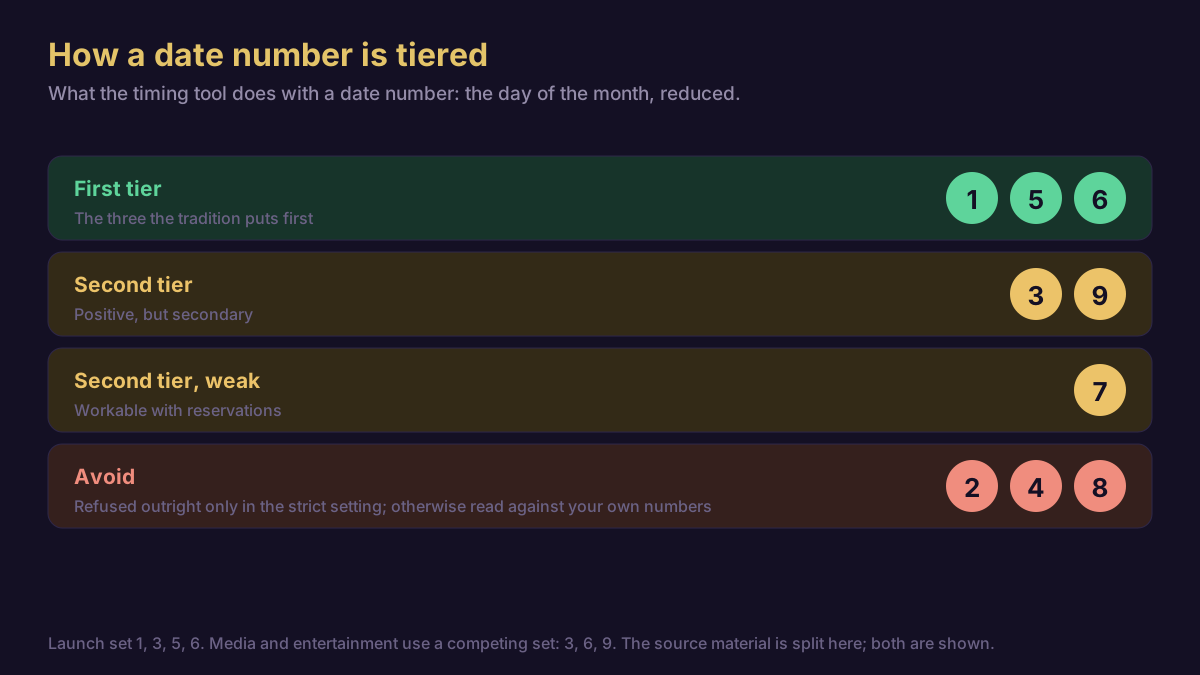
Step three — the month. Conductor 5 is friendly to every number, so it rules nothing out; the driver does the work. Driver 4 is friendly with 1, 5, 6 and 7, and adverse to 2, 4, 8 and 9. That is the filter: the date number — the day of the month reduced — must avoid 2, 4, 8 and 9. Dates on 1, 5, 6 or 7 score best; a 3, neutral to a driver 4, is allowed but scores lower. Every month contains several, so the month is chosen on business grounds and the day on numbers. March is taken here as the first quarter the company can realistically be ready in.
Step four — the day. Ranking every date in March 2027 against this founder refuses fourteen outright and ties seven at the top on 86. Four of the survivors and three of the refusals are shown here.
| Candidate | Full-date total | Date number | vs driver 4 | Verdict |
|---|---|---|---|---|
| Fri 5 Mar | 5+0+3+2+0+2+7 = 19 | 5 | friendly | Excellent, 86 |
| Sun 7 Mar | 7+0+3+2+0+2+7 = 21 | 7 | friendly | Excellent, 86 |
| Wed 10 Mar | 1+0+0+3+2+0+2+7 = 15 | 1 | friendly | Excellent, 86 |
| Tue 16 Mar | 1+6+0+3+2+0+2+7 = 21 | 7 | friendly | Strong, 73 |
| Mon 8 Mar | 8+0+3+2+0+2+7 = 22 | 8 | adverse | refused |
| Thu 18 Mar | 1+8+0+3+2+0+2+7 = 23 | 9 | adverse | refused |
| Sat 27 Mar | 2+7+0+3+2+0+2+7 = 23 | 9 | adverse | refused |
The last three matter more than the first four. The 18th and the 27th both total 23, a compound the old tables like, and a founder reading compounds alone would pick one of them. Both are refused, because the date number — 9 in each case — is adverse to a driver 4, and a hard block outranks a favourable compound. The 16th clears the filter but loses ground on the weekday: Tuesday is Mars, number 9, adverse to a 4.
Step five — the weekday, and reality. Of the three shown at the top, the 5th is a Friday ruled by Venus (6), friendly to a driver 4. The 10th is a Wednesday ruled by Mercury (5), also friendly. The 7th scores identically and is a Sunday, and no company registry incorporates on a Sunday.
Which is the honest end of this worked example. The incorporation date is stamped by a registrar, not chosen by a founder — the same principle that keeps entity suffixes like Ltd and Inc out of a name calculation. You can file in time for a target date, but you cannot command it. Friday 5 March 2027, 19/1 is the date that survives contact with the process, with Wednesday the 10th as the fallback if the filing slips, and Friday the 19th and Wednesday the 24th, which also score 86, beyond that.
To run this against your own date, the launch date finder tests a range of dates against a driver and conductor, the timing dashboard shows how the personal year sits underneath, and the guide to registration dates covers the filing mechanics.
Frequently asked questions
What is the luckiest date to start a business in 2027?
There isn't one, and any page naming a single date has skipped the step that makes the method work. The strongest general-purpose candidates in 2027 are the 1-days carrying compound 19, found in every month except August and September, and the 5-days carrying 23, found in every month. Whether any suit you depends on your driver number.
Is 2027 a good year to start a business?
The tradition reads 2027 as an 11/2 year, which favours partnerships, acquisitions, licensing and second products over solo launches. It is a comfortable year for a founder with a counterparty and an awkward one for a founder who intends to do everything alone. That is a description of character, not a forecast.
Which months in 2027 should I avoid?
July is the month most practitioners would move a launch out of, because its universal month number is 9 and 9 is read as completion. May is quiet rather than bad — suited to a specialist practice, poor for anything needing footfall. June's 8 is slow rather than unlucky, which matters if you have budgeted for early revenue.
How do I calculate the universal day number for a date?
Add every digit of the date and reduce to one digit, keeping the two-digit compound. For 12 September 2027: 1 + 2 + 0 + 9 + 2 + 0 + 2 + 7 = 23, then 2 + 3 = 5. A 23/5 day. The shortcut — universal year plus reduced month plus reduced day — gives the same result.
Does the day of the week matter as well as the date?
It carries less weight than the date number or the personal year — 16 against 28 and 22 in the site's launch date finder — and gives way to them when they conflict. Weekdays carry planetary rulers — Sunday 1, Monday 2, Tuesday 9, Wednesday 5, Thursday 3, Friday 6, Saturday 8 — and 4 and 7 have no weekday at all, which tells you how loosely the mapping fits. Use it to break a tie, not to make a decision.
Where this runs out
A start date in this tradition is read as a birth date for the business. It is one figure among five or six, and it is not the heaviest. It cannot override a trading name whose total sits adverse to the founder, fix a premises number, or produce a market that does not exist.
There is no evidence that a start date affects a business outcome. No study supports it. This is a traditional interpretive framework with a long history and no experimental backing. Everything above is offered as a structure for reflection and planning, not as a finding, and none of it is financial, legal or medical advice.
Practitioners disagree on the arithmetic, not just the meaning. Some compute a universal day number from the full date, as this page's month table does. Others add the day of the month to a universal month figure without reducing the day first, producing different compounds. Some read the compound of the day of the month alone, so the 26th is always a 26/8 day regardless of month or year — the date number the site's launch date finder and the worked example above use. Those three methods disagree on most dates, and when two readings conflict the cause is almost always method.
The reduction hides a great deal. Nine possible day numbers means roughly one day in nine shares any given verdict — about forty candidate dates a year for any founder. That is not scarce enough to justify moving a launch far. The compound narrows it, which is why this page reports it, but the framework is coarse by construction.
A date is the variable people reach for because it is free. It attracts attention out of proportion to the weight the tradition itself gives it. Where two dates are otherwise equal, there is no cost in preferring the one the old tables rate higher. Where the choice starts costing real money — delaying two months, missing a season, holding capital idle — ordinary commercial judgement takes over.
It cannot tell you the things that decide businesses. Whether the market exists, whether the pricing works, whether the co-founder will still be there in eighteen months, whether the capital lasts until revenue starts. None of that is in a calendar. Used sensibly, a date choice does one modest and real thing: it forces you to decide when you are actually starting, and to write down what you expect the first quarter to look like. That has value. It has less value than doing the work.