
There is no single best date to start business in 2026, and anyone selling you one is selling you a list. What exists is a method. 2026 is a universal year 1 — 2 + 0 + 2 + 6 = 10, and 1 + 0 = 1 — which the tradition reads as a beginnings year. Within it each date carries its own number, and that number means something only once you set it against the founder's own.
This guide gives the arithmetic for every month of 2026 so you can compute any date yourself, and shows why the answer changes with who is asking.
Why 2026 is a 1 year, and what the tradition makes of it
Add the digits of the year: 2 + 0 + 2 + 6 = 10. Reduce: 1 + 0 = 1. Recorded compound-first, 2026 is a 10/1 year.
The compound matters. Ten is read as the wheel — rise and fall, self-made outcomes, the consequences of earlier decisions arriving. It reduces to 1: initiation, sole direction, the founder acting alone.
For a launch year that reads well. The years the tradition treats as poor for beginnings are the 4s, the 7s and the 9s — one heavy with structure, one turned inward, one given to endings. 2026 is none of them. But a favourable universal year is a weak signal: it applies to everyone at once, so it distinguishes nothing between you and a competitor. Treat it as background, not a reason.
The character of 1 in founder-led ventures is set out on the number 1 in business page.
The method: working out the best date to start business in 2026 yourself
Four numbers do the work. Each one is a digit sum.
1. Universal year. The year's digits, reduced. 2026 → 10 → 1.
2. Universal month. The universal year plus the month number, reduced. January is 1 + 1 = 2, February 1 + 2 = 3, on to August at 1 + 8 = 9, then September 1 + 9 = 10 → 1. The last three use their own reduced value: October (10 → 1) gives 2, November (11 → 2) gives 3, December (12 → 3) gives 4.
3. Universal day. Add every digit of the full date and reduce. For 14 April 2026: 1 + 4 + 0 + 4 + 2 + 0 + 2 + 6 = 19, then 1 + 9 = 10, and 1 + 0 = 1. Written 19/1.
A shortcut check: April's universal month is 5, the day 14 reduces to 5, and 5 + 5 = 10 → 1. The routes always agree. Use the full digit sum as the working method, because it also hands you the compound.
4. Your personal day. The part most date lists leave out, and the part that makes a date yours.
- Personal year = birth day + birth month + the current year, summed and reduced.
- Personal month = personal year + the calendar month, reduced.
- Personal day = personal month + the calendar day, reduced.
Your driver is your day of birth reduced; your conductor is your whole birth date reduced. Those do not change; the personal year, month and day do. The personal year number for business guide covers that layer.
Read the compound, not just the digit
Every date in 2026 has a digit sum between 12 (1 January) and 30 (29 September). In that narrow range each reduced digit arrives by only one or two compound routes, and the tradition reads those routes very differently.
| Reduced day | Compounds in 2026 | The difference the tradition draws |
|---|---|---|
| 1 | 19 or 28 | 19 is among the most favourable; 28 warns of loss through trusting others |
| 3 | 12, 21 or 30 | 21 is the crown; 12 the sacrifice; 30 thoughtful but neutral |
| 5 | 14 or 23 | 23 is one of the strongest compounds; 14 favours trade and speculation, but with marked risk |
| 6 | 15 or 24 | 15 favourable, drawing money and favours through persuasion; 24 split — gain through others, but the sources disagree on it |
Two dates both reducing to 1 can therefore read almost oppositely. 8 January sums to 19; 9 September sums to 28. Both are "a 1 day". A practitioner working from compounds would not treat them as equivalent, and a list showing only the reduced digit has hidden the distinction.
What each universal day number is read to mean for a launch
| Universal day | Read as | Suits |
|---|---|---|
| 1 | Beginnings, sole direction | A founder-led venture; a first trading day |
| 2 | Agreement, partnership | Signing with a co-founder; weak for a solo start |
| 3 | Announcement, visibility | The marketing launch or press day |
| 4 | Foundations, paperwork | Incorporation; slow to show revenue |
| 5 | Trade, movement | Retail and fast-turnover businesses; first sales |
| 6 | Service, the customer | Hospitality, premises openings, customer-facing work |
| 7 | Research, specialism | Consultancies; poor for a shopfront |
| 8 | Capital, long cycles | Property and infrastructure; late rather than unlucky |
| 9 | Completion, relaunch | Closing one chapter to open another; not a first day |
The reading of 8 as slow and accumulating rather than unfortunate is set out in is 8 a good number for business — the most commonly misread number in the set.
Month by month: the best date to start business in 2026
Every date below is a weekday. Public holidays differ by country, so check your registrar's calendar before committing. April is set out in full to show the working; the other eleven give compounds you can verify yourself.
April 2026 in full — universal month 5
Five is trade and movement, and sits well inside a 1 year. For a transactional business — retail, distribution, anything with turnover rather than retainers — April is the strongest month of the first half.
| Date | Day | Digit sum | Universal day |
|---|---|---|---|
| 9 April | Thursday | 0+9+0+4+2+0+2+6 = 23 | 23/5 |
| 14 April | Tuesday | 1+4+0+4+2+0+2+6 = 19 | 19/1 |
| 23 April | Thursday | 2+3+0+4+2+0+2+6 = 19 | 19/1 |
| 27 April | Monday | 2+7+0+4+2+0+2+6 = 23 | 23/5 |
| 28 April | Tuesday | 2+8+0+4+2+0+2+6 = 24 | 24/6 |
The other eleven months
| Month | Universal month | Dates worth shortlisting |
|---|---|---|
| January | 2 | 19/1: 8, 26 · 21/3: 19 · 14/5: 30 |
| February | 3 | 19/1: 16, 25 · 21/3: 9 · 15/6: 3 |
| March | 4 | 19/1: 6, 24 · 23/5: 19 · 15/6: 2 |
| May | 6 | 19/1: 4, 22 · 23/5: 8 · 24/6: 18 |
| June | 7 | 19/1: 3, 12, 30 · 23/5: 16 · 21/3: 5 |
| July | 8 | 19/1: 2, 20 · 23/5: 6, 24 · 21/3: 13 |
| August | 9 | 19/1: 10 · 23/5: 5 · 24/6: 6 · 28/1: 19 |
| September | 1 | 23/5: 4, 22 · 24/6: 14 · 28/1: 9, 18 |
| October | 2 | 19/1: 8, 26 · 21/3: 19 · 15/6: 13 |
| November | 3 | 19/1: 16, 25 · 21/3: 9, 27 · 15/6: 3 |
| December | 4 | 19/1: 15, 24 · 21/3: 8 · 15/6: 2 |
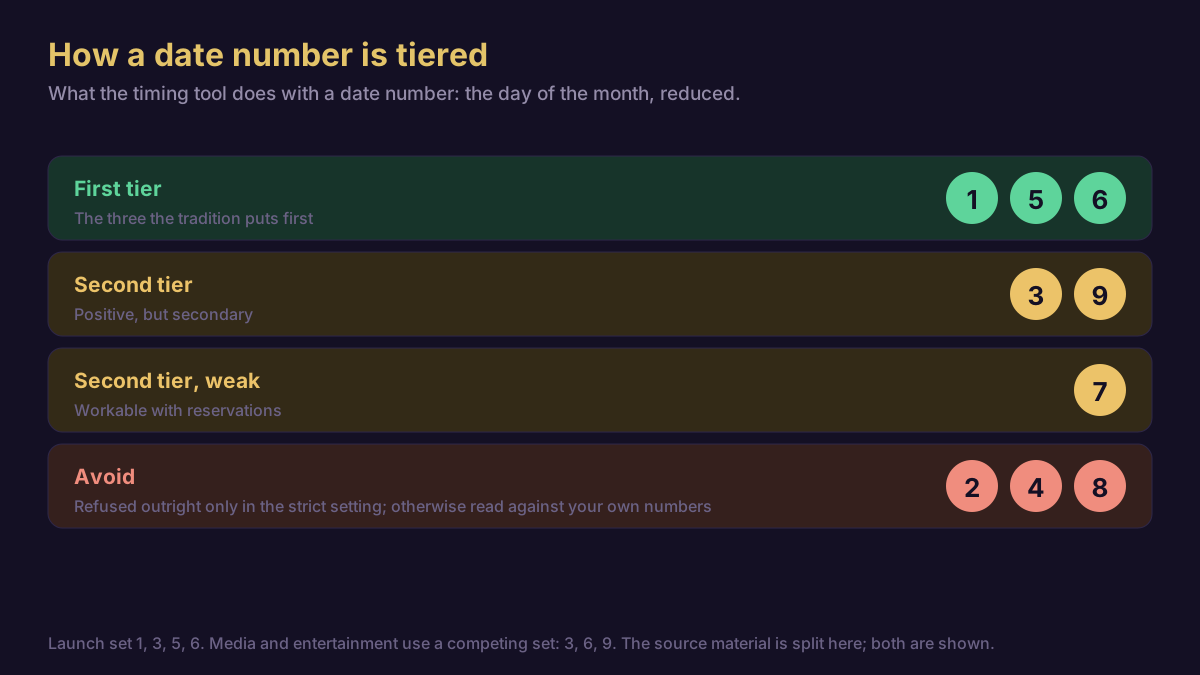
These are full-date totals. The launch date finder judges the date number — the day of the month reduced — first, so the 2nd, 4th, 8th, 13th, 20th, 22nd and 26th in this table sit on its avoid tier, and any date whose date number is adverse to your birth or destiny number is refused outright there.
Four months repay a second look.
January (2) reads as agreement rather than initiation: better for signing than starting. And 1 January 2026 sums to 12, the compound the tradition treats most cautiously in the 3 family. The date everyone wants is not the one the method points at.
June (7) is inward and analytical: cautious about a shopfront, comfortable with a consultancy. May (6) is the opposite — the customer, anything with a door people walk through.
August (9) is completion, better for a relaunch than a first day. Because the universal month is 9, the universal day equals the reduced day of the month exactly. Compare 10 August (19/1) with 19 August (28/1): same digit, and 28 is read with real caution.
September (1) repeats the year's own number, the most beginnings-flavoured month on the reduction alone. But its digits sum to 9, so no date in it produces a 19/1. If you want that compound September cannot give it; the 4th or 22nd at 23/5 is the stronger pick.
The launch date finder ranks any month against your own chart, and the timing dashboard runs the personal year and month layers together.
Reading the best date to start business in 2026 against your own chart
Everything above describes the calendar, not you. This is where most date lists stop and where the method begins.
Worked example: one founder, one name, one date
A founder born 14 July 1990 is launching a last-mile delivery business.
Driver. Day of birth reduced: 14 → 1 + 4 = 5. Trade and movement — a structural match for delivery work.
Conductor. The whole date: 1 + 4 + 0 + 7 + 1 + 9 + 9 + 0 = 31, and 3 + 1 = 4. Recorded 31/4.
Trading name. SWIFTCART, in Chaldean: S=3, W=6, I=1, F=8, T=4, C=3, A=1, R=2, T=4, so 3+6+1+8+4+3+1+2+4 = 32, and 3 + 2 = 5. Recorded 32/5, matching the driver. (The business name analyser does this in one click.)
Personal year 2026. Birth day + birth month + year: 1 + 4 + 0 + 7 + 2 + 0 + 2 + 6 = 22, and 2 + 2 = 4. Recorded 22/4, read as foundations — systems, contracts, vehicles, licences. Not a year the tradition expects fast returns from: the method reads a personal year 4 as the hardest of the cycle for new ventures, which reframes what the date is for.
Personal months. Personal year 4 plus the month number, so January to December runs 5, 6, 7, 8, 9, 1, 2, 3, 4, 5, 6, 7.
Set those against the universal months and the personal month sits exactly three above it in every row. Not coincidence: the personal year is 4, the universal year is 1, and the gap carries through every month and so every day.
That is a real constraint. For this founder the personal day is always the universal day plus three: a universal 1 gives a personal 4, a universal 5 gives a personal 8. Only a universal day of 2 gives a personal 5, the match to their driver. They cannot have both a 1 universal day and a 5 personal day in 2026 — no date offers it. They must choose which layer wins: a genuine trade-off, not a puzzle with a hidden answer.
The decision. They choose Tuesday 14 April 2026.
- Universal day: 1 + 4 + 0 + 4 + 2 + 0 + 2 + 6 = 19/1 — a beginnings day, on the compound rated highest among the 1s.
- Personal day: April's personal month is 8, the day 14 reduces to 5, and 8 + 5 = 13 → 4. A foundations day, consistent with the 4 personal year and arguably right for a business whose first six months are vehicles, insurance and depot leases.
- The 14th is also the founder's day of birth, read as a supporting echo, and reduces to 5, their driver.
They gave up a personal-day match, kept the date-number match (14/5, their driver) and took the strongest universal day. The launch date finder scores the date 76, Strong, for this founder and name — the personal year 4 is what holds it back. Another founder would reasonably choose the opposite. That is the point: a date is good relative to someone, and the same Tuesday is unremarkable for the next person.
Which layer should win
When the layers disagree, no rule in the tradition orders them. The source material does not define a personal day at all — it extends the personal-month rule, and the site's launch date finder does not score it. Some put the personal day first for a solo venture, the universal day first for anything public-facing, and the compound over the reduced digit when the two point differently; you will find the ordering reversed elsewhere.
When the date cannot move
Most founders arrive at this question late: a lease starting on the 1st, an investor's wire landing on a fixed day, a registrar's queue returning a certificate whenever it does. The method still has answers.
Separate the dates you control from the ones you do not. A business has several: incorporation, first invoice, first trading day, public launch, signage. The registrar controls one; you control the rest, so a certificate dated on a heavy day still leaves the first trading day free. Choosing a company registration date covers the distinction.
Use the compound to find the better version of a bad digit. Stuck inside a particular week, the dates within it still carry different compounds. In October 2026 both the 1st and the 19th are 3 days — but one is a 12 and the other a 21.
Do not pay to reschedule. If moving a launch by nine days costs a month's rent or a supplier slot, the arithmetic has stopped being useful and started being expensive. Nothing here justifies a real cost.
Frequently asked questions
What is the best date to start a business in 2026?
There is no universal answer: a date is read against the founder's own numbers. The dates summing to 19 or 23 are the ones the tradition rates most highly across 2026 — 14 and 23 April and 3 and 30 June among them. Which suits you depends on your driver and personal year.
Is 2026 a good year to start a business in numerology?
The tradition reads 2026 as a 10/1 year — beginnings, self-direction, outcomes following from your own earlier choices. That is favourable for a launch relative to a 4, 7 or 9 year. It is also shared by everyone alive in 2026, so it should carry very little weight in a real decision.
Which month in 2026 is best for a new business?
It depends on the business. April (universal month 5) is read as best for trade and fast turnover. May (6) suits customer-facing openings. June (7) suits consultancies and specialist practice. September (1) is the most beginnings-flavoured on the reduction, though no September date produces the favoured 19 compound.
Does the registration date or the opening date matter more?
Practitioners differ. The common position is that registration is the entity's legal birth and the first trading day its commercial one, and that the second is more useful because you control it. Registrars issue certificates on their own schedule, making the registration date largely a matter of queue position.
What if I can only register on a date the method reads badly?
Take it. A registration date is one number among several, and the alternative — delaying incorporation and paying for the delay — is a certain cost against an unmeasurable benefit. Choose the first invoice, the first trading day and the public launch deliberately instead, since those are within your control.
Do I use my own birth date or just the calendar date?
Both, and the calendar date alone tells you little. The universal day describes the day for everyone; your personal day describes what that day is doing in your own cycle. When people say a date "did not work" for them, usually only the first half was ever calculated.
Where this runs out
This method has clear limits, and they should be stated rather than buried.
A date has never been shown to cause a commercial outcome. No evidence base connects incorporation dates to business survival or revenue. Everything here is a traditional framework for structured reflection at a decision point — not a forecast, and no promise of a result of any kind.
The universal layer is worthless as a differentiator. 2026 being a 1 year is true for every founder on the planet, as is every universal day above. Only the personal layer says anything about you, and even that is shared with everyone born on the same day of the same month.
The rules are contested. Whether to prioritise the personal day or the universal day. Whether the compound outranks the reduced digit. Whether registration or opening governs. Whether to use the local date or the date where the company is incorporated — a real problem for a founder in Auckland registering in Delaware. The methodology page sets out the conventions this site uses, but they are conventions, not findings.
Calendars are conventions too. The Gregorian date is an administrative artefact. A founder using a lunar calendar computes an entirely different set of numbers for the same afternoon, and the tradition cannot adjudicate between them.
Most of what determines a launch date is not numerological. Supply lead times, staff notice, tax year boundaries, seasonality, funding, when the licence comes through. If those point at one week and the numbers at another, the numbers give way.
Use the tables to narrow a shortlist you already had for commercial reasons. That is the honest use of this method: not to find the date, but to choose between two that were already acceptable.