
Signature numerology business readings score the letters you actually write when you sign, rather than the name on your birth certificate. The tradition treats that as your working name. The honest position: a signature is the cheapest number in your chart to change and the least likely to move anything, because the registered name is what the world transacts with.
The arithmetic is sound on its own terms. The commercial claims stacked on top are the part to be sceptical about.
What signature numerology business claims rest on
The reasoning runs like this. A number is held to act through repetition and public use. Your birth date is fixed and gives you a driver and a conductor. Your legal name gives a name number. But most people are not called by their legal name, and the argument is that the name in daily circulation carries more weight than the one on the certificate — which is why a called name or a trading name is scored separately from a registered one.
A signature extends that idea. It is the version of your name you produce with your own hand, repeatedly, at the moments that matter commercially: opening the account, signing the lease, accepting the terms, authorising the payment. The tradition reads it as the name you use when you commit. The overview of what business numerology covers sets out how the larger numbers in a chart are built; the signature is one of the smaller ones.
Two claims follow, and they should be kept apart because their evidence is different.
The first is arithmetical: a signature has a letter total like any name, and that total can be compared against your driver and conductor. Whether or not you accept the premise, the calculation is the one used everywhere else in the system, and it can be checked line by line.
The second is formal: the slant, the underline, the dot and the legibility are read for meaning. That is graphology — a separate discipline with a separate history, attached to numerology in the last century and now sold as one package. It matters, because the two halves are priced together and only one of them involves numbers.
How signature numerology business scoring works in Chaldean values
Take the letters you actually write — not your legal name, not what people assume is in there. Apply the Chaldean values and add.
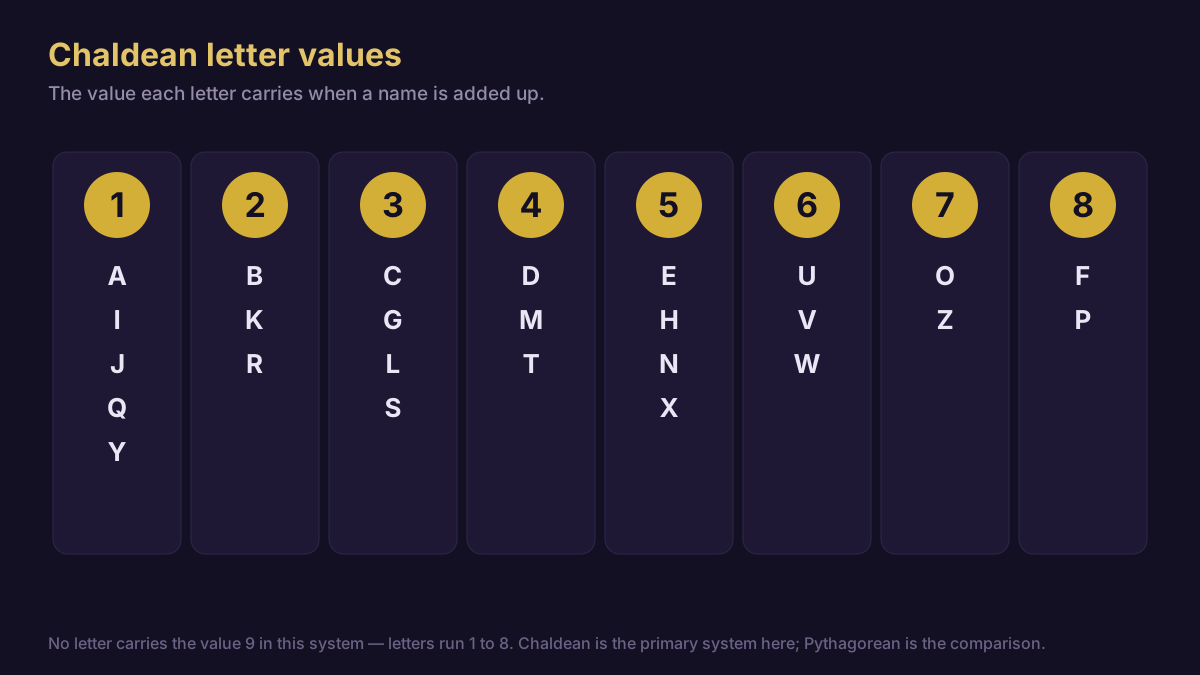
| Value | Letters |
|---|---|
| 1 | A, I, J, Q, Y |
| 2 | B, K, R |
| 3 | C, G, L, S |
| 4 | D, M, T |
| 5 | E, H, N, X |
| 6 | U, V, W |
| 7 | O, Z |
| 8 | F, P |
There is no 9 for letters in Chaldean. A total can reduce to 9; no single letter carries it.
Punctuation is not counted. A full stop, an underline and a flourish have no letter value, so they add nothing to the total, whatever else the tradition reads into them. An initial is scored at the value of that letter alone: a written R is worth 2, not the value of the first name it stands for.
A worked example, carried end to end
Take an invented founder: Ravindra Mohan Deshpande, born 14 May 1988.
- Driver = day of month, reduced. 14 → 1 + 4 = 5.
- Conductor = the whole date, reduced. 1 + 4 + 0 + 5 + 1 + 9 + 8 + 8 = 36 → 3 + 6 = 9. Report as 36/9.
Now the name components in Chaldean.
RAVINDRA — R 2, A 1, V 6, I 1, N 5, D 4, R 2, A 1 = 2 + 1 + 6 + 1 + 5 + 4 + 2 + 1 = 22 → 4.
MOHAN — M 4, O 7, H 5, A 1, N 5 = 4 + 7 + 5 + 1 + 5 = 22 → 4.
DESHPANDE — D 4, E 5, S 3, H 5, P 8, A 1, N 5, D 4, E 5 = 4 + 5 + 3 + 5 + 8 + 1 + 5 + 4 + 5 = 40 → 4.
Full legal name: 22 + 22 + 40 = 84 → 8 + 4 = 12 → 1 + 2 = 3. Report as 84/3.
Note something easy to miss. Every component reduces to 4, yet the whole name reduces to 3, because 4 + 4 + 4 = 12 → 3. Reduction does not carry through the parts, which is why the compound is always reported before the digit.
Now the signature variants — the six forms this founder could plausibly write.
| Signature as written | Arithmetic | Compound / reduced |
|---|---|---|
| Ravindra Mohan Deshpande | 22 + 22 + 40 | 84/3 |
| Ravindra M Deshpande | 22 + 4 + 40 | 66/3 |
| Ravindra Deshpande | 22 + 40 | 62/8 |
| R M Deshpande | 2 + 4 + 40 | 46/1 |
| R Deshpande | 2 + 40 | 42/6 |
| Deshpande | 40 | 40/4 |
Six legitimate ways to sign one name, producing five different reduced digits: 3, 3, 8, 1, 6, 4.
For a 5 driver, most published tables treat 1, 3, 5 and 6 as supportive, 2, 4 and 7 as mixed, and 8 as the drag. This site's business name analyser reads this founder — driver 5, conductor 36/9 — differently: it grades the 84/3, 66/3 and 46/1 variants Excellent, the 42/6 Strong, and the 62/8 and 40/4 Weak. On that reading four of the six variants sit in the favourable band, and two are weak. A practitioner would likely recommend R M Deshpande at 46/1, where 46 also carries a favourable classical reading.
Hold on to that result, because it contains the whole problem with the exercise. Four of six variants were already fine. Generate enough forms of your own name and you will always find one in a friendly band. That is not a discovery about your name. It is a property of having six samples and a rule that approves of more than half the digits.
You can run the same arithmetic on your own name with the core calculators, and on a trading name with the business name analyser.
Chaldean and Pythagorean disagree about the same signature
Score R M Deshpande in Pythagorean instead, where A–I run 1–9, J–R run 1–9 again, and S–Z run 1–8.
R 9, M 4, then DESHPANDE: D 4, E 5, S 1, H 8, P 7, A 1, N 5, D 4, E 5 = 40.
9 + 4 + 40 = 53 → 5 + 3 = 8.
The same signature is 46/1 in Chaldean and 53/8 in Pythagorean. Under a 5 driver that is the difference between the recommended option and the one a practitioner would tell you to abandon. Nothing about the signature changed. Only the letter table did.
This site uses Chaldean as primary for reasons set out in the comparison of the two systems and in the methodology. Anyone paying for a signature correction should know the verdict depends on which table was opened, and that they will rarely be told which one it was.
What the tradition reads into signature form
This is the graphology layer, described rather than endorsed. None of it involves arithmetic, and none can be checked.
| Feature | Traditional reading | Honest note |
|---|---|---|
| Underline beneath the name | Self-support; a base under the venture | Widely taught, no stated mechanism |
| Full stop after the name | A stop placed on your own progress | The most commonly "corrected" feature |
| Line struck through your own name | Cancelling yourself; strongly discouraged | Consistent across sources |
| Upward slant | A rising trajectory | Borrowed wholesale from graphology |
| Downward slant | Fatigue; a business past its peak | Same |
| Fully illegible signature | Concealment | Practitioners split: guarded, or evasive |
| Oversized first letter | Emphasis on the self; founder-led | Echoes the 1 reading elsewhere |
| Different signatures on different documents | A divided working identity | Also a real operational problem |
Two rows deserve separating out. The illegible signature is a methodological hole: if the glyph is a squiggle, there is no letter set to add. And the last row matters for ordinary reasons — signing inconsistently across bank mandates, deeds and identity documents causes real friction, whatever your name totals.
Why signature correction is the most oversold service in this field
Consider the economics from the seller's side.
A trading name change is expensive to deliver and expensive to act on. The client must file with a registrar, reprint, buy a domain, tell suppliers, update the shopfront and absorb the search-visibility hit — the chain is set out in the piece on changing a registered company name. The practitioner has to justify all of that, so the recommendation is usually made carefully.
A signature correction costs the practitioner one sitting. No filings, no printing, no domain, no notifications, no legal fees. It can be delivered in twenty minutes and priced as a standalone service or as an upsell after a report. The margin is close to total.
Then there is the attribution window. The standard instruction is to practise the new signature repeatedly — a hundred times a day for forty days is a common formulation — and to expect results over the following months. That structure is long enough that ordinary business variation will produce something to point at, effortful enough that failure can be blamed on insufficient practice, and unfalsifiable, because you cannot run your business twice and compare. If revenue rises, the correction worked. If nothing happens, the real problem was the name total, or the premises, or the launch date — each available as the next thing to buy.
None of this proves the tradition wrong. It explains why this service is sold harder than any other in the field, and why the intensity of the sell tells you nothing about the strength of the claim. A signature line inside a full report, at no extra cost, is a reasonable use of the idea. A standalone correction sold at a premium with a promised revenue effect is not. No practitioner can promise a commercial result from a change to how you sign your name.
The signature is the smallest surface in the chart
Argue this on the tradition's own terms. The system holds that a number acts through repetition and public exposure, so count the exposures.
A trading name appears on every invoice and receipt, the shopfront, the website, the packaging, search results, the map listing, the tax registration and every conversation in which someone recommends you. For a modest retail business that is tens of thousands of impressions a month.
A signature appears on a lease, a bank mandate, a handful of contracts and some HR paperwork, seen by a landlord, a lender, an accountant and a few counterparties. Call it a hundred exposures a year.
On the tradition's own logic, then, the signature is the smallest surface in the chart by two or three orders of magnitude. A practitioner who ranks it above the trading name is arguing against their own framework.
The surface is also shrinking. Much of what once needed a wet signature now runs on a typed name in a box, a tick, a one-time password, or a cryptographic certificate containing no letters you wrote. There is nothing there to score.
How to sign your name if you want to try this anyway
If you have read the caveats and still want to work through it, the operational checks matter more than the arithmetic.
- Write out every form you would genuinely use. Full name, first plus surname, initials plus surname, surname alone. Do not invent a form you would not write.
- Score each in Chaldean. Letters only. Show the working so you can check it later.
- Read each total against your driver and conductor, not against a generic list of lucky numbers. A total is friendly or adverse only relative to a specific person.
- Check the compound, not just the digit. Two signatures that both reduce to 8 can carry very different classical readings — see the compound numbers reference.
- Then do the boring part. Before changing anything: your bank's specimen signature on file, cheque signing authority, board resolutions and share transfer forms, notarised deeds, insurance and identity documents where a mismatch causes problems at a counter. This is where an enthusiastic signature change actually costs people money.
- Change once, then leave it. A signature that varies reads worse on every account, mystical and practical.
Where signature numerology business readings run out
The method cannot be tested. There is no way to sign a business two ways at once and compare, so every claim about a signature's commercial effect rests on cases selected after the fact by people who sell the service. That is not evidence.
The scoring has an unresolved hole. If your signature is illegible there is no letter set, and practitioners quietly substitute the legal name — contradicting the reason the signature was said to matter.
The two halves of the service also have different standing. The arithmetic is consistent and checkable. The shape reading is graphology from a different lineage, and the tradition offers no account of why the two belong together.
Practitioners disagree on the basics: whether initials count at their own letter value or at the value of the name they stand for, whether a middle name omitted from a signature is absent from the reading, whether a surname alone is sufficient. These are not fine distinctions. They change the total, and therefore the verdict.
And the variant problem does not go away. Most people can write their name six or more legitimate ways. With that many samples and a rule that approves of most of the nine digits — seven of them for this founder — a friendly result is close to guaranteed. Finding one is not a finding.
Treat this as what it is: a small piece of a larger chart, useful as a prompt for reflection about how you present yourself and commit to things, and worth very little money. If you are going to spend on the method, spend it on the numbers with real surface area — the trading name, the founder's driver and conductor, the premises — and treat the signature as the free line at the bottom of the report.
Frequently asked questions
Does changing my signature change my business numerology?
It changes one small number in the chart, not the chart. The trading name, your driver and conductor, the registration date and the premises are all unaffected by how you sign. On the tradition's own logic — that numbers act through public repetition — a signature is the least-exposed name you own, so it should be expected to carry the least weight in a business reading.
How do I calculate my signature number?
Take only the letters you actually write, apply the Chaldean values (A, I, J, Q, Y = 1; B, K, R = 2; C, G, L, S = 3; D, M, T = 4; E, H, N, X = 5; U, V, W = 6; O, Z = 7; F, P = 8), and add them. An initial scores as that single letter. Punctuation, underlines and flourishes score nothing. Keep the compound total, then reduce it.
Is signature correction worth paying for?
As a standalone premium service the case is weak: it costs the practitioner almost nothing to deliver, cannot be tested, and comes with a built-in explanation for failure. As one line inside a full report at no extra cost, it is harmless. No outcome can be promised either way, and anyone promising one is describing their pricing.
Should my signature match my registered legal name?
That is a question for your bank, your registrar and anyone holding your specimen signature, not for numerology. Practically, consistency across your bank mandate, statutory filings and identity documents avoids friction. The tradition has no settled view on whether a signature must match the legal name, which is itself worth noting.
Which is right for a signature, Chaldean or Pythagorean?
They disagree, sometimes completely. The worked example above scores 46/1 in Chaldean and 53/8 in Pythagorean — a recommended total in one system, a discouraged one in the other. This site uses Chaldean as primary and reports Pythagorean as the comparison. Ask which table a practitioner used before accepting a verdict.
What does a dot after my signature mean?
The tradition reads a full stop after the name as a stop placed on your own progress, and it is the feature most often removed in a signature correction. It carries no numerical value, since punctuation is not scored. Treat it as a claim from the graphology layer rather than from the numbers.