
A lo shu grid explanation begins with a 3x3 square holding the digits 1 to 9, each in a fixed cell, arranged so every row, column and diagonal adds to 15. You place the digits of a birth date into their cells. What is repeated, and what is missing, is the reading.
That is the whole mechanism. It takes about ninety seconds to fill in by hand, and the rest of this page is about doing it correctly and about what the tradition claims the result means.
What the lo shu grid actually is
The grid is a magic square: numbers arranged so that the rows, the columns and both diagonals share one total. The 3x3 version, using each digit from 1 to 9 once, looks like this.
| 4 | 9 | 2 |
| 3 | 5 | 7 |
| 8 | 1 | 6 |
Add any line and you get 15. Top row: 4+9+2. Left column: 4+3+8. Long diagonal: 4+5+6. All eight lines give the same number.
The positions are fixed. This is the most misunderstood point about the grid: the cells do not move, and nothing about your date changes where a 7 lives. All a birth date does is decide which cells get filled, and how often.
In its Chinese usage the square is drawn with south at the top, which is why 9 — a fire number there — sits top-centre and 1, a water number, at the bottom. In the Indian practice this site works in, the layout is kept but the directional meaning dropped, and the cells read as qualities of a person instead.
Why every line sums to 15
You do not have to take 15 on trust. It falls out of two lines of arithmetic.
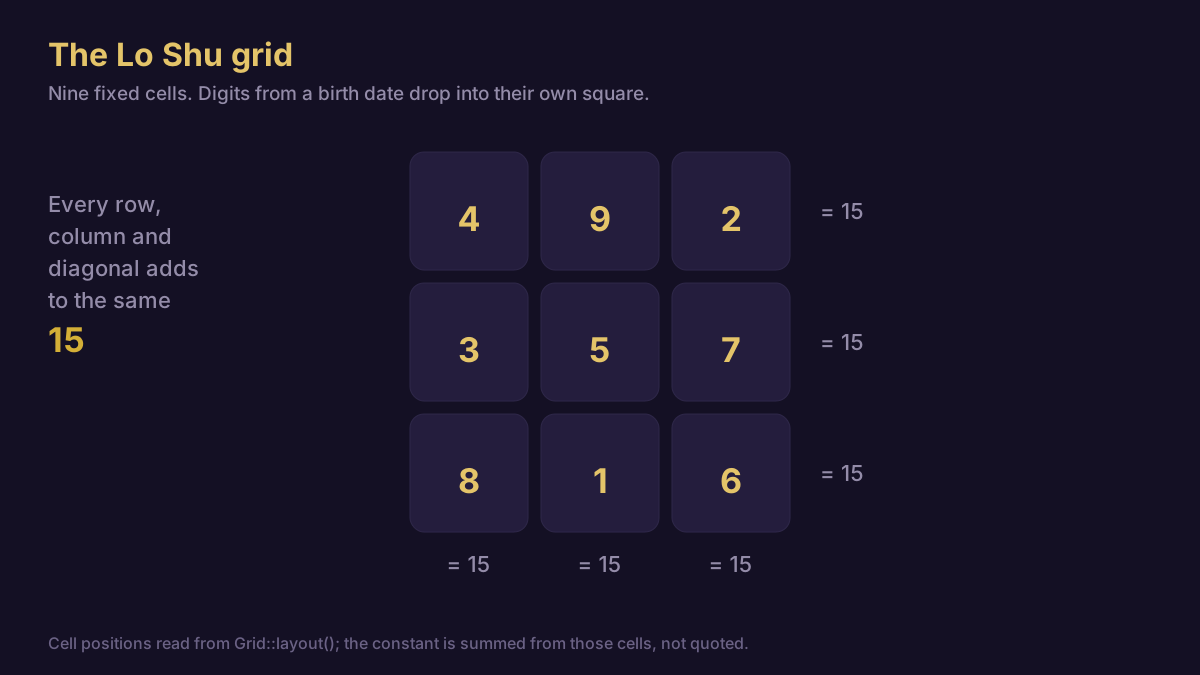
The digits 1 to 9 add up to 45. The three rows between them use every digit once, so the row totals must add to 45. If the rows are equal, each is 45 ÷ 3 = 15. No other value is possible.
The 5 in the centre is forced too. Four lines pass through the middle cell: the middle row, the middle column and both diagonals. Those four lines add to 4 x 15 = 60, and between them cover the centre four times and every other cell once. So:
60 = (45 - centre) + (4 x centre)
60 = 45 + 3 x centre
centre = 5
The centre has to be 5. Not by tradition, by arithmetic.
The rest of the layout is forced as well. There are exactly eight ways to make 15 from three different digits between 1 and 9: 1+5+9, 1+6+8, 2+4+9, 2+5+8, 2+6+7, 3+4+8, 3+5+7, 4+5+6. Count how often each digit appears across them:
| Digit | Appears in | Sits at |
|---|---|---|
| 5 | 4 triples | the centre (4 lines) |
| 2, 4, 6, 8 | 3 triples each | the corners (3 lines) |
| 1, 3, 7, 9 | 2 triples each | the edges (2 lines) |
Every corner is even, every edge odd, the centre 5. The only remaining freedom is rotating or mirroring the square, which gives eight arrangements of one thing. There is only one 3x3 magic square — not an arbitrary diagram somebody drew, but the only object of its kind.
How a birth date fills the grid
Write the date as DD-MM-YYYY with a four-digit year, then write each digit into the cell that bears that number. Three rules govern what goes in.
Zeros are dropped. There is no cell 0, so a zero contributes nothing. A date with many zeros produces a sparse grid — see the section on structural bias below.
Every digit is placed, including repeats. If the date contains three 4s, cell 4 gets three entries, written as 444. The count is the point.
Most schools add the driver, the conductor and the Kua. The driver is the day of the month reduced; the conductor is every digit of the full date added and reduced; the Kua comes from the birth year and sex — the year's digits reduced, then 11 minus that for a man or plus 4 for a woman, reduced again. All three are placed as extra entries. Some practitioners leave the Kua out, and some leave all three out, producing a different grid for the same person — a real disagreement, and you should know which convention a reading has used. This page places all three, as the Lo Shu grid tool does. The core calculators show each addition step.
A worked lo shu grid explanation, cell by cell
Take an invented founder born on 14 August 1979 — 14-08-1979.
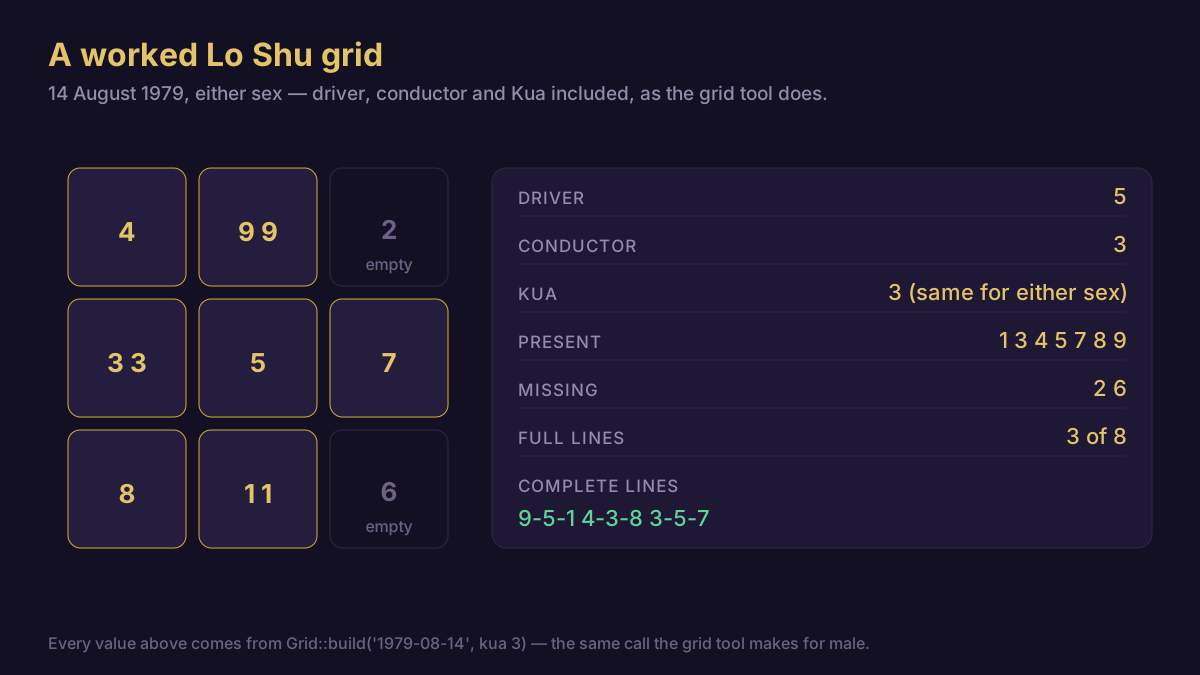
Step 1: list the digits. 1, 4, 0, 8, 1, 9, 7, 9. The zero is dropped, leaving 1, 4, 8, 1, 9, 7, 9.
Step 2: driver. Day 14. 1+4 = 5. Driver 5.
Step 3: conductor. 1+4+0+8+1+9+7+9 = 39. 3+9 = 12. 1+2 = 3. Conductor 39/3. Check by remainder: 39 ÷ 9 = 4 remainder 3, matching the reduced digit.
Step 4: Kua. Year 1979: 1+9+7+9 = 26. 2+6 = 8. For a man, 11 − 8 = 3; for a woman, 8+4 = 12, and 1+2 = 3. Kua 3 either way — this year gives both sexes the same Kua, which is not true of every year.
Step 5: place all ten entries. Seven date digits, plus the driver 5, the conductor 3 and the Kua 3. Cells 1, 3 and 9 take two each; cells 4, 5, 7 and 8 take one; cells 2 and 6 take none.
Step 6: draw it.
| 4 | 99 | — |
| 33 | 5 | 7 |
| 8 | 11 | — |
Read off the three things that matter. Repeats: 1 twice, 3 twice, 9 twice. Empty cells: 2 and 6. Complete lines: the middle row 3-5-7, the left column 4-3-8 and the middle column 9-5-1; the other five are broken by the missing 2 or 6.
That is a complete grid. Everything after this is interpretation.
Repeats and empty squares: what the tradition reads
One framing point the rest of this section depends on: a repeated digit is described as an emphasis, an absent one as a tendency. Neither is a diagnosis and neither predicts anything. These are prompts for reflection, useful when they name something you already half-knew.
Repeated digits
| Cell | Twice | Three or more |
|---|---|---|
| 1 | Comfortable at the front; speaks for the business easily | Talks past the point; hears agreement that was not given |
| 2 | Strong instinct for people; useful in negotiation | Takes ordinary feedback as attack |
| 3 | Strong conceptual and planning capacity | Ideas outrun execution; many starts, few finishes |
| 4 | Methodical; builds systems by instinct | Rigidity; over-engineering what needed to ship |
| 5 | Emotionally balanced and adaptable | Restless, needs constant change; volatile at four or more |
| 6 | Strong service and aesthetic instinct | Over-attachment to comfort and premises |
| 7 | Analytical depth; learns from setbacks | A working life marked by loss and hard lessons |
| 8 | Patient accumulation; good over long horizons | Restless with detail, or holds on past usefulness |
| 9 | Considerable energy and ambition | Force where persuasion would have worked |
The founder in the worked example has 11, 33 and 99: strong self-expression, planning capacity and drive in the tradition's reading, with nothing in cell 2 to temper them. Whether that is worth anything is for the reader to judge.
Empty cells
| Empty cell | What the tradition reads |
|---|---|
| 1 | Under-claims credit; lets others speak for the work |
| 2 | Slow to read the unsaid; patience has to be practised |
| 3 | Weak recall for detail; needs written systems |
| 4 | Order has to be imposed from outside. The cell tied to technology and unseen mechanics |
| 5 | Swings between commitment and withdrawal. Missing from nearly half of charts, even with driver, conductor and Kua added |
| 6 | Home and workplace interchangeable; comfort deferred indefinitely |
| 7 | Learns through direct experience rather than instruction, often the hard way; may repeat an expensive lesson |
| 8 | Accumulation is not instinctive; money moves through rather than settling |
| 9 | Drive arrives in bursts; needs an external deadline |
Now the caveat that makes the table honest: almost every grid is missing several cells. A modern date gives eight digits, some of them zeros, plus three derived numbers — at best eleven entries across nine cells. Three or four empty cells is normal, so anyone presenting yours as a rare weakness is describing the ordinary condition of the method. The numerology glossary covers how the same vocabulary is used across schools.
The eight lines through the grid
Practitioners also read the eight lines — three rows, three columns, two diagonals. Each carries a traditional label, and a line with all three cells filled is read as unusual strength.
| Line | Cells | Usually called |
|---|---|---|
| Top row | 4-9-2 | Mental plane |
| Middle row | 3-5-7 | Emotional plane |
| Bottom row | 8-1-6 | Practical plane |
| Left column | 4-3-8 | Thought plane |
| Middle column | 9-5-1 | Plane of will |
| Right column | 2-7-6 | Plane of action |
| Long diagonal | 4-5-6 | Golden plane |
| Short diagonal | 2-5-8 | Earth plane |
The worked example above has three complete lines: the emotional plane 3-5-7, the thought plane 4-3-8 and the will plane 9-5-1. Its golden and earth planes are broken, by the missing 6 and the missing 2.
One observation should give a careful reader pause. Because 5 sits in four of the eight lines, and is often supplied by the driver, conductor or Kua even when absent from the date, the middle row, middle column and both diagonals complete far more readily than the outer lines. The strength the grid finds there is partly an artefact of where 5 lives.
Using a lo shu grid explanation for a business, not a person
A company has a date on its incorporation certificate, and it grids exactly like a birth date. An invented company registered on 27 March 2018 — 27-03-2018.
Digits: 2, 7, 0, 3, 2, 0, 1, 8. Zeros dropped: 2, 7, 3, 2, 1, 8. Driver: day 27, so 2+7 = 9. Conductor: 2+7+0+3+2+0+1+8 = 23, then 2+3 = 23/5.
A company has no sex, so it has no Kua, and the grid below leaves it out. The Lo Shu grid tool asks for a sex and adds a Kua anyway — 9 on its default setting, which here makes a second 9 — so for a business read that extra entry as absent. Placing all eight entries:
| — | 9 | 22 |
| 3 | 5 | 7 |
| 8 | 1 | — |
Repeats: 2 twice. Empty: 4 and 6. Complete lines: the emotional plane 3-5-7, the will plane 9-5-1 and the earth plane 2-5-8.
The tradition reads this as an entity with strong instinct for people (22), no natural gift for internal process (cell 4 empty) and no pull towards premises or comfort (cell 6 empty) — a business that will need its systems designed deliberately. Whether that survives contact with the actual company is an open question: a registration date is a bureaucratic fact, set by a filing queue as often as by intention.
Two practical notes. The grid takes a date only, so the trading name plays no part; the name total is a separate calculation, read beside the grid rather than combined with it. And the entity suffix is irrelevant, because suffixes have no digits. You can produce both readings with the business numerology score, or build the grid with the Lo Shu grid tool.
What most lo shu grid explanations leave out
Three structural facts about the method are rarely mentioned, and each one limits how much weight a grid can carry.
Everyone born in the twentieth century has a 1 and a 9. The "19" in 1979, 1984 or 1999 puts an entry into cell 1 and one into cell 9 for every person born in that span, so those cells can never be empty for them. Whatever the empty-cell table says about a missing 1 or 9 cannot apply to anyone born before 2000.
Everyone born in this century has a 2, and loses digits to zeros. The "20" in 2004 or 2018 puts an entry in cell 2 and contributes a zero that places nowhere. The grids are sparser too: 4 April 2004 gives 0, 4, 0, 4, 2, 0, 0, 4 — four zeros discarded, leaving three 4s and a 2, plus a driver of 4, a conductor of 14/5 and a Kua of 5 for a man (1 for a woman). For a man six of the nine cells are empty and cell 4 holds four entries. That is not a portrait of an unusual person but of a date with a lot of zeros in it.
The day and month tens digits skew the low cells. The tens digit of a day can only be 0, 1, 2 or 3; of a month, only 0 or 1. So cells 1, 2 and 3 take entries from positions that can never feed cells 6 to 9. Across a population the low cells fill more often, for reasons to do with the Gregorian calendar rather than with people.
None of this makes the grid useless. It does mean a reading that treats every empty cell as personally significant is over-claiming, and that comparisons across decades are not like with like. The methodology page sets out where this site draws those lines.
Frequently asked questions
What is the lo shu grid used for?
To see at a glance which numbers a birth date emphasises and which it omits. Practitioners read the repeats as strengths or excesses and the empty cells as tendencies to work around. In business it is applied to a founder's date and sometimes to a registration date, as one input among several.
Do you include the year in the lo shu grid?
Yes. All eight digits of DD-MM-YYYY are placed, with zeros dropped since there is no cell 0. A two-digit year is a mistake: it discards the century digits, changes which cells fill, and alters the conductor. Write the year in full.
What does it mean if a number appears three times?
The tradition reads two of a digit as strength and three or more as the same quality overrunning its useful range — a strong communicator who talks past the point, a methodical builder gone rigid. Three of a kind is uncommon but not rare, and dates with repeated digits produce it mechanically.
Is the lo shu grid the same as a magic square?
Yes, the 3x3 magic square, the only one that exists at that size once rotations and mirrors are set aside. Every row, column and diagonal sums to 15, the centre is necessarily 5, the corners even. Numerological use adds interpretation on top of arithmetic that stands on its own.
Why is my lo shu grid almost empty?
Most likely because your date contains several zeros, which place nowhere. Dates such as 04-04-2004 or 01-09-2000 lose four or five digits before you start. That is a property of the calendar, not a statement about you, and the clearest reason to treat empty cells as weak evidence.
Does the lo shu grid change over your life?
No. It is built from a fixed date, so it never changes. Practitioners who offer a changing grid are adding a current year or personal year on top, which is a separate optional layer. The underlying grid is the same at seventy as it was at seven.
Where this runs out
The arithmetic in the first half of this page is exact and can be checked by anyone. The square sums to 15 because 45 divides by 3. The centre is 5 because four lines through it must total 60. Those are facts about numbers.
The second half is a different kind of claim. That a missing 6 indicates deferred comfort, or a doubled 9 force where persuasion would serve, is a description handed down in source material. It is not derived from the arithmetic, cannot be tested by adding anything up, and practitioners differ — including on whether the driver, conductor and Kua belong in the grid at all. Two competent readers using two conventions will hand you two grids for one birthday, both internally consistent.
The grid also cannot see anything the date does not contain. It does not know your training, your capital, your market or the people around you. It cannot tell you whether to take the lease, and it has no view on whether a business will work — nothing here promises an outcome of any kind, and any reading that does is making a claim the method cannot support. Its honest use is narrower: a structured prompt for thinking about how you work, which occasionally names something you had already noticed and been avoiding.
Read alongside the other numbers from the same date, and against the traditional readings for each digit — the number 4 in business page shows how one cell's meaning is expanded — a grid is useful to have in front of you during a planning conversation. Treated as a description of what you are capable of, it is worth less than the fifteen minutes it took to draw.