
Is 7 a good number for business? For expert work sold to a small number of clients who buy on competence — consulting, research, diagnostics, specialist craft — yes, 7 is one of the better name totals in this system. For mass-market retail, volume trade or anything sold on price and footfall, it is one of the weakest. 7 describes depth, not reach. Everything below is the reasoning, the arithmetic, and the point where the method stops being useful.
What 7 stands for in business numerology
The source material attaches 7 to Ketu, the south lunar node: the unseen, things that take time to surface. Every trait the tradition gives it points inward rather than outward. In operating terms, four characteristics.
- Few clients, high value. Eleven engagements a year at substantial fees is a 7-shaped business. Four hundred transactions a day is not.
- Long consideration. The gap between first hearing the name and signing something is measured in months. 7 does not do impulse purchase.
- Authority through knowledge. What is sold is understanding — an opinion, a test result, a judgement. The buyer cannot verify it, which is why they are paying.
- Reluctance to be public. The tradition reads 7 as private, exacting and averse to selling. An advantage where salesmanship reads as desperation, a handicap everywhere else.
Discussions of number 7 business numerology tend to stop at the word "spiritual" and leave a founder with nothing usable. The commercially meaningful reading is narrower and more testable: 7 is the number of the specialist. The fuller trait list sits on the reference page for what 7 means for a business.
7 describes a method, not a result
Nothing here says a 7 name produces revenue. A name total is a lens for reflection and planning; its use is that it makes a founder state their own model out loud — customer count, cycle length, what the buyer is paying for — before a name is carved into a door.
How a name adds up to 7 in Chaldean
Chaldean assigns letters the values 1 to 8. There is no 9 for letters — 9 is held apart, which is why a name can total 9 but no letter contributes one. Add the values, keep the compound total, then reduce. Report both, compound first.
| Value | Letters |
|---|---|
| 1 | A, I, J, Q, Y |
| 2 | B, K, R |
| 3 | C, G, L, S |
| 4 | D, M, T |
| 5 | E, H, N, X |
| 6 | U, V, W |
| 7 | O, Z |
| 8 | F, P |
Four worked conversions, invented names:
Slate — S3 + L3 + A1 + T4 + E5 = 16, and 1 + 6 = 7. Reported as 16/7.
Slate Labs — S3 + L3 + A1 + T4 + E5 = 16; L3 + A1 + B2 + S3 = 9; 16 + 9 = 25, and 2 + 5 = 7. Reported as 25/7.
Quiet Research — Q1 + U6 + I1 + E5 + T4 = 17; R2 + E5 + S3 + E5 + A1 + R2 + C3 + H5 = 26; 17 + 26 = 43, and 4 + 3 = 7.
Osprey Research — O7 + S3 + P8 + R2 + E5 + Y1 = 26; Research = 26 again; 26 + 26 = 52, and 5 + 2 = 7.
Entity suffixes are not counted. "Slate Labs Ltd" and "Slate Labs Inc" are both 25/7: a registrar confers the suffix, and the tradition counts the name a client says out loud. The business name analyser shows the working for any candidate.
The compound numbers behind a 7
The totals reducing to 7 are 7, 16, 25, 34, 43, 52, 61, 70, 79 and 88, and the tradition reads them very differently. Two names can both be "a 7" and carry opposite warnings.
| Compound | Traditional character | Business read |
|---|---|---|
| 7 | Bare. Independent, analytical, inward-facing. | Sole practitioners. Little commercial weight. |
| 16/7 | Heavily cautioned in the classical list: plans built high, struck down. The business sources split on it, favouring it only for jewellery and luxury goods. | Advised against where public standing matters. Short one-word names often land here. |
| 25/7 | Strength through experience, after early difficulty. Favourable, but late. | A practice judged on track record. |
| 34/7 | Close to 25. Gains through hard experience, often via a partner. | Partnerships that mature slowly. |
| 43/7 | Cautioned. Upheaval, plans overturned, internal dispute. | Widely treated as a poor trading name. |
| 52/7 | Most lineages group it with 43; some soften it. | Same care as 43. The disagreement is genuine. |
| 61/7 | Little classical detail. Read the digits: 6's service under 7's analysis. | Advisory work with strong client care. |
| 70/7 | 7 with a zero: detachment amplified, the human element thinned. | Institutes, archives, deep research. Poor where warmth matters. |
| 79/7 · 88/7 | Long names only. Rarely reached. | Heavy 7s. Read the digits directly. |
If two candidates both reduce to 7, the compound decides. 25/7 and 16/7 are not the same recommendation, and the compound number reference for 16 shows why reducing too early throws away the information you wanted.
Is 7 a good number for business? The verdict depends on the model
| Business model | 7 as the name total | Reasoning |
|---|---|---|
| Professional practice (audit, surveying) | Strong | Few clients, high fees, sold on competence. Law is the exception: the sector map advises against 7 for legal services. |
| Research, testing, diagnostics | Strong | The product is a verified finding. Reticence reads as rigour. |
| Specialist consulting | Strong | Long cycle, judgement-based, reputation-led. |
| Niche craft and restoration | Strong | Small volume, deep skill, patient buyers. |
| Software for a narrow technical market | Strong | 7 is on the sector map's favoured list for software and SaaS; it strains only when sold on features to everyone. |
| Education and training at depth | Strong | Favoured in the sector map; weak only for mass courses. |
| Agency and creative services | Workable | Favoured in the sector map for digital marketing, but 7 undersells, and agencies win on visible confidence. |
| Restaurants and food service | Strained | Warmth and frequency are the product. The sector map is neutral here, and favours 7 for hotels and travel. |
| Mass-market retail | Poor fit | High volume, low consideration, price-led. |
| Franchising | Poor fit | Needs reach and repeatability. Logistics is different: the sector map favours 7 there. |
"Strained" is not "avoid". The mismatch is real and you should be able to say how you will cover it. A 7-named agency with an outgoing partner running new business is fine. One where nobody enjoys selling is the reading playing out as described.
The sectors where a numerology 7 business name reads well share one property: the customer cannot check the work. They buy a judgement they cannot verify, so they buy the appearance of expertise instead, and 7's reserve is read there as seriousness. Testing houses, forensic work, risk analysis, clinical diagnostics, archives, instrument-making, conservation, cryptography, single-discipline consultancies. It also fits businesses whose growth is deliberately capped — a workshop taking nine commissions a year, an advisory practice that turns work away to protect its standard. The tradition reads 7 as content with limits in a way that 1, 5 and 8 are not.
Is 7 a good number for business in retail and volume trade?
Generally not, and this is the clearest negative reading in the set. Retail is a frequency business: many small transactions, short consideration, easy recall, a name that asks nothing of the shopper. The tradition reads 7 as slow to be understood and prone to withdrawing when it should be visible. The argument for the other awkward number is in the piece on whether 8 is a good number for business — a different problem, because 8 is slow where 7 is closed.
A worked mismatch
An invented discount grocery chain, Ember Retail.
E5 + M4 + B2 + E5 + R2 = 18 R2 + E5 + T4 + A1 + I1 + L3 = 16 18 + 16 = 34, and 3 + 4 = 7. Reported as 34/7.
34 is one of the better compounds in the 7 family. But the reduced 7 describes few customers and long consideration, and a discount grocer has thousands of customers and no consideration at all. The reading is not "this will fail". It is "the label describes a different machine from the one you built". The fix is one word:
Ember Stores E5 + M4 + B2 + E5 + R2 = 18 S3 + T4 + O7 + R2 + E5 + S3 = 24 18 + 24 = 42, and 4 + 2 = 6. Reported as 42/6.
Six letters changed, and the total moves to the number the tradition attaches to service, comfort and repeat custom — what a grocery chain actually sells. Note what did not happen: the business did not improve. Only the description did.
Is 7 a good number for business against your own driver number?
Name totals are read against the founder's driver number — the day of the month of birth, reduced — rather than in isolation. The table below is the common reading, not a unanimous one. Friendship tables vary between lineages.
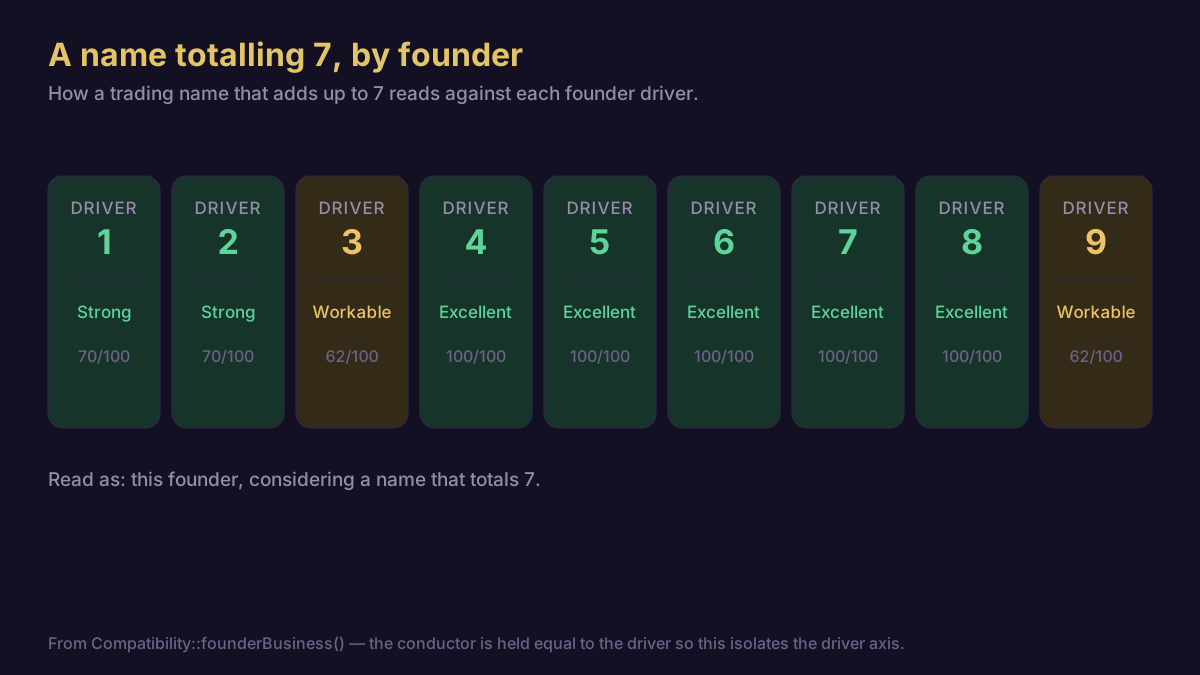
| Driver | 7 as the name total | Why |
|---|---|---|
| 1 | Strong | 1 wants to be seen; 7 wants to be right. Fine if the founder is the public face. |
| 2 | Strong | The classical pairing. Sensitivity and reflection at different volumes. |
| 3 | Workable | 3 expresses and expands. A 7 name asks it to be quiet. |
| 4 | Strong | Systems and analysis reinforce each other. Common in technical practices. |
| 5 | Excellent | 5 sells to many and quickly where a 7 name promises few and slowly. The totals agree; the pace is what needs managing. |
| 6 | Excellent | 6 supplies the client warmth 7 does not generate. |
| 7 | Strong but insular | Excellent work, real risk nobody hears about it. |
| 8 | Excellent | Both slow. 8 accumulates, 7 refines. Suits practices holding property. |
| 9 | Workable | 9's breadth against 7's depth. Works when 9 handles the outside world. |
To score a shortlist against a specific birth date rather than read it off a table, the founder compatibility tool does it in one pass.
Chaldean and Pythagorean will often disagree
The same names under Pythagorean values (A–I 1–9, J–R 1–9, S–Z 1–8):
| Name | Chaldean | Pythagorean |
|---|---|---|
| Slate Labs | 25/7 | 19/1 |
| Quiet Research | 43/7 | 68/5 |
| Osprey Research | 52/7 | 76/4 |
| Winnow Consulting | 70/7 | 79/7 |
Three of the four disagree outright. The fourth agrees on the reduced digit but not the compound, which is arguably worse: it looks like corroboration and is not. This site treats Chaldean as primary because it is the older letter assignment and the one the compound tradition was built on, but a practitioner using the other table would give a different answer and neither can prove the other wrong. The comparison of the two systems sets out what separates them.
A worked example: one founder, one shortlist
An invented founder, born 16 March 1988, setting up a materials-testing laboratory.
Driver number — the day of the month, reduced: 16 → 1 + 6 = 7. Conductor number — the whole date, reduced: 1 + 6 + 0 + 3 + 1 + 9 + 8 + 8 = 36 → 3 + 6 = 9.
A 7 driver with a 9 conductor: an analytical, private working method carried by a broad, impersonal outer life. A 7 name against a 7 driver is strong but insular, and the 9 conductor is what has to compensate.
Six invented candidates, computed in Chaldean:
| Candidate | Working | Total | Read |
|---|---|---|---|
| Slate Labs | 16 + 9 | 25/7 | Late-maturing, credential-led. Matches the driver. |
| Slate Metrology | 16 + 36 | 52/7 | Same digit, cautioned compound. |
| Basalt Labs | 14 + 9 | 23/5 | Excellent on the founder check; outward in tone for a laboratory. |
| Slate Testing | 16 + 25 | 41/5 | Excellent on the founder check, on the most prescribed compound; outward in tone. |
| Halden Testing | 23 + 25 | 48/3 | Expressive, Workable for this founder, and on a compound advised against. |
| Slate Instruments | 16 + 42 | 58/4 | Systems and technology in tone, but a 4 total the founder check reads as Avoid for this founder. |
The last of those spelled out in full, because it reduces twice:
Slate Instruments — S3 + L3 + A1 + T4 + E5 = 16; I1 + N5 + S3 + T4 + R2 + U6 + M4 + E5 + N5 + T4 + S3 = 42; 16 + 42 = 58, and 5 + 8 = 13, and 1 + 3 = 4.
This site's founder check ranks Basalt Labs and Slate Testing highest, both 5s at 100, and Slate Labs next at 83, Strong; Slate Instruments at 58/4 reads Avoid for this founder. If the founder prefers Slate Labs at 25/7 for tone — it matches the driver, and 25's character, strength through accumulated experience, describes a testing house accurately — that is a judgement about the brand, not what the numbers rank first. Neither is a prediction. The shortlist earned its keep by making the founder say what the business is before choosing what to call it. A broader view of the totals the tradition rates well sits in the guide to the best name numbers for business.
Frequently asked questions
Is 7 a lucky number for business?
The tradition does not describe 7 as lucky. It describes it as deep and private. Depth is an asset in a diagnostics firm and a liability in a coffee chain. Calling a number lucky without first asking what the business sells, and to how many people, skips the part of the method that carries information.
Is 7 or 8 better for a business name?
They answer different questions. 7 is read as expertise, small volume and reputation; 8 as accumulation, property, long horizons and institutional weight. A boutique advisory reads better on 7, a construction or land business on 8. If the business needs frequency and reach, both are the wrong end of the scale and 5 or 6 fit better.
My business name comes to 16. Is that the same as a 7?
It reduces to 7, so it carries 7's character, but the compound is read first and 16 is heavily cautioned in the classical list, though the business sources favour it for jewellery and luxury goods. Given a choice, most practitioners would move a name off 16 rather than argue about it. Given no choice, the caution concerns over-extension: keep commitments modest and promises small.
Can I use a 7 name if my driver number is 5?
Yes — the founder check rates a 7 name Excellent for a 5 driver, because 5 is friendly to every number. The gap is tempo, not fit: a 5 driver wants many customers and quick turnover, and a 7 name promises few clients and a long wait. That can show up as a founder impatient with their own business model, so plan for it.
Does adding a word to a 7 name change the whole reading?
Yes, completely. Adding "Group" adds G3 + R2 + O7 + U6 + P8 = 26, which moves the compound and usually the reduced digit too. "Quiet Research" is 43/7; "Quiet Research Group" is 69/6. The tradition treats the full trading name — the one customers say — as the unit of analysis, not the memorable part of it.
Where this runs out
No number causes revenue. There is no measured evidence that a business named on a 7 outperforms one named on a 3. The value of the exercise is that it forces a founder to describe their own model before committing to a label. That discipline is worth having whether or not the numbers mean anything.
The compound readings are contested. Whether 52 belongs with 43, whether 16 is a serious warning or a mild one, whether 7 and 4 are genuinely friendly — none of it is settled. Different lineages teach different tables. Any confident single answer describes somebody's training, not a fact about the world.
7 has the largest gap between reading and reality. 7's traditional character can simply be overridden by a founder who chooses to be visible. Reading "7 is private" and concluding that you should not market the business takes a description as an instruction, which is a misuse of the method.
The method cannot see your market. It says nothing about whether the unit economics work, whether the name clears as a trademark or a domain, whether a competitor trades under something similar, or what it means in another language. Those checks are not optional.
Nothing here is financial, legal or professional advice. Treat a number as a prompt for reflection and planning. If a reading names something you already half-suspected, that is the method doing its job. If it says something you cannot make sense of, put it down and get on with the work.