
Is 6 a good number for business? Yes, where the money comes from being chosen rather than being cheapest — hospitality, interiors, fashion, brokerage, anything sold on taste and repeat custom. It is a poor fit where the job is to hold a hard line: collections, enforcement, procurement, low-margin volume. The tradition reads 6 as the number that wants the room to be comfortable, and comfort has a price.
What 6 stands for in business numerology
In the source material 6 belongs to Venus: attraction, comfort, proportion, mediation, the pleasure of being looked after. It is the number of the host rather than the merchant. Commercially that resolves into four traits.
- Chosen, not compared. A 6 business wins because someone preferred it, not because it undercut anyone. Taste is the moat.
- Long consideration, high retention. Customers take a while to decide and then stay. Referral carries much of the new revenue.
- Service intensity. The product includes attention. Somebody is present, and their presence is part of what is paid for.
- Negotiation as accommodation. 6 settles. It finds the version everybody can live with — a genuine skill and an expensive habit.
That last trait is where this article sits. Most treatments list 6's virtues and stop. The virtues are real, and so is the fact that a 6 disposition loses money in four predictable ways. The page on what 6 means for a business carries the fuller trait list; this one is about the trade-off.
Nothing here says a 6 name produces revenue. A name total is a lens for reflection and planning — a way of asking whether the promise on the sign matches the machine behind it. Businesses live or die on product, price, cash and people.
How a name adds up to 6 in Chaldean
Chaldean assigns letters 1 to 8. There is no 9 for letters. Add the values, keep the compound, then reduce. Report the compound first.
| Value | Letters |
|---|---|
| 1 | A, I, J, Q, Y |
| 2 | B, K, R |
| 3 | C, G, L, S |
| 4 | D, M, T |
| 5 | E, H, N, X |
| 6 | U, V, W |
| 7 | O, Z |
| 8 | F, P |
Three invented names, worked end to end.
Sage Spa S3 + A1 + G3 + E5 = 12 S3 + P8 + A1 = 12 12 + 12 = 24, and 2 + 4 = 6. Reported 24/6.
Ivy Studio I1 + V6 + Y1 = 8 S3 + T4 + U6 + D4 + I1 + O7 = 25 8 + 25 = 33, and 3 + 3 = 6. Reported 33/6.
Copper Market C3 + O7 + P8 + P8 + E5 + R2 = 33 M4 + A1 + R2 + K2 + E5 + T4 = 18 33 + 18 = 51, and 5 + 1 = 6. Reported 51/6.
Entity suffixes are not counted. "Copper Market Ltd", "Copper Market LLP" and "Copper Market Inc" are all 51/6: the suffix is conferred by a registrar, not chosen. The tradition counts the name a customer says aloud, so a legal name and a trading name can carry different numbers — and the trading name is the one read.
The compound numbers behind a 6
Every total below reduces to 6, and the tradition reads them as different animals. Two businesses can both be "a 6" and behave nothing alike.
| Compound | Traditional character | Business read |
|---|---|---|
| 15/6 | Magnetism and charm. Gain that arrives easily. | Anything sold on desire. The caution: charm can carry a weak product too far. |
| 24/6 | Gain through association and established help. | Referral businesses, partnerships, agencies with a patron. |
| 33/6 | Read close to 24 by most lineages. | A dependable 6. The 33-as-master reading is noted, but the default here reduces. |
| 42/6 | 4's structure inside 6's comfort. | Operations-heavy hospitality: hotels, catering, multi-site service. |
| 51/6 | Sudden advance, forceful. The tradition warns it makes rivals. | Service brands that grow fast. Expect competitors to notice. |
Practitioners disagree here, particularly over 24 and 42. Where the compound and the digit pull apart, most lineages let the compound speak first for a business and the digit first for a person. The reference on compound number 42 sets out that argument.
Is 6 a good number for business, or only for some businesses?
Four questions settle it faster than any trait list.
1. Does taste decide the sale? If a customer picks you for how the thing looks, feels or is served, 6 fits. If they pick on delivered price, it does not.
2. How much of next year's revenue arrives by referral? A third or more points to 6. Under a tenth points away.
3. How long does a customer stay? 6 is a retention number. If the relationship is one transaction and done, 5 describes the business better.
4. Does the job involve saying no to people you like? Debt recovery, procurement, enforcement, adversarial legal work. If yes, a 6 name describes the wrong temperament.
Three or four yeses and 6 is congruent. One or none and you are putting a hospitality label on something that is not hospitable. The industry compatibility tool runs the comparison across sectors.
Where is 6 a good number for business? The sectors that fit
The tradition attaches 6 to the following. The logic is the same each time: the customer is choosing, not comparing.
- Hospitality. Restaurants, hotels, guesthouses, bars, catering. 6's home ground, worked through in the longer piece on restaurant numerology.
- Interiors, furnishing and joinery. The product is literally comfort and proportion.
- Fashion, textiles and personal goods. Sold on desire, renewed on taste.
- Beauty and salons. Service intensity plus repeat visit.
- Slow brokerage. Estate agency, lettings, business sales, insurance advisory. The value is mediation — Venus's classical role.
- Design and creative agencies. Particularly those retained rather than pitched.
Fit is not a ranking. A 6 name over a boutique hotel is not better than an 8 name over a quarry; it is congruent with it.
Where 6 becomes a commercial weakness
This is the section most treatments skip. The tradition's own description of 6 — accommodating, peace-seeking, comfort-loving — describes habits that reliably cost money. Four, specifically.
It discounts to keep the room pleasant. A 6 disposition finds price conversations uncomfortable and resolves them by conceding — not once, but as a pattern. Over a year that shows up as a rate card nobody pays and a gross margin two or three points below plan, with no single decision to point at.
It absorbs scope. The extra revision, the additional cover, the small favour that keeps the relationship warm. Each is defensible. In aggregate they are unbilled labour, and in a service business unbilled labour is the margin.
It hires for comfort and will not fire. 6 builds pleasant teams. Pleasant teams are productive, and they carry underperformance for years longer than they should, because ending it would make the room unpleasant.
It spends on finish before the revenue exists. The premises, the fit-out, the coffee, the letterhead. A 6 business often looks larger than it is, and the gap is funded from working capital.
None of that is a prediction about you. These are tendencies the tradition attaches to the number, and plenty of founders with a 6 name price ruthlessly. Naming them lets a founder put a control against each: a floor price signed off by someone else, a change-order process, a written probation review, a capex threshold. That is the method used as intended: not a forecast, but a checklist of where to look.
A worked mismatch
An invented debt recovery agency considers Fern Recovery.
F8 + E5 + R2 + N5 = 20 R2 + E5 + C3 + O7 + V6 + E5 + R2 + Y1 = 31 20 + 31 = 51, and 5 + 1 = 6.
The founder was born on 17 April 1981: driver 1 + 7 = 8, reported 17/8; conductor (1+7) + (0+4) + (1+9+8+1) = 8 + 4 + 19 = 31, and 3 + 1 = 4, reported 31/4. Slow accumulation and systems, which suits recovery work: patient, procedural, adversarial. The name does not. 51/6 puts an accommodating label on a business whose product is the credible refusal to accommodate.
Hearth Recovery instead: H5 + E5 + A1 + R2 + T4 + H5 = 22, plus the same 31, giving 53, and 5 + 3 = 8. 53/8 matches the founder's driver in tempo — slow, heavy, accumulating — but this site's founder check reads an 8 name as Avoid (16) for this founder, since 8 is adverse to itself and penalised as a trading-name total, while Fern Recovery reads Excellent (100). The temperament mismatch is better handled in how the business operates than by renaming onto 8. Nothing says Fern Recovery would fail; it says the label and the machine disagree.
A worked example from date of birth to shortlist
An invented founder, born 15 June 1985, is naming an interiors studio.
Driver — 1 + 5 = 6. Reported 15/6. Conductor — (1+5) + (0+6) + (1+9+8+5) = 6 + 6 + 23 = 35, and 3 + 5 = 8. Reported 35/8.
A 6 driver with an 8 conductor suits this trade: the taste of a 6 expressed through the slowness of an 8. Expect to be underpriced for the first two years — the 6's characteristic failure, worth planning against rather than discovering.
Three names on the shortlist.
Sable Living S3 + A1 + B2 + L3 + E5 = 14 L3 + I1 + V6 + I1 + N5 + G3 = 19 14 + 19 = 33 → 6.
Marigold House M4 + A1 + R2 + I1 + G3 + O7 + L3 + D4 = 25 H5 + O7 + U6 + S3 + E5 = 26 25 + 26 = 51 → 6.
Willow Court W6 + I1 + L3 + L3 + O7 + W6 = 26 C3 + O7 + U6 + R2 + T4 = 22 26 + 22 = 48 → 4 + 8 = 12 → 3.
| Name | Chaldean | Reduced | Read against driver 15/6 |
|---|---|---|---|
| Sable Living | 33 | 6 | Steady, dependable 6. Matches the driver without amplifying it. |
| Marigold House | 51 | 6 | Also a 6, but the forceful kind. Faster growth, more visible, more rivals. |
| Willow Court | 48 | 3 | A 3, on a compound the method advises against, and a total a 6 driver counts adverse. Workable (55) at best for this founder. |
For a residential practice building by referral, 33/6 is congruent. For a named brand with showrooms inside five years, 51/6 describes it better, and the compound's warning about rivals becomes an instruction to sort out the trademark early. Willow Court at 48/3 is the weakest of the three: a compound marked avoid, and a total a 6 driver counts as an enemy.
Small edits, large moves
Totals shift more than founders expect.
- Marigold House 51/6 becomes Marigold Home 46/1. Swapping U6 + S3 for M4 removes five points and turns a Venus name into a founder-led 1.
- Copper Market 51/6 becomes Copper Markets 54/9. S is worth 3 in Chaldean, so a plural moves the name off 6.
- The Copper Market = 65/2. "The" is T4 + H5 + E5 = 14, a partnership number.
Check before the signwriter, not after. The business name analyser shows the working letter by letter, and the name recommendation engine generates candidates that land where you want them.
Is 6 a good number for business against your own driver number?
Name totals are read against the founder's driver, not in isolation. The reading below is common, not unanimous — friendship tables vary between lineages.
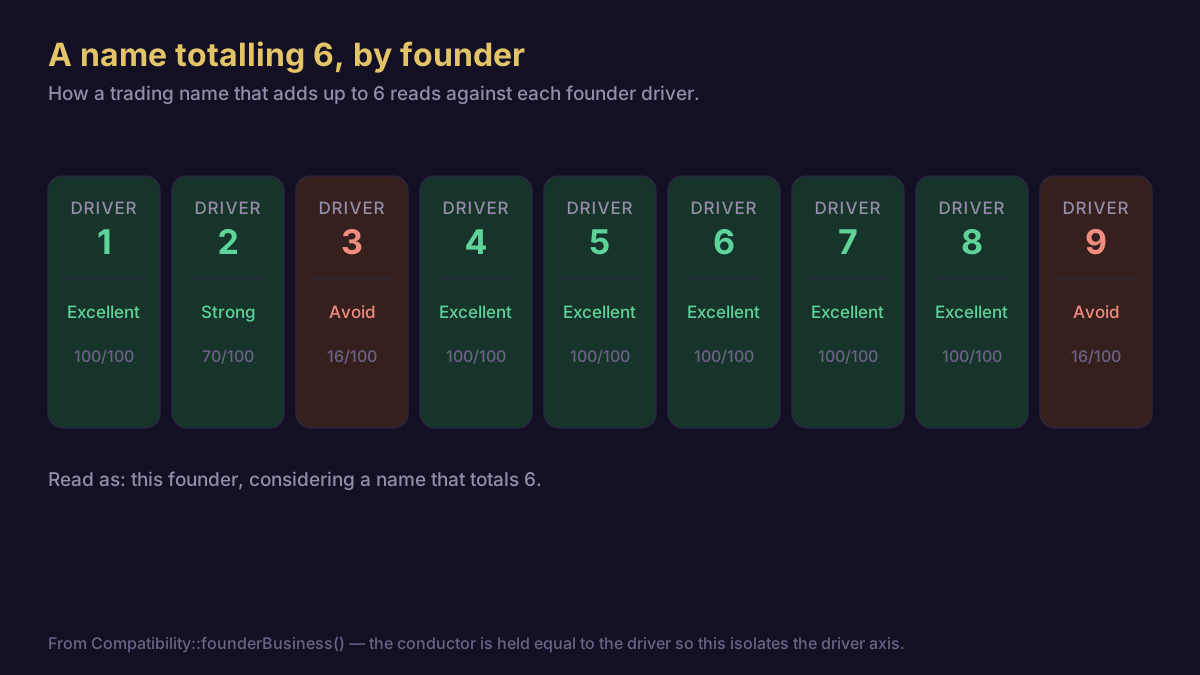
| Driver | 6 as the name total | Why |
|---|---|---|
| 1 | Excellent | 1 decides, 6 charms. A blunt founder behind a soft brand. |
| 2 | Strong | Both relational. The risk: nobody in the building will say no. |
| 3 | Avoid | Jupiter and Venus are read as rivals, so the method turns a 6 name down for a 3 driver. |
| 4 | Excellent | 4 supplies the systems a 6 will not build for itself. |
| 5 | Strong | 5 brings traffic, 6 converts and retains it. The hospitality pairing. |
| 6 | Strong but soft | Doubled Venus. Beautiful work, weak pricing. Put margin discipline outside the founder. |
| 7 | Excellent | The numbers agree. 7 wants privacy and few clients where 6 wants to please the room, so the gap is temperament, not fit. |
| 8 | Strong | The property pairing: 8 holds the asset, 6 makes it desirable. |
| 9 | Avoid | 9 and 6 read each other as adverse, so the method turns a 6 name down for a 9 driver, whatever the reach on offer. |
Only two rows there are refusals — drivers 3 and 9. Everywhere else the numbers agree and the column is grading temperament rather than permission. A 7-driver consultant trading under a 6 name is well matched arithmetically and still has a job to do — provided someone else does the hosting.
Chaldean and Pythagorean will usually disagree
The same names under Pythagorean, where A–I are 1–9, J–R are 1–9 and S–Z are 1–8:
| Name | Chaldean | Pythagorean |
|---|---|---|
| Sage Spa | 24/6 | 23/5 |
| Ivy Studio | 33/6 | 45/9 |
| Marigold House | 51/6 | 66/3 |
| Copper Market | 51/6 | 60/6 |
Three of the four disagree. Copper Market lands on 6 in both, which is coincidence rather than confirmation. This site treats Chaldean as primary — the older assignment, and the one the compound tradition was built on. A practitioner using the other table would give a different answer, and neither could prove the other wrong. The guide to choosing a business name sets out the order to run the checks in.
Frequently asked questions
Is 6 a lucky number for business?
The tradition does not call it lucky. It calls it attractive — the number of being preferred. That is worth a great deal in hospitality and little in commodity distribution. Anyone calling a number lucky without asking what the business does has skipped the part that carries information.
Which is better for business, 6 or 8?
They answer different questions. 6 is read as demand and desirability; 8 as slow accumulation, property and land. A hotel wants both — 8 to own the building, 6 to fill it. If the business is an asset play, 8 reads better. If it is a service brand, 6 does.
My business name comes to 33. Is that a master number?
Some lineages treat 11, 22 and 33 as master numbers and report them unreduced. This site reports the compound and then reduces, so 33 is recorded as 33/6 and read as a strong 6. Practitioners who insist on the unreduced reading exist, and there is no way to settle that from within the tradition.
Is 6 good for a hotel or restaurant name?
It is the number the tradition most often attaches to hospitality, yes. The caveat is operational rather than mystical: hospitality already runs on thin margins and long hours, and 6's habit of accommodating erodes both. The name is congruent; the pricing discipline still has to come from somewhere.
Can I keep a 6 name if my driver number is 7?
Yes, and the numbers actively support it — 6 is among the totals the method names as best for a 7 driver, and the calculator scores the pairing at the top of its range. The gap is temperament, not fit: a brand promising warmth, run by someone who would rather be left alone with the work. In practice that shows up as a founder avoiding the client-facing part of their own business. Name it honestly, or hire for the gap.
Where this runs out
No number causes revenue. There is no measured evidence that a business named on a 6 outperforms one named on a 5. The exercise makes a founder describe their own model out loud — how customers choose, how long they stay, how much comes by referral — before committing to a label.
The systems disagree, and so do practitioners within them. Chaldean and Pythagorean rarely land on the same digit. Inside Chaldean, whether 33 reduces or stands, whether 15 is charm or a warning about charm, whether 6 suits 4 or merely tolerates it — none of it is settled.
Tendencies are not diagnoses. The four ways a 6 leaks margin are patterns the tradition describes, not a prediction about a particular founder — a founder with a 4 name can discount just as badly. Treat the list as somewhere to look.
The method cannot see your market. It says nothing about whether the unit economics work, whether the name clears as a trademark or domain, whether a competitor already trades under it, or how it reads in another language. Those checks are not optional.
Nothing here is financial, legal or professional advice. A number is a prompt for reflection and planning. If a reading names something you already half-suspected, that is it working. If it says something you cannot make sense of, put it down.