
Is 5 a good number for business? For a fast, transactional, many-customers business, yes — 5 is one of the strongest name totals in this system. For slow, capital-heavy, few-customers work it is one of the weakest. The number describes a tempo, not a quality. Match the tempo to the model and 5 fits. Mismatch it and 5 reads as restlessness.
What 5 stands for in business numerology
In the source material 5 is attached to Mercury: speech, hands, exchange, short journeys, the marketplace. Every trait the tradition gives it belongs to circulation rather than accumulation. Commercially that turns into four things.
- High transaction frequency. Many small events, not a few large ones. A newsagent taking four hundred sales a day is a 5 business. A firm closing eleven contracts a year is not.
- Short cycle time. The gap between first contact and cash is minutes, days or weeks.
- Adaptability. 5 changes its offer without agonising. Product lines rotate; channels come and go.
- Reach through talk. Advertising, word of mouth, sales calls, listings. 5 is a communicating number before it is a producing one.
The tradition also calls 5 the easiest number to get along with: a 5 name sits well beside every founder number, where a 7 or an 8 grates against several. But "gets along with everything" is not "right for everything", and that gap is where most bad advice about 5 lives. The page on what 5 means for a business carries the full trait list.
None of this says a 5 name produces revenue. A name total is a lens for reflection and planning — a vocabulary for asking whether the label on the door matches the machine behind it. Businesses succeed and fail on product, price, cash and people.
How a name adds up to 5 in Chaldean
Chaldean assigns letters values 1 to 8. There is no 9 for letters — 9 is held apart. Add the values, keep the compound total, then reduce. Report both, compound first.
| Value | Letters |
|---|---|
| 1 | A, I, J, Q, Y |
| 2 | B, K, R |
| 3 | C, G, L, S |
| 4 | D, M, T |
| 5 | E, H, N, X |
| 6 | U, V, W |
| 7 | O, Z |
| 8 | F, P |
Three worked conversions, all invented names:
Halo Trade H5 + A1 + L3 + O7 = 16 T4 + R2 + A1 + D4 + E5 = 16 16 + 16 = 32, and 3 + 2 = 5. Reported as 32/5.
Casa Media C3 + A1 + S3 + A1 = 8 M4 + E5 + D4 + I1 + A1 = 15 8 + 15 = 23, and 2 + 3 = 5. Reported as 23/5.
Ivy Lab I1 + V6 + Y1 = 8 L3 + A1 + B2 = 6 8 + 6 = 14, and 1 + 4 = 5. Reported as 14/5.
Entity suffixes are not counted. "Halo Trade Pvt Ltd", "Halo Trade LLP" and "Halo Trade Inc" are all 32/5: the suffix is conferred by a registrar, not chosen. The tradition counts the name a customer says out loud. The business name analyser runs both systems at once.
The compound numbers behind a 5
This is the part most quick answers skip. Every total below reduces to 5 and the tradition reads them differently. Two names can both be "a 5" and behave nothing alike.
| Compound | Traditional character | Business read |
|---|---|---|
| 14/5 | Movement and risk. Repeated change. | Trade and media. The tradition is wary where borrowed money is involved. |
| 23/5 | Widely treated as the most favourable of the 5s. | Trading, distribution, growth through partners. |
| 32/5 | Communication reaching many people. | Media, retail chains, anything spoken to a crowd. |
| 50/5 | 5 with a zero: reach amplified and hollowed at once. | Distribution, platforms, franchising. Watch thin margins spread wide. |
| 59/5 | Persuasion and influence. | Advertising, publishing, anything sold by argument. |
| 68/5 | A 6 and an 8 inside a 5. Slowness under a fast surface. | Grows more slowly than the 5 suggests. |
Practitioners disagree about several of these, particularly 14 and 68. Where compound and digit pull apart, most lineages let the compound speak first for a business and the digit first for a person. The reference on compound number 50 sets out that argument.
Is 5 a good number for business, or only for some businesses?
Only for some. Four questions decide it faster than any trait list.
1. How many separate transactions in a normal week in year two? Hundreds or thousands points to 5. Under twenty points away.
2. What is the gap between first contact and cash? Minutes to a fortnight suits 5. Past a quarter is 8's territory — and the tradition treats 8 as slow rather than unlucky, a different problem from being wrong.
3. How often will the offer change? If the catalogue, menu or rate card will be materially different in eighteen months, 5 fits. If you are selling the same thing in 2040, it does not.
4. How many channels will carry the revenue? Three or more — shop, marketplace, wholesale, app — favours 5. One channel and one large customer does not.
Three or four yeses and 5 fits. One or none and the name describes a business you are not running. Two is a coin toss the founder's own numbers break.
Where is 5 a good number for business? The sectors that fit
The tradition attaches 5 to the following, and the logic is the same each time: many transactions, short cycle, talk-driven demand.
- Retail and food retail. Convenience, groceries, kiosks, market stalls. High frequency, low ticket.
- Media, publishing and advertising. The business is literally circulation; 59/5 is read as a persuasion number.
- Courier, last-mile, freight forwarding. Movement is the product.
- Marketplaces and aggregators. Small transactions between other people — Mercury's classical job.
- Travel, ticketing and events. Short bookings, seasonal churn, heavy communication.
- FMCG distribution. Route trade, wholesale, cash-and-carry. Thin margin, huge volume.
- Fast brokerage. Insurance renewals, freight broking, ad inventory. The slow kind — business sales, land held for years — runs at a different tempo, even though the sector map names 5 first for property trading.
Sector fit is not a ranking. A 5 name on a courier firm is not "better" than an 8 name on a quarry; it is congruent with it. The industry reference pages set out the numbers attached to each sector.
Where 5 is not a good number for business
This is where a 5 name quietly costs something.
Long-cycle, capital-heavy work. Precision manufacturing, foundries, tooling, plant hire, infrastructure. These businesses win by being the same next decade. A 5 name sets an expectation of pace the operation cannot honour: the brand promising quick, the process delivering slow.
Property development. The sector map names 5 first for real estate and property trading, but a development business that holds land for years runs at 8's tempo: a 5 name over it describes a trader, not a holder — and development is holding.
Long-horizon advice. Finance favours 5 in the sector map, but a practice selling decade-long continuity — long-term funds, planning — pulls against 5's vocabulary of movement.
Trust-heavy professional practice. Clinical, legal, forensic. Few clients, long relationships, high consequence. 7 is the tradition's number for depth, and a 5 name pulls against what the practice sells. The same holds for heritage crafts and slow luxury, where the value is patience made visible and a fast name undercuts the price.
A worked mismatch
An invented precision engineering firm considers Cedar Precision.
C3 + E5 + D4 + A1 + R2 = 15 P8 + R2 + E5 + C3 + I1 + S3 + I1 + O7 + N5 = 35 15 + 35 = 50, reducing to 5.
The founder was born on 22 September 1975. Driver is the day reduced: 2 + 2 = 4, reported 22/4. Conductor is the whole date: (2+2) + (0+9) + (1+9+7+5) = 4 + 9 + 22 = 35, and 3 + 5 = 8, reported 35/8. A person built for systems and slow accumulation. The business is a five-axis machining shop with an eight-month sales cycle and three customers carrying most of the revenue. Every input says slow; the name says fast.
Swap one word. Meridian Precision is M4 + E5 + R2 + I1 + D4 + I1 + A1 + N5 = 23, plus the same 35, giving 58, and 5 + 8 = 13, 1 + 3 = 4. The tradition associates 4 with technology and the unseen — the work nobody watches, and in tempo 58/4 suits the shop. But this site's founder check reads a 4 name as Avoid (16) for a founder whose driver is 4 and conductor 8, and Cedar Precision (50/5) as Excellent (100). The tempo mismatch is real; the fix it points to is operational, not a rename onto 4. Nothing says Cedar Precision would fail; it says the label and the machine disagree.
A worked example from date of birth to shortlist
An invented founder, born 23 May 1988, is naming a last-mile delivery company.
Driver number — day of month reduced: 23 → 2 + 3 = 5. Reported 23/5. Conductor number — the whole date reduced: (2+3) + (0+5) + (1+9+8+8) = 5 + 5 + 26 = 36, and 3 + 6 = 9. Reported 36/9.
A 5 driver with a 9 conductor: quick, trade-minded, broad in outer expression. On a courier business the model and the founder already agree. Three names are on the shortlist.
Orbit Courier O7 + R2 + B2 + I1 + T4 = 16 C3 + O7 + U6 + R2 + I1 + E5 + R2 = 26 16 + 26 = 42 → 4 + 2 = 6.
Kestrel Courier K2 + E5 + S3 + T4 + R2 + E5 + L3 = 24 C3 + O7 + U6 + R2 + I1 + E5 + R2 = 26 24 + 26 = 50 → 5.
Copper Courier C3 + O7 + P8 + P8 + E5 + R2 = 33 C3 + O7 + U6 + R2 + I1 + E5 + R2 = 26 33 + 26 = 59 → 5 + 9 = 14 → 1 + 4 = 5.
| Name | Chaldean | Reduced | Read against driver 23/5 |
|---|---|---|---|
| Orbit Courier | 42 | 6 | Service and comfort. Fine for a concierge courier, soft for volume. |
| Kestrel Courier | 50 | 5 | Matches the driver. The zero widens reach; the caution is margin. |
| Copper Courier | 59 | 5 | Also matches, with a persuasion flavour for a firm that sells hard. |
For volume last-mile on thin margins, 50/5 is congruent, and the compound's warning — reach spread thin — is an operational note, not a superstition. For a courier brand competing on story rather than price, 59/5 reads better. Either is defensible, which is the honest state of most numerology decisions.
The plural trap
Small edits move totals a long way.
- Kestrel Courier = 50/5.
- Kestrel Couriers = 53/8. S is worth 3 in Chaldean, so a plural adds three points and moves a fast 5 to a slow 8.
- The Kestrel Courier = 64/1. "The" is T4 + H5 + E5 = 14, pushing the total into a 1 — founder-led and singular.
It works in reverse: Vela Trade is 31, a 4, while Halo Trade is 32, a 5. One point between a systems name and a trading name.
This is not a reason to torture a good name into a number. It is a reason to check before the signwriter. The founder compatibility tool runs a shortlist against a birth date in one pass.
Is 5 a good number for business against your own driver number?
Name totals are read against the founder's driver, not in isolation. Friendship tables vary between lineages. This site's own reading is that 5 is friendly to every driver — no founder number blocks a 5 name — so the column below grades how well the tempos agree, not whether the pairing is permitted.
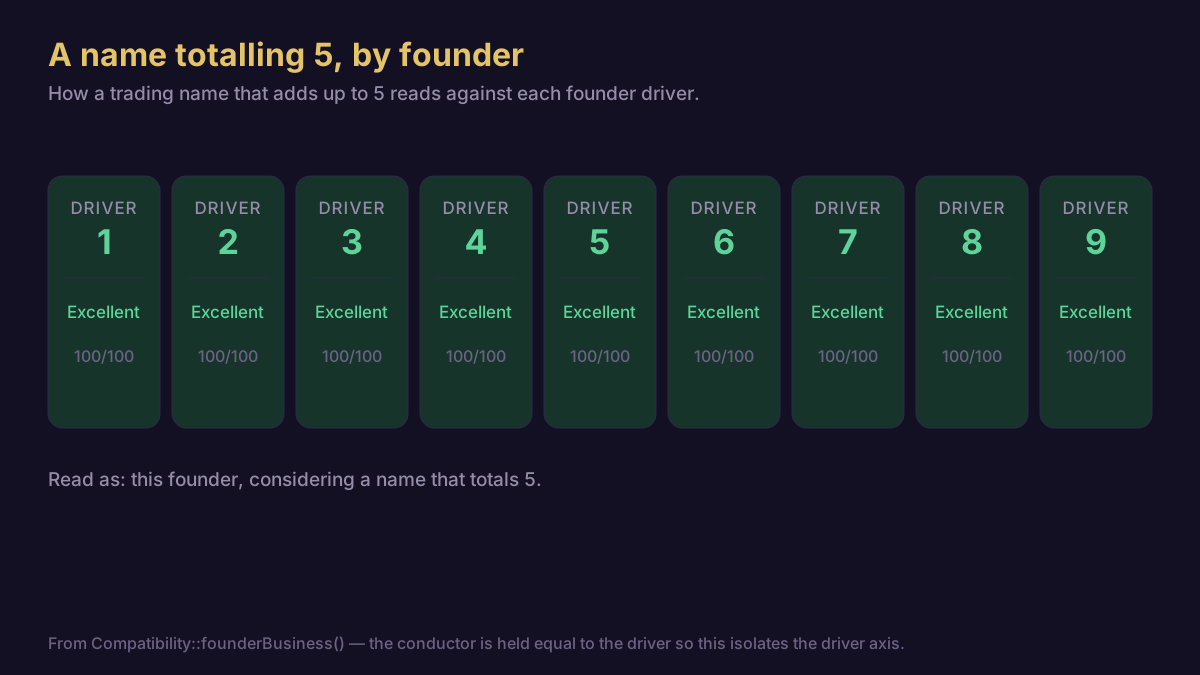
| Driver | 5 as the name total | Why |
|---|---|---|
| 1 | Strong | 1 sets direction, 5 sells it. Risk: two impatient forces, no brake. |
| 2 | Excellent | 2's caution steadies 5's churn. Best when 2 owns the relationships. |
| 3 | Strong | Expression plus circulation. Natural for media, publishing, training. |
| 4 | Excellent | 4 builds process and 5 keeps changing it, so expect argument about structure — but the totals themselves agree. |
| 5 | Strong but volatile | Doubled Mercury. Prone to starting a fourth thing before the third pays. |
| 6 | Strong | 6 supplies taste and retention, 5 supplies traffic. The retail pairing. |
| 7 | Excellent | 5 is one of the three totals the method names as best for a 7. Let the name carry the reach and keep delivery selective. |
| 8 | Excellent | Saturn's friend list is short and 5 is on it. Tempo still differs: 8 accumulates over years, 5 turns over in days. |
| 9 | Excellent | 9's breadth and 5's distribution sit together. Watch the detail. |
No row in that table is a refusal, because no driver number blocks a 5 name. What the column grades is how much managing the pairing needs. A 7-driver founder running a 5-named training company is well matched on the numbers and still has a job to do — provided someone else does the selling.
Chaldean and Pythagorean will often disagree
The same names in Pythagorean, where A–I are 1–9, J–R are 1–9 and S–Z are 1–8:
| Name | Chaldean | Pythagorean |
|---|---|---|
| Halo Trade | 32/5 | 39/3 |
| Kestrel Courier | 50/5 | 71/8 |
| Copper Courier | 59/5 | 81/9 |
Not one agrees. This site treats Chaldean as primary because it is the older assignment and the one the compound tradition was built on. A practitioner using the other table would give a different answer about the same name, and neither can prove the other wrong. The comparison of the two systems sets out what separates them.
Frequently asked questions
Is 5 a lucky number for business?
The tradition does not describe 5 as lucky. It describes it as fast. Speed helps a convenience chain and hurts a foundry. Anyone calling a number lucky without asking what your business does has skipped the part of the method that carries information.
Which is better for business, 5 or 6?
Neither in the abstract. 5 is read as trade and volume; 6 as service, taste and retention. Retail often wants both — 5 to bring people in, 6 to keep them. If your margin comes from repeat custom, 6 usually reads better. If it comes from throughput, 5 does.
My business name comes to 23. Is that the same as a 5?
It reduces to 5 and carries 5's tempo, but the compound is read first for a business. 23 is among the most favourably regarded compounds in the tradition — help arriving from outside, growth through association. A 14/5 shares the digit and a more cautious reading.
Can I keep a 5 name if my driver number is 8?
Yes — the tradition does better than permit it. Saturn's list of friends is short and 5 is on it, and the founder compatibility tool scores a 5 name against an 8 driver at the top of its range. What is left is tempo rather than compatibility: the name promises turnover and the founder is built to accumulate, so expect a founder who finds the business slower than the brand sounds, and plan for that gap.
Is 5 good for an online business?
Usually, yes — most online models are high-frequency and short-cycle, which is 5's shape. The exception is high-ticket services with long sales cycles: those behave like professional practice rather than retail, whatever the delivery channel, and are read closer to 7 or 8 than to 5.
Where this runs out
No number causes revenue. There is no measured evidence that a business named on a 5 outperforms one named on a 4. The value of the exercise is that it makes a founder describe their own model out loud — frequency, cycle length, channels, rate of change — before committing to a label.
The systems disagree, and so do practitioners inside them. Chaldean and Pythagorean rarely land on the same digit, so any answer depends on a choice of table the tradition does not settle. Within Chaldean, whether 14 is a warning or a mild caution, whether 68 leans to 6 or 8, whether 5 is friendly with 4 or merely tolerant — none of it is settled.
The method cannot see your market. It says nothing about whether your unit economics work, whether the name clears as a trademark or domain, whether a competitor already uses it, or what it means in another language. Those checks are not optional.
Nothing here is financial, legal or professional advice. Treat a number as a prompt for reflection and planning. If a reading names something you already suspected, that is it working. If it says something you cannot make sense of, put it down.
To test a shortlist rather than read about one, the business numerology score shows the working for each candidate in both systems.