
There are no lucky words for business names in the sense most people mean. What the tradition holds is that every word carries a number, that the words in a name add together, and that some totals suit some kinds of business better than others. Below are 81 brandable English words with their Chaldean values, grouped by the number they produce.
That reframing turns a superstition into something checkable. A word is not lucky. A word is 25, or 17, or 9, and what it does to your name depends on what the rest of the name totals.
What people mean by lucky words for business names
Most searches start from a reasonable instinct: some words feel better on a sign than others. Summit reads differently from Sludge. But that instinct is about sound and connotation, not number, and the two come apart constantly. In Chaldean numerology, Bright, Crest and Delta all total 17 and land on 8 — the slow number tied to property. The number does not follow the meaning.
The practical claim is narrower than the folklore. A name total has a character; a word contributes a fixed amount to it; you can therefore reach a chosen total by choosing words. Whether that total helps your business is a separate question, answered only in general terms.
Two things this page does not do. It does not promise that a word will bring customers or money — no arrangement of letters does that. And it does not tell you a word is available: these are ordinary English nouns, trademarked in most classes somewhere.
The letter values behind every total
Chaldean numerology uses eight values across the twenty-six letters. There is no 9 for any letter — the tradition holds it apart — though a word's total can still land on 9.
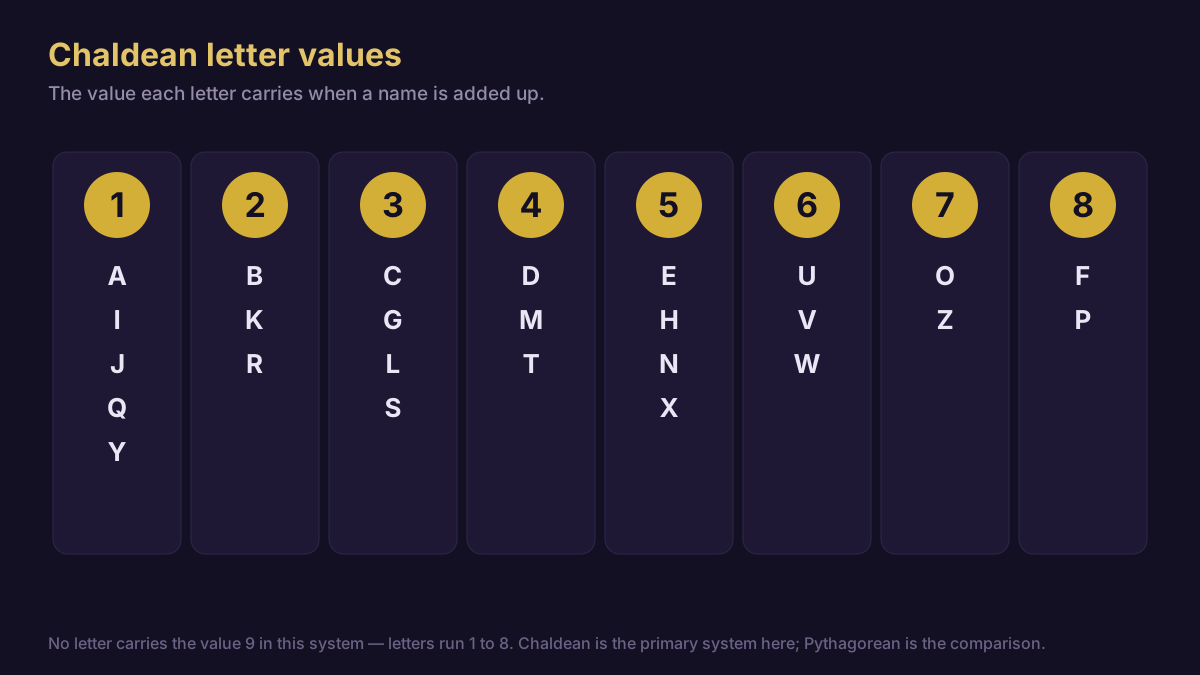
| Value | Letters |
|---|---|
| 1 | A, I, J, Q, Y |
| 2 | B, K, R |
| 3 | C, G, L, S |
| 4 | D, M, T |
| 5 | E, H, N, X |
| 6 | U, V, W |
| 7 | O, Z |
| 8 | F, P |
Two worked conversions, so the table below is checkable rather than merely asserted:
Harbour — H·A·R·B·O·U·R = 5+1+2+2+7+6+2 = 25, then 2+5 = 7. Reported as 25/7.
Copper — C·O·P·P·E·R = 3+7+8+8+5+2 = 33, then 3+3 = 6. Reported as 33/6.
Note the two Ps in Copper carrying 8 each. F and P are the only letters worth 8, and the fastest way to push a short word upward. A word's total is bounded by its length — an n-letter word totals between n and 8*n* — which is why Bay can only be 4 while Copper reaches 33.
Pythagorean spreads 1–9 across the alphabet and values the same words differently, so the two cannot be mixed in one calculation; the comparison between Chaldean and Pythagorean sets out where they diverge.
Reference table: lucky words for business names, grouped 1 to 9
Eighty-one words, sorted within each row by ascending total. The figure is the compound; the row heading is the reduced digit.
| Reduces to | Word and Chaldean total |
|---|---|
| 1 | Axis 10 · Oak 10 · Apex 19 · Aurora 19 · Origin 19 · Pearl 19 · Quest 19 · Trust 19 · Verity 19 |
| 2 | Jade 11 · Salt 11 · Echo 20 · Frame 20 · Garden 20 · Prime 20 · Root 20 · Vault 20 · Compass 29 |
| 3 | Atlas 12 · Beam 12 · Elm 12 · Sage 12 · Ascent 21 · Cove 21 · Field 21 · Granite 21 · Torch 21 |
| 4 | Bay 4 · Bell 13 · Gate 13 · Quarry 13 · Haven 22 · Hearth 22 · Ledger 22 · Noble 22 · Summit 22 |
| 5 | Ark 5 · Mint 14 · Quill 14 · Tide 14 · Anchor 23 · Beacon 23 · Crown 23 · Grove 23 · Meridian 23 |
| 6 | Arc 6 · Cedar 15 · Clarity 15 · Ridge 15 · Nexus 24 · Stone 24 · Tower 24 · Union 24 · Copper 33 |
| 7 | Dawn 16 · Light 16 · Orbit 16 · Peak 16 · River 16 · Forge 25 · Harbour 25 · Lantern 25 · Horizon 34 |
| 8 | Ivy 8 · Sail 8 · Bridge 17 · Bright 17 · Circle 17 · Core 17 · Crest 17 · Delta 17 · Pivot 26 |
| 9 | Crag 9 · Dial 9 · Acorn 18 · Bond 18 · Craft 18 · Ember 18 · Pillar 18 · Timber 18 · Zenith 27 |
Look down the totals and the structure is obvious. Every word in the 1 row totals 10 or 19; every word in the 7 row totals 16, 25 or 34. The totals for each digit sit on a ladder nine apart, because reduction is remainder-after-division-by-nine arithmetic. A word off its ladder has been miscounted — most often U, V or W, all worth 6.
What the tradition attaches to each row
1 — origination. Apex, Origin, Quest. First-mover and singular: read as suiting a business built around one identifiable operator, and as a poor description of a partnership.
2 — pairing. Compass, Frame, Root, Prime. Balance and mediation rather than initiative. Reads well over agency, broking and advisory work, less well where the proposition is speed.
3 — expression. Field, Torch, Ascent, Sage. Communication, teaching and expansion — publishing, education, events. The traditional caution is scatter: more started than finished.
4 — structure. Ledger, Gate, Summit, Quarry. Technology, systems and the unseen mechanism. Strong for infrastructure, cool for anything meant to feel warm at a counter.
5 — movement. Anchor sits here despite its meaning, with Beacon, Crown, Meridian. Trade and turnover: the most commercially adaptable of the nine, and the least patient.
6 — service. Cedar, Stone, Union, Tower. Comfort, appearance and negotiation: hospitality, interiors, textiles. Its weakness is accommodation — discounts given to keep people happy.
7 — depth. Harbour, Forge, Lantern, Horizon. Research and specialism over reach. Matched to consultancy and niche manufacture; the tradition is cautious about it for mass-market retail.
8 — accumulation. Bright, Bridge, Core, Crest, Delta. Slow, heavy and patient, with property as its asset class — and, with 4, one of the two totals the method flags as difficult for a trading name. A poor fit for anything that must pay for itself quickly.
9 — completion. Timber, Craft, Bond, Ember. No Chaldean letter is worth 9, yet these words total to multiples of it. Force, finishing and endings — with the ending part as its risk.
Why word totals simply add up
Spaces contribute nothing to a Chaldean total, so a multi-word name's total is the sum of the totals of its words. You never re-letter a whole name to test a variation. You add.
- Bright = 17, Forge = 25. Bright Forge = 17 + 25 = 42, and 4+2 = 6.
The long way: B2+R2+I1+G3+H5+T4+F8+O7+R2+G3+E5 = 42. Same answer. The shortcut holds for any number of words, which turns a word list into a tool.
| Name | Sum | Total |
|---|---|---|
| Bright Copper Forge | 17 + 33 + 25 | 75/3 |
| Bright Forge | 17 + 25 | 42/6 |
| Copper Forge | 33 + 25 | 58/4 |
| Bright Copper | 17 + 33 | 50/5 |
One three-word name and its two-word subsets produce four different numbers. Dropping Copper from Bright Copper Forge moves it from 75/3 to 42/6 — a shift of exactly 33, Copper's own value. Every word added or removed moves the total by precisely its own number.
The neutral words that change nothing
One consequence of the ladder is worth knowing before you spend an evening testing combinations. A word totalling a multiple of nine leaves the reduced digit exactly where it was. It changes the compound, not the digit.
Start from Harbour at 25/7 and add words from the 9 row:
| Name | Arithmetic | Result |
|---|---|---|
| Harbour | 25 | 25/7 |
| Harbour Labs | 25 + 9 | 34/7 |
| Harbour Craft | 25 + 18 | 43/7 |
| Harbour Timber | 25 + 18 | 43/7 |
| Harbour Zenith | 25 + 27 | 52/7 |
| Harbour Ventures | 25 + 36 | 61/7 |
Every one is still a 7. This is not a special property of Harbour: it follows from the arithmetic and holds for any base name. Quarry is 13/4 and Quarry Labs 22/4; Bright is 17/8 and Bright Timber 35/8.
That gives two practical moves. To lengthen a name without disturbing its digit, add a 9-row word — Craft, Timber, Bond, Ember, or the descriptor Labs. If you need the digit to move, a 9-row word is the wrong choice.
It also disposes of a common claim. People sometimes say that appending a word "strengthens" a name numerologically. Where that word is a multiple of nine, it changes the compound and leaves the digit alone; whether that counts as strengthening is interpretation, not calculation.
Descriptor words and what each one costs
The second half of most business names is a descriptor. These are rarely chosen for their number and almost always determine it, because they are long. Entity suffixes — Pvt Ltd, LLP, Inc — are conferred by a registrar and not counted.
| Descriptor | Value | Descriptor | Value |
|---|---|---|---|
| Labs | 9/9 | Instruments | 42/6 |
| Realty | 16/7 | Group | 26/8 |
| Works | 20/2 | Logistics | 28/1 |
| Trading | 20/2 | Company | 29/2 |
| Capital | 21/3 | Supply | 29/2 |
| Press | 21/3 | Partners | 30/3 |
| Design | 21/3 | Associates | 31/4 |
| Bureau | 22/4 | Industries | 34/7 |
| Systems | 23/5 | Ventures | 36/9 |
| Estates | 25/7 | Collective | 40/4 |
| Studio | 25/7 | Consulting | 40/4 |
| Properties | 45/9 | International | 44/8 |
Some near-synonyms carry very different values. Group is 26 and Company 29; swap one for the other and the name moves by 3. Works is 20, Studio 25, Partners 30, Associates 31. If a name is one rung off the total you want, the cheapest fix is usually here rather than in the distinctive word — nobody forms an attachment to the word Group.
Note Labs at 9/9 and Ventures at 36/9: both neutral by the rule above. And Consulting, Collective and Engineering, all 40/4 — numerically identical despite sounding nothing alike.
Using lucky words for business names to hit a target number
Work backwards: decide the digit, choose the descriptor, then pick the distinctive word that closes the gap. Suppose an invented consultancy wants a 7, the tradition's number for specialism, and the founders like the word Meridian.
- Meridian = M4+E5+R2+I1+D4+I1+A1+N5 = 23, which reduces to 5.
- A 7 needs a total on the 7 ladder: 16, 25, 34, 43, 52, 61, 70, 79.
- From 23, the reachable rungs are 34 (add 11), 43 (add 20), 52 (add 29), 61 (add 38), 70 (add 47).
- Check the descriptor table for those values. Works and Trading are 20. Company and Supply are 29.
| Candidate | Arithmetic | Total |
|---|---|---|
| Meridian Works | 23 + 20 | 43/7 |
| Meridian Company | 23 + 29 | 52/7 |
| Meridian Partners | 23 + 30 | 53/8 |
| Meridian Group | 23 + 26 | 49/4 |
| Meridian Systems | 23 + 23 | 46/1 |
| Meridian Labs | 23 + 9 | 32/5 |
Meridian Works at 43/7 and Meridian Company at 52/7 both reach the digit, but neither reaches a comfortable compound. Meridian Partners, which the founders might have reached for first, lands on 53/8, a total the method marks down for any trading name, even though the sector map lists 8 for consultancy. Meridian Labs stays on 5, because Labs is a 9-row word and changes nothing.
The two 7s do not rescue each other: 43 is avoided for a company name, and the classical table gives 52 the same meaning as 43 — upheaval and plans that do not complete. The compound numbers reference sets out what each is held to mean, the business name analyser runs this arithmetic and shows its working, and the name recommendation tool inverts the problem, generating candidates that already land on a target. If the name has to survive as a web address, the domain name analyser scores the string as it would be registered, which is not always the same string.
One caution about spelling tricks. Respelling often fails, because Chaldean gives several letters the same value. Kite and Kyte both total 12, since I and Y are both 1. Verity is 19 and Veritas 22, because the added S is worth 3 — that one works. But a name nobody can spell on the phone has a commercial price the number does not offset.
Frequently asked questions
Which words are luckiest for a business name?
None, taken alone. A word carries a fixed number and contributes it to the name's total, but whether that total suits you depends on the business and the founder's own numbers. Bright is 17/8: 8 is tied to property and slow accumulation, but the method marks an 8 total down for a trading name and reads 17 as the weakest route to 8.
How do I find the number of a word myself?
Replace each letter with its Chaldean value from the table above, add them for the compound total, then add those digits until one remains. Forge is F8+O7+R2+G3+E5 = 25, and 2+5 = 7, so 25/7. Report both figures, compound first.
Does adding a word to my business name change its number?
Yes, by exactly that word's own total. Bright is 17/8; add Forge at 25 and Bright Forge becomes 42/6. The exception is a word totalling a multiple of nine — Labs, Craft, Timber, Ventures — which changes the compound but leaves the reduced digit untouched.
Do I count Ltd, LLC or Inc in the total?
No. Entity suffixes are conferred by a registrar and describe legal form rather than identity, so the tradition excludes them. Score the trading name — what appears on signage, invoices and advertising. Where registered and trading names differ, the trading name is what the market transacts with.
Are these words available to use?
They are ordinary English words, which means they are common in existing brand names and registered as trademarks in many classes. Nothing on this page is a clearance opinion. Search the relevant registers in your own jurisdiction and classes before spending anything on branding.
Why do some very different words have identical numbers?
Because only eight letter values exist and totals collapse to nine digits. Bright, Crest, Delta, Circle and Core all total 17. The system cannot distinguish them, which is a real limitation rather than a hidden subtlety — the number is a coarse measurement, not a fingerprint.
Where this runs out
The arithmetic here is exact and checkable. The interpretation is not, and it is worth being clear about which is which.
Verifiable: the letter values, the totals, the additivity rule, and the fact that multiples of nine leave a reduced digit unchanged. Anyone can confirm it with a pen, and if a source gives a different total for Harbour than 25, one of you has miscounted.
Not verifiable: that 7 means depth, that 8 accumulates slowly, or that any of it affects a business's results. Those are traditional attributions — a reason to find them interesting, not to treat them as established. No study demonstrates that name numbers influence commercial outcomes, and this page makes no such claim. Nothing here is financial or legal advice, and no word above will bring in revenue.
Practitioners also disagree in ways that change the answer. Some count entity suffixes. Some score the legal name rather than the trading name. Some treat 11, 22 and 33 as master numbers never to be reduced, which would move Jade, Salt, Copper and the five 22s — Haven, Hearth, Ledger, Noble, Summit — out of the rows shown here. Some use Pythagorean throughout and get different values for every word. There is no adjudicating body, and any source presenting one method as definitively correct overstates what is known. The numerology glossary sets out competing terms.
The deepest limit is in the arithmetic. Eighty-one words collapse into nine outcomes, and dozens of unrelated words share a value. A system with nine answers cannot capture what distinguishes one business from another. It is a prompt for structured reflection — a question, not an answer.
Choose a word because it says what you mean, is available, and will still fit in ten years. Then, if the number matters to you, check it against the best name numbers for business and your own chart, treating a poor score as a reason to think again rather than a verdict. The sequence in how to choose a business name puts those steps in order.