
Is 3 a good number for business? For anything that sells words, ideas, teaching or reach — publishing, media, training, agencies, courses — the tradition treats 3 as one of the strongest name totals available. For anything that needs patience, secrecy or heavy capital, it is one of the weakest. The digit is not lucky or unlucky. It is specialised.
That specialisation is why a flat verdict is useless. This page shows the arithmetic that gets a name to 3, what the tradition says the digit does, and — the part most pages skip — the specific commercial ways a 3 goes wrong.
Is 3 a good number for business? The short answer
In the source material, 3 is the number of expression, attributed to Jupiter: expansion, teaching, optimism, visibility, multiplication. A 3 is what happens when something gets said out loud and repeated. Three consequences follow, and they are why the digit divides opinion.
3 multiplies. A 3 name is read as amplifying whatever the business already does. Excellent if that thing is good and repeatable; expensive if it is half-finished, because 3 does not distinguish between multiplying revenue and multiplying loose ends.
3 sells attention rather than assets. Money comes from reach — audience, reputation, referral — not from stock, plant or property. That means low capital requirements and fast starts, and a thin asset base when a bad quarter arrives.
3 does not naturally finish things. The same quality that makes a 3 good at starting conversations makes it bad at closing them.
If your model is "make something once, sell it many times, to people who heard about you", the tradition reads 3 as a strong fit. If it is "build something slowly and expensively, then defend it", 3 reads poorly, and the tradition points toward 8 and its slow accumulating character instead.
How a business name reaches 3: the arithmetic
Every number claim here shows its working. Chaldean is the primary system throughout.
| Value | Letters |
|---|---|
| 1 | A, I, J, Q, Y |
| 2 | B, K, R |
| 3 | C, G, L, S |
| 4 | D, M, T |
| 5 | E, H, N, X |
| 6 | U, V, W |
| 7 | O, Z |
| 8 | F, P |
There is no 9 in the Chaldean letter set. Nine is held apart, so a total can reduce to 9 but no single letter contributes one.
Take an invented publishing imprint, Ember Press.
E5 + M4 + B2 + E5 + R2 = 18
P8 + R2 + E5 + S3 + S3 = 21
18 + 21 = 39
3 + 9 = 12 → 1 + 2 = 3
That is 39/3 — compound first, reduced digit second. The compound carries its own character, so it is never thrown away: two names can both reduce to 3 and read differently because one arrived via 12 and the other via 48.
One rule catches people out: entity suffixes are not counted. Ltd, Pvt Ltd, LLP and Inc are conferred by a registrar, not chosen, so the tradition does not treat them as part of the name. Counting them would move the reading — Ember Press Ltd computes to 50/5 — and give one brand a different number in every jurisdiction. The business name analyser runs the same arithmetic and shows each letter's contribution.
The compound routes to 3
Nine realistic compounds reduce to 3 in English business names. They are not interchangeable.
| Compound | Reduced | Traditional character | Business read |
|---|---|---|---|
| 3 | 3 | The bare digit. Only very short names reach it. | Raw expression, nothing modifying it. Rare and blunt. |
| 12/3 | 3 | Effort given to others; learning through being used. | Strong at teaching and service, chronically weak at pricing. |
| 21/3 | 3 | Advancement and honours after a long climb. Favourable. | The best 3 for a business that takes years to build an audience. |
| 30/3 | 3 | Thoughtful, detached, able but indifferent to material reward. | Neither helps nor hinders. The outcome rests on the operator. |
| 39/3 | 3 | The 30 family with output added. | The workhorse publishing and media 3. |
| 48/3 | 3 | Reach and ambition, with 4 and 8 inside it. | Advised against for a company name; 39 or 57 are the preferred routes to 3. |
| 57/3 | 3 | Trade meeting analysis. | A 3 that travels and specialises rather than broadcasts. |
| 66/3 | 3 | Doubled comfort and attraction. | Spends on appearance. Fine for lifestyle brands, costly elsewhere. |
| 75/3 | 3 | Analysis expressed. | A 3 that advises rather than performs. |
A word of honesty about that table. The classical compound list is well attested to about 52 and thins above it. The readings for 57, 66 and 75 are derived by treating the two digits as a pair rather than inherited whole, and practitioners differ on them. If a reading of 66 is presented as ancient and settled, treat that with scepticism. The reference page for compound number 39 is the one to read first: 39 is by some distance the most common route to 3 in English trading names.
Where 3 works: expression, teaching and reach
The tradition attaches 3 to sectors where the product is, in some form, something said.
| Sector | Why the tradition fits 3 | The failure mode to watch |
|---|---|---|
| Publishing and print | One work multiplied; reputation compounds | Backlist neglected while chasing the next title |
| Media, content, newsletters | Revenue scales with reach, not headcount | Audience growth mistaken for a business model |
| Training, courses, academies | Teaching is 3's native activity | Curriculum sprawl; many courses, none finished |
| Marketing and creative agencies | Sells expression directly | Underpricing; scope creep; slow collection |
| PR, events, speaking | Visibility is the product | Cash flow gaps between engagements |
| Coaching and advisory practices | Reputation-led acquisition | Founder becomes the bottleneck |
Notice what is absent. Manufacturing, property and logistics — none appear. Those are businesses where money is made by holding something over time rather than by saying it well. The number 3 in business page covers the sector associations, and the ranking of name totals is in best name numbers for business.
Where 3 costs money: the scattering problem
This is the part most numerology pages leave out.
Product proliferation. The characteristic 3 failure is launching the fourth thing before the second has paid back its build cost. It is hard to stop from the inside, because each launch produces a burst of interest that feels like validation. One discipline: before launching, write down the revenue figure at which the previous product is declared finished. If you cannot state that number, you are about to scatter.
Pricing softness. 3 is warm, and warmth discounts. The tradition attaches to 3 a tendency to price for approval rather than margin. The commercial version is arithmetic: a 10% discount on a 40% gross margin removes a quarter of the gross profit. Do that across a client book and the business works a third harder for the same money.
Slow collection. Businesses that sell relationships are bad at chasing relationships for money. Receivables are where the tendency shows first and most measurably: if average days-to-payment drifts up while revenue is flat, that is the pattern.
Hiring for personality. 3 recruits people it enjoys talking to, and keeps them too long. The tradition's phrasing is that 3 finds it hard to be unpopular.
The focus tax. If a founder's attention is the scarce input and three product lines each take a third, none gets the push that turns a decent product into a category one. Two usually subsidise the one that eventually works, and the question is whether you can afford the subsidy long enough.
Where 3 is the wrong tool. For a business that needs patience — a practice building over a decade, a manufacturer amortising tooling, a property holding company — the tradition treats a 3 name as working against the grain. Not fatal. Against the grain.
The traditional mitigation is not to abandon the 3 but to add ballast elsewhere: an operating partner whose driver is 4 or 8, or a steady first-tier registration date. A date or a unit number on 4 or 8 is not the way to do it here — the launch date finder puts 4 and 8 on its avoid tier, and the premises analyser caps a unit on 2, 4 or 8. That structures your thinking; it is not a formula that produces results.
Worked example: a training company, end to end
An invented professional training company, Larkfield Academy. One founder, born 21 March 1988.
Step 1 — the trading name.
L3 + A1 + R2 + K2 + F8 + I1 + E5 + L3 + D4 = 29
A1 + C3 + A1 + D4 + E5 + M4 + Y1        = 19
29 + 19 = 48
4 + 8 = 12 → 1 + 2 = 3
Larkfield Academy = 48/3. A 3, but on a compound the business sources advise against for a company name; 39 and 57 are the preferred routes to 3.
Step 2 — the founder's driver number. Day of the month, reduced.
21 → 2 + 1 = 3Driver = 3.
Step 3 — the founder's conductor number. The whole date, reduced.
2 + 1 + 0 + 3 + 1 + 9 + 8 + 8 = 32 → 3 + 2 = 5Conductor = 32/5.
Step 4 — read the three together. A 3 name, a 3 driver, a 5 conductor: every element is a moving one, weighted toward expression and change with nothing anchoring it. The tradition would expect a business that grows quickly on the founder's visibility, then struggles to become a repeatable, delegable operation. Course count rises. Completion rates fall. The founder is on every call.
Step 5 — what the tradition suggests. Two options, both with visible arithmetic. First, change the name to add weight — keep "Larkfield" and change the second word:
| Name | Arithmetic | Total |
|---|---|---|
| Larkfield Academy | 29 + 19 | 48/3 |
| Larkfield Labs | 29 + 9 | 38/2 |
| Larkfield Media | 29 + 15 | 44/8 |
| Larkfield Works | 29 + 20 | 49/4 |
| Larkfield Studio | 29 + 25 | 54/9 |
| Larkfield School | 29 + 28 | 57/3 |
| Larkfield Institute | 29 + 33 | 62/8 |
Larkfield Institute at 62/8 is the heaviest option, Larkfield Works at 49/4 the most structural. School keeps it on 3 despite feeling more solid than Academy — intuition and arithmetic disagree, which is why the calculation matters. The founder check settles the choice: Institute and Works both drop this founder's fit from Excellent (100) to Workable (57), because 4 and 8 are penalised as trading-name totals, while Larkfield School at 57/3 keeps it at 100 and lands on the compound the business sources prefer as the correction for 48.
Or keep the name and choose the date. Registering on 5 August 2026 gives a day number of 5, a first-tier date number, and a full-date number of 0+5+0+8+2+0+2+6 = 23 → 5. The launch date finder scores it 66 for this founder and does not block it; an 8th, by contrast, sits on its avoid tier and scores 28.
Neither is a promise. Both are structured ways of naming a tension the founder can already feel. The founder compatibility tool runs the name-against-driver comparison across candidates, and how to choose a business name covers the wider process.
Is 3 a good number for business when the founder is not a 3?
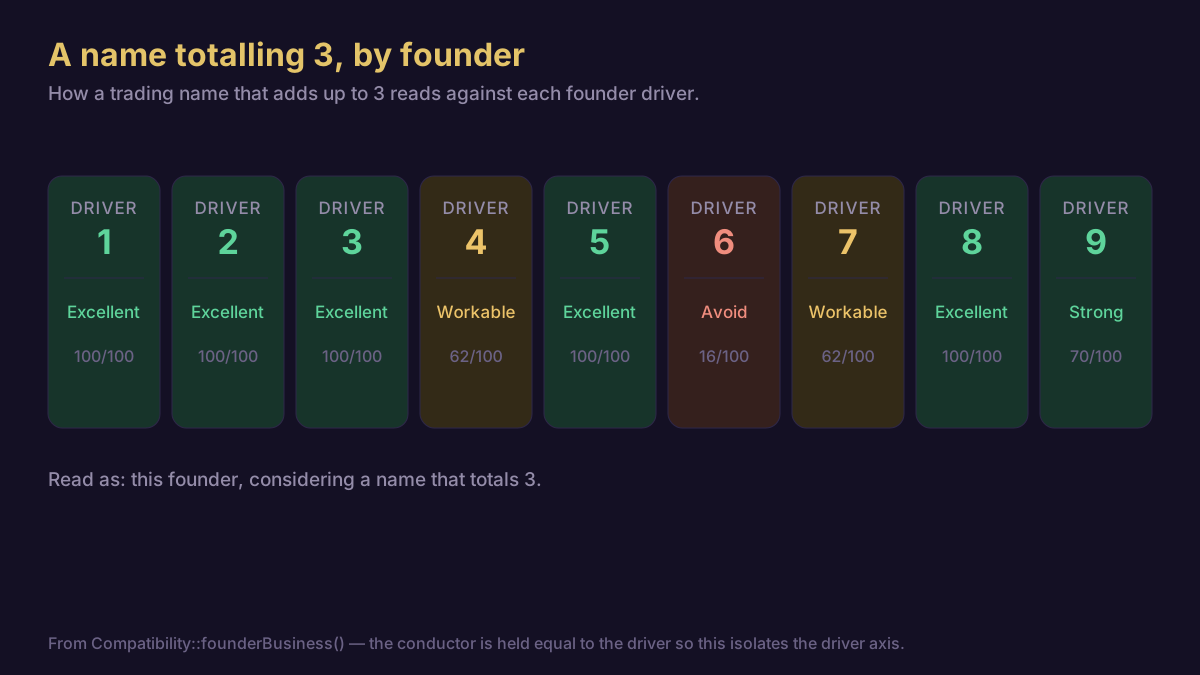
A name total is read against the founder, not alone. The tradition's usual grouping for a 3 name:
| Founder's driver | Reading of a 3 name | Note |
|---|---|---|
| 1 | Friendly | 1 supplies the decisiveness 3 lacks |
| 2 | Friendly | Softens 3 further; risk of a business that is all charm |
| 3 | Amplifying | Doubles both the strength and the scattering |
| 4 | Mixed | 4 supplies structure but resents 3's improvisation |
| 5 | Excellent | Two moving numbers; the totals agree, but consolidation needs managing |
| 6 | Avoid | Jupiter and Venus are read as rivals; the method turns a 3 name down for a 6 driver |
| 7 | Workable | 7 wants depth, 3 wants breadth |
| 8 | Excellent | 8 counts 3 a friend and supplies the weight 3 lacks |
| 9 | Friendly | Both expansive; 9 adds a finishing instinct 3 needs |
Practitioners disagree most about the 3–4 and 3–7 pairings, and confident opposite verdicts circulate on both. Where the tradition contradicts itself, saying so is more useful than picking the version that sounds better.
Chaldean and Pythagorean do not agree about 3
Both systems are in circulation and routinely disagree, because Chaldean assigns letters by sound value across eight numbers while Pythagorean runs A–Z through 1–9.
| Name | Chaldean | Pythagorean |
|---|---|---|
| Ember Press | 39/3 | 48/3 |
| Larkfield Academy | 48/3 | 67/4 |
| Wren Books | 39/3 | 41/5 |
| Trellis Labs | 30/3 | 39/3 |
Two agree, two do not. Chaldean is primary here and Pythagorean is comparison — not because Chaldean is provably correct, but because the business-naming source material is written in it, and mixing the two produces incoherent readings. See Chaldean vs Pythagorean numerology. Pick one and stay in it.
Frequently asked questions
Is 3 a good number for a business name?
It is a good number for a business that sells expression — publishing, media, training, agencies, events, anything growing through reputation and repetition. It is poor for businesses needing patience, secrecy or heavy fixed assets. The digit describes a working style rather than a level of luck, so the question only has an answer once you say what the business does.
What does 39 mean in business numerology?
39 reduces to 3 and sits in the same family as 30: capable, expressive, not especially attached to material accumulation. The 9 adds output and completion, which is why 39 is the most common favourable route to 3 in English trading names. It reads as a workhorse, not a windfall.
Can I change my business name so it adds to 3?
Yes, and usually with one word rather than a rewrite. Changing "Labs" to "Academy" moves a total ten points, because Labs is 9 in Chaldean and Academy is 19. Work out your current total, then find the gap to close. A legal name change carries cost and disruption, and the method promises no return on that spend.
Is 3 better than 8 for business?
They are not on the same scale. 3 is fast, visible and light on capital; 8 is slow, heavy and accumulating, with property and land as its asset class. A media company with an 8 name and a property company with a 3 name are each fighting their own number. Match the digit to the model rather than rank them.
Does adding Ltd or Inc change the number?
No. Entity suffixes are conferred by a registrar rather than chosen, so the tradition excludes them. It matters more than it sounds: Ember Press is 39/3, while Ember Press Ltd computes to 50/5. Counting suffixes would give one brand a different number in every country it registers in.
Which number 3 compound is best for business?
21/3 is the one the tradition treats most favourably, read as advancement after a long climb. 48/3 is advised against for a company name, with 39/3 and 57/3 the preferred routes. 12/3 needs the most commercial care: its character is effort given away, a fair description of an agency that consistently underprices.
Where this runs out
The method cannot see your market. It has nothing to say about demand for what you sell, whether your unit economics work, or whether your co-founder is trustworthy. Those questions decide outcomes. A name total does not.
Nor is the evidence of a kind that would satisfy a sceptic, and it should not be presented as though it were. The pattern-matching runs backwards: you notice the 3-named media companies that worked, not the far larger number that closed in year two. That is survivorship bias, and it is the most serious honest objection to the field.
There is real internal disagreement too. The compound readings above 52 are thin, and practitioners split on the 3–4 and 3–7 pairings. There is also no settled answer to the most practical question — which name counts. The registered name, the trading name, the domain and the phrase customers say are often four strings with four totals. Most practitioners weight by usage: the name said out loud wins. That is a convention, not a rule with authority behind it.
Used well, this is a structured prompt. If the arithmetic says your name is a 3 and your business needs patience, the useful move is not to panic but to look honestly at your receivables, your product count and your discount rate. If they show scattering, the number gave you a prompt worth having. If not, ignore it.
Do not spend meaningful money reshaping a working brand on this basis. Rebranding costs are real, recognition is hard-won, and no reading here promises a return. Treat it as guidance for reflection and planning.