
Is 1 a good number for business? Yes, if the business is genuinely one person's — a founder-led consultancy, a studio with a name on the door, a first-mover product. No, if it is a partnership of equals. In the tradition, 1 is the number of the single point of authority. It does not divide well.
That is a sharper verdict than most digits allow, because 1's character is narrow. It says something specific about ownership: who decides, who is visible, and what happens when that person is not in the room. This page shows the arithmetic, the nine compound routes to 1, and what the tradition suggests when you already have co-founders.
Is 1 a good number for business? The short answer
In the source material, 1 is attributed to the Sun: beginning, originality, visibility, command, singularity. It is the number of the thing with no precedent and no committee. Four consequences matter commercially.
1 concentrates. A 1 name gathers attention, credit and decision-making toward one point. Where speed of decision is the product — a boutique advisory, a specialist bought for their judgement — that is an advantage. Nothing waits to be agreed.
1 is visible. A public number, suiting businesses whose acquisition runs through reputation attached to a person rather than a category. So 1 sits well on named practices and badly on commodity resellers.
1 originates but does not maintain. Its character is first, not lasting. It starts well and is indifferent to the second phase, where a business becomes a system rather than a person.
1 does not share. This is the part that costs money.
For a sole founder building around their own judgement, the tradition reads 1 as one of the strongest totals available. Where there are two of you on equal shares and equal say, it quietly backs one of you.
How a business name reaches 1: the arithmetic
Chaldean is primary here, assigning letters eight values rather than nine.
| Value | Letters |
|---|---|
| 1 | A, I, J, Q, Y |
| 2 | B, K, R |
| 3 | C, G, L, S |
| 4 | D, M, T |
| 5 | E, H, N, X |
| 6 | U, V, W |
| 7 | O, Z |
| 8 | F, P |
Nine is not assigned to any letter, so a total can reduce to 9 but no letter contributes one. Take an invented advisory firm, Kestrel Consulting.
K2 + E5 + S3 + T4 + R2 + E5 + L3                    = 24
C3 + O7 + N5 + S3 + U6 + L3 + T4 + I1 + N5 + G3     = 40
24 + 40 = 64
6 + 4 = 10 → 1 + 0 = 1
That is 64/1 — compound first, reduced digit second. The compound is not decoration: a name reaching 1 via 19 and one reaching it via 28 read differently, and reducing straight to the digit loses that.
Entity suffixes are excluded. Ltd, Pvt Ltd, LLP and Inc are conferred by a registrar, not chosen. Run it and the reason is obvious: Kestrel Consulting Pvt Ltd computes to 93/3, a different reading of the same firm. The business name analyser applies the convention and shows the working.
The compound routes to 1
Nine realistic compounds reduce to 1 in English business names. They are not equivalent.
| Compound | Reduced | Traditional character | Business read |
|---|---|---|---|
| 1 | 1 | The bare digit. Only very short names reach it. | Raw command, nothing modifying it. |
| 10/1 | 1 | The wheel: rise and fall, honour and reverse. | A weak route to 1; 19 is preferred. Needs a balance sheet that survives a bad year. |
| 19/1 | 1 | Among the most favourable compounds: recognition, the sun at height. | The best 1 for a founder-brand business. |
| 28/1 | 1 | Building, then rebuilding; loss through misplaced trust. | Be most careful with this one. Get the contracts right. |
| 37/1 | 1 | Good fortune through associations and partnerships. | The exception, with 46: a 1 the tradition reads as good for partnerships. |
| 46/1 | 1 | Read with 37: fortunate friendships and partnerships. | Favoured for a company name; a sociable route to 1. |
| 55/1 | 1 | Doubled 5: movement resolving to one point. | Favoured for a sole owner and avoided for a partnership. Suits trading and distribution. |
| 64/1 | 1 | Split: the sources disagree on reading it as a compound at all. | One source lists it among the strong routes to 1; treat it as unsettled. |
| 73/1 | 1 | 7's analysis expressed through 3. | Specialist authority. Consulting and research-led firms. |
A necessary caveat. The classical list is well attested to roughly 52 and thins above it. The reading for 73 is derived by reading the digits as a pair; 55 and 64 carry brief business readings but no classical entry, and practitioners differ sharply. Any page presenting all nine with equal confidence is overselling. See compound number 19, the strongest of them.
When is 1 a good number for business? Founder-led companies
The tradition attaches 1 to structures, not only sectors. What these share is a customer buying one person's judgement, and one apex on the org chart.
| Business type | Why 1 fits | What it looks like when it works |
|---|---|---|
| Named consultancy or advisory practice | Client buys the principal's judgement | Premium pricing, referral-led, small team |
| Architecture or design practice | Authorship is the product | Portfolio compounds; the name means something |
| Founder-brand media, coaching, education | Audience is attached to a person | Direct relationship, low acquisition cost |
| First-to-market product or original IP | 1 is the number of the unprecedented | Category defined before competitors arrive |
| Sole trader and single-member companies | Structure matches the number exactly | No friction between name and reality |
The mechanism claimed is concentration: a 1 name pulls the identity of the business toward one point. Where that point is a competent, visible operator, it is an asset. The number 1 in business page covers the sector associations.
Why 1 struggles in a genuine partnership
This part is worth taking seriously, because the pattern plays out in commercial documents, not anything mystical.
Equity drifts from the cap table. A 1-named business tends toward a single centre of gravity regardless of the shareholders' register. Two founders can hold 50/50 and still have a business where one is unmistakably the company. That gap between legal and perceived ownership is where disputes start.
There is no tiebreaker. A 50/50 split with no casting vote works exactly as long as the founders agree. A 1 name pushes toward a single decision-maker; if the constitution names none, the business picks one informally, and the other founder finds out which they are during the first serious disagreement.
Key-person risk becomes valuation risk. This one is measurable. A business whose revenue is visibly attached to one named individual attracts a key-person discount on exit, because buyers pay for cash flows that survive the seller's departure. If the second founder's contribution is real but invisible, the discount applies regardless.
Senior hires bounce off. Strong operators want authority, and one apex leaves little room to grant it. The hires who would let the founders step back are the hardest to keep.
Succession is unresolved. The 1 pattern produces businesses that do not obviously continue — a live problem for professional practices.
None of this means a 1-named partnership fails. The tension is structural rather than personal, and the response is to write it down rather than hope it resolves. See numerology compatibility for business partners.
What to do if you already have co-founders
The realistic case: the company is registered, the name is on the contracts, and the total is 1. Three options, in ascending order of disruption.
Formalise the reality. Decide who holds the casting vote, write it into the shareholders' agreement, and price the other founder's contribution properly — in equity, or in a remit they own outright. The number stopped being the point once you named the tension.
Change the customer-facing name, not the legal one. The tradition weights the name people actually say, so a trading name with a partnership-friendly total can sit over a 1-named legal entity. The cheap option, used more often than practitioners admit.
Choose the registration date instead. A date whose day number is 6 is the traditional counterweight; a day number of 2 sits on the method's avoid tier. 6 April 2026 gives a day number of 6, a first-tier date number, and a full-date number of 0+6+0+4+2+0+2+6 = 20 → 2. The finder scores it 66 for A and 86 for B. The launch date finder computes these for a given month.
Worked example: two founders and a name that will not share
An invented consultancy, Orbit Partners, with two co-founders on equal shares.
Step 1 — the trading name.
O7 + R2 + B2 + I1 + T4                = 16
P8 + A1 + R2 + T4 + N5 + E5 + R2 + S3 = 30
16 + 30 = 46
4 + 6 = 10 → 1 + 0 = 1
Orbit Partners = 46/1. The digit is 1, the concentrating number, but the compound 46 is read like 37, as good for partnerships, so the two layers pull against each other. The word Partners is itself a 30/3 and pulls toward neither 2 nor 6.
Step 2 — the two founders. Driver is the day of the month reduced; conductor is the whole date reduced.
A, born 19 July 1982
Driver:    19 → 1 + 9 = 10 → 1
Conductor: 1+9+0+7+1+9+8+2 = 37 → 3 + 7 = 10 → 1

B, born 6 December 1987
Driver:    6
Conductor: 0+6+1+2+1+9+8+7 = 34 → 3 + 4 = 7
A is driver 1, conductor 37/1 — a pure 1 chart. B is driver 6, conductor 34/7.
Step 3 — read them together. The name is a 1 and A is a 1 twice over. B is a 6 with a 7 conductor — service and analysis, neither a command number. The digits point at A; the compound, and this site's partnership check — which scores A and B together on this name at 100, a Strong partnership — do not. The digit reading is blunt: A's company, with B inside it, whatever the register says.
That is a gradient, not a prediction of conflict. What usually happens is that B's contribution becomes structurally invisible — B builds delivery, A holds the client relationships, and the business ends up worth what A is worth. B's conductor of 7 makes that likelier, because 7 is content to work out of sight.
Step 4 — the options, with arithmetic.
| Name | Arithmetic | Total | Reading |
|---|---|---|---|
| Orbit Partners | 16 + 30 | 46/1 | Single centre of gravity |
| Orbyt Partners | 16 + 30 | 46/1 | Unchanged — Y and I are both 1 |
| Orbit Labs | 16 + 9 | 25/7 | Research-led, neutral on ownership |
| Orbit Group | 16 + 26 | 42/6 | Partnership-friendly |
| Orbit Collective | 16 + 40 | 56/2 | A 2 total; reads only Workable for B on this site's check |
| Orbit Partnership | 16 + 44 | 60/6 | Partnership-friendly |
Orbyt Partners is the trap: a cosmetic respelling that moves nothing, because Y and I carry the same Chaldean value. Orbit Partnership shifts the total from 46/1 to 60/6 by adding three letters — H, I and P are worth 14 between them, the biggest move on the list from the smallest change to how the name sounds.
Reading a 1 name against your own driver number
A name total is read against the founder's driver — the day of the month, reduced:
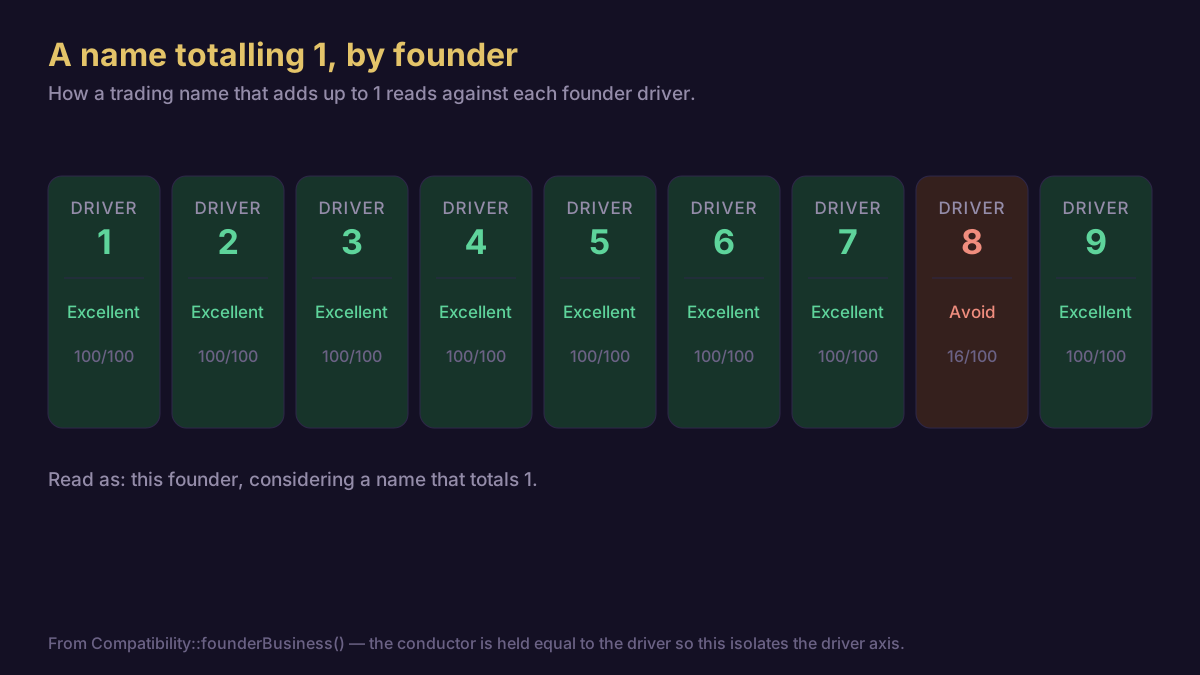
| Driver | Reading of a 1 name | Note |
|---|---|---|
| 1 | Amplifying | Doubles both the command and the isolation |
| 2 | Friendly | Complementary; the 2 partner absorbs what 1 will not |
| 3 | Friendly | 3 supplies the expression 1 tends to skip |
| 4 | Excellent | Well matched on the numbers. The friction to manage is two theories of control, pulling against each other |
| 5 | Excellent | 5 moves quickly enough to keep up |
| 6 | Excellent | The numbers agree. 6 wants consensus, which a 1 does not naturally offer — a management note, not a mismatch |
| 7 | Excellent | 7 is indifferent to who is in charge, which suits a 1 |
| 8 | Difficult | The classic mismatch: 8 is slow and heavy, 1 is neither |
| 9 | Friendly | Both forward-moving; 9 adds completion |
Practitioners disagree most about 1 against 4 and 1 against 7, and confident opposite verdicts circulate on both. Where the tradition contradicts itself, saying so beats picking whichever version sounds better. The founder compatibility tool runs this comparison against a birth date.
Chaldean and Pythagorean disagree about 1
Both systems are in use and routinely produce different totals, because Chaldean assigns letters by sound value across eight numbers while Pythagorean runs A–Z through 1–9.
| Name | Chaldean | Pythagorean |
|---|---|---|
| Kestrel Consulting | 64/1 | 71/8 |
| Orbit Partners | 46/1 | 67/4 |
| Solace Media | 37/1 | 42/6 |
| Compass House | 55/1 | 46/1 |
Only the last agrees. Chaldean is primary here and Pythagorean is comparison — not because Chaldean is provably right, but because the business-naming source material is written in it, and mixing them produces contradictory readings. See Chaldean vs Pythagorean numerology. Choose one system and stay inside it.
Frequently asked questions
Is 1 a good number for a business name?
It is strong for a business built around one person's judgement and awkward for an equal partnership. The digit's character is command and singularity, so it fits a named consultancy or a founder-brand well, and a co-operative or a family firm with several equal voices badly. Structure matters more than sector.
Is 19 a lucky number for business?
19 is treated as one of the most favourable compounds in the classical list, read as recognition and success at height. It is the strongest route to 1, and suits a business carrying a founder's name or reputation publicly. It carries no promise of an outcome, and no reading here should be treated as one.
Can two partners use a business name that adds to 1?
Plenty do, and it is not a prohibition. The caution is that a 1 name concentrates authority at one point regardless of the shareholding, so the useful response is to settle decision rights explicitly rather than assume equal shares produce equal say. Writing the casting vote into the agreement covers the substance.
Which is better for business, 1 or 8?
They describe different businesses. 1 is fast, visible and founder-led. 8 is slow, heavy and accumulating, with property and land as its asset class; late rather than unlucky. A consultancy with an 8 name and a property firm with a 1 name each fight their own number. See is 8 a good number for business.
Is 1 good for a partnership firm?
The tradition says no, and it is one of the clearer verdicts in the system. For a partnership it points toward totals reducing to 6, which carry co-operation and negotiation; 2 is contested, since every documented compound reducing to 2 is marked avoid for a company name. That said, many established firms carry 1 names, so the number describes a tendency, not an outcome.
Where this runs out
The method cannot tell you who should own what. It has no view on whether your co-founder's contribution justifies their equity, whether your fee structure works, or whether the market wants what you sell. Those decide the business. A name total does not.
The most important limit is ethical rather than technical. Nothing here is a reason to take control from a co-founder. If you find yourself using "the name says this is really my company" in an equity conversation, the method is being misused. It describes a pressure you may already feel. It does not settle a dispute, and it is no substitute for a drafted shareholders' agreement or qualified legal advice.
There is real internal disagreement too. The compound readings above 52 are inferred rather than inherited, and practitioners split on 1 against 4 and 1 against 7. The field also has no settled answer to its most practical question: which name counts. The registered name, the trading name, the domain and the phrase customers say are often four strings with four totals. Most practitioners weight by usage — the name said out loud wins — a convention, not a rule.
The evidential objection deserves stating plainly. The pattern-matching runs backwards: you notice the 1-named founder-led firms that grew, not the far larger number that stalled at one person's capacity. That is survivorship bias, the strongest honest argument against the approach.
Used well, this is a structured prompt rather than a forecast. If your name computes to 1 and there are two of you, the move is not to rename the company. It is to answer, in writing, who decides when you disagree, what happens if one of you leaves, and how the invisible contribution gets paid for. If the number brought that conversation forward a year, it has done the only job it can honestly claim.