
Driver and conductor number compatibility compares two founders on four figures, not two: each partner's driver (day of birth reduced) and each partner's conductor (whole date reduced). Drivers that clash can be carried by conductors that agree, and friendly drivers undone by conductors that do not. The matrix below grades all forty-five pairings and shows the arithmetic behind each.
Most partnership readings compare name numbers and birth numbers. This one uses the driver–conductor pair on both sides, which says more about where two founders will disagree than about whether they should work together at all.
What driver and conductor number compatibility actually measures
The claim this tradition makes is narrow. A driver is working style: the reflex, the thing a person does before thinking. Two drivers agree when the reflexes do not contradict under pressure. A conductor is terms — the conditions a working life keeps returning to. Two conductors agree when the partners want the same kind of outcome on a similar timescale.
The four figures answer four questions:
- Driver against driver — will the day-to-day be abrasive?
- Conductor against conductor — are we building the same thing?
- A's driver against B's conductor — does how A works serve what B is after?
- B's driver against A's conductor — and the reverse.
The last two are where partnerships usually fail, and most readings skip them. A pair can enjoy each other's company enormously and still find that one person's operating style quietly erodes the other's position. For the name-based test, numerology compatibility for business partners covers that method, and the partnership compatibility tool runs both sets together.
The scoring rule, and why it is symmetric
The grades below are derived, not asserted. They come from the planetary friendships this system assigns to each digit — 1 Sun, 2 Moon, 3 Jupiter, 4 Rahu, 5 Mercury, 6 Venus, 7 Ketu, 8 Saturn, 9 Mars — plus one correction.
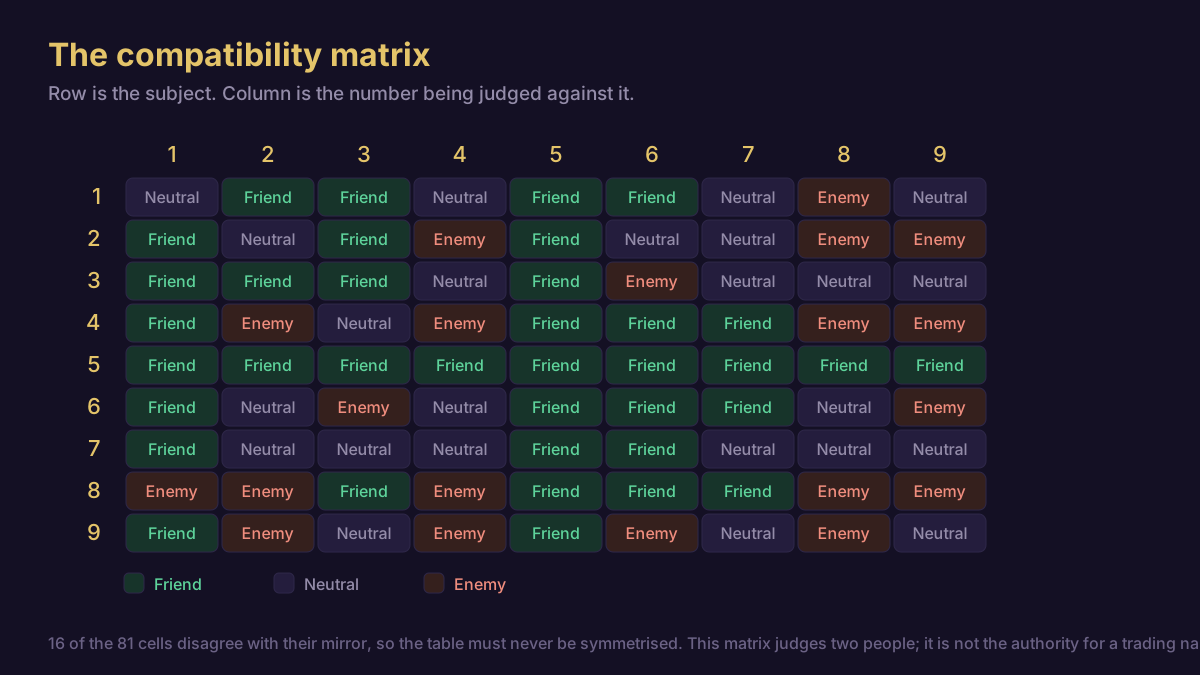
The friendship table is not symmetric. Rahu counts the Sun a friend while the Sun counts Rahu only neutral. That is coherent for an astrological chart, where the planets sit in different positions. It is incoherent for a partnership, which is one relationship with both people in it.
So the rule here reads each direction separately and then gives the pair a single grade, the same way the partnership compatibility tool grades two founders:
| Value | Grade | Read |
|---|---|---|
| +2 | F Friendly | Both directions read the other as a friend |
| +1 | W Workable | One direction friendly, the other neutral |
| 0 | N Neutral | Both directions neutral |
| −1 | S Strained | The two read each other as adverse |
| −2 | A Adverse | The pairing is on the refused list, whatever the directions say |
The correction is that list: nine pairings the method refuses outright for a business partnership — 1-8, 2-7, 2-8, 2-9, 3-6, 4-4, 4-8, 4-9 and 8-8. A refused pairing grades Adverse even where the planets alone would not put it there. In this table enmity always runs both ways, so no pairing has one side hostile and the other friendly.
A one-sided friendship lands at Workable rather than Friendly. That is deliberate: it is the pairing where one founder feels supported and the other quietly does not — better than mutual indifference, short of a mutual friendship, and harder to spot than either.
The driver and conductor number compatibility matrix
Read across from your number to your partner's. The figure shows the one-way relations underneath — the row is the subject, the column the number judged against it, and 16 of its 81 cells disagree with their mirror. The table beneath it combines both directions into one grade, so the table is symmetric and it does not matter who is A.
| 1 | 2 | 3 | 4 | 5 | 6 | 7 | 8 | 9 | |
|---|---|---|---|---|---|---|---|---|---|
| 1 | N | F | F | W | F | F | W | A | W |
| 2 | F | N | F | S | F | N | A | A | A |
| 3 | F | F | F | N | F | A | N | W | N |
| 4 | W | S | N | A | F | W | W | A | A |
| 5 | F | F | F | F | F | F | F | F | F |
| 6 | F | N | A | W | F | F | F | W | S |
| 7 | W | A | N | W | F | F | N | W | N |
| 8 | A | A | W | A | F | W | W | A | S |
| 9 | W | A | N | A | F | S | N | S | N |
Of the forty-five distinct pairings, sixteen are Friendly (three of those a number with itself: 3, 5 and 6), eight Workable, nine Neutral, three Strained and nine Adverse. The same table serves drivers and conductors; what differs is what you read into a poor result.
The nine adverse pairs
| Pair | Planets | The structural conflict |
|---|---|---|
| 1 & 8 | Sun / Saturn | Speed against patience: the most common co-founder deadlock |
| 2 & 7 | Moon / Ketu | Neither reads the other as hostile, and the method refuses the pairing anyway |
| 2 & 8 | Moon / Saturn | The 8 reads the 2 as soft, the 2 reads the 8 as cold |
| 2 & 9 | Moon / Mars | The 9 pushes for a contest the 2 would rather not have |
| 3 & 6 | Jupiter / Venus | Two advisers with opposed ideas of what good counsel is |
| 4 & 4 | Rahu / Rahu | Two people redesigning the same system, neither finishing it |
| 4 & 8 | Rahu / Saturn | Unconventional method against rule and labour |
| 4 & 9 | Rahu / Mars | Two kinds of force, no shared method |
| 8 & 8 | Saturn / Saturn | Each waits for the other to commit |
Adverse does not mean unworkable. The friction is structural rather than personal, so getting on better will not resolve it. Founders in an adverse pairing cope by separating domains, not by improving the relationship.
Two results worth arguing about
4 & 8 comes out Adverse, and it is on the refused list. Rahu and Saturn read each other as adverse in both directions. One strand of the tradition defends the pair, arguing that a 4 is the number that best understands an 8; this system does not follow it. The friction it reads is about how the work is done — unconventional method against rule and labour — rather than whether it gets done.
2 & 7 comes out Adverse, which will surprise anyone reading the planets alone: neither number counts the other an enemy, and both directions are only neutral. It grades Adverse because the method places it on the refused list on its own authority. It is a real divergence between practitioners, not a typo — worth checking before treating any table as settled.
How the conductor changes the verdict
Drivers alone are a partial test. The composite below is this article's own construction, and the partnership compatibility tool does not compute it: the tool grades driver against driver, shows the conductor pair beside it, reads no cross terms, and returns Proceed with caution whenever the two drivers are a refused pairing. Treat the composite as a way to see where the rest of the four figures pull, not as a replacement for that flag. To combine the four figures, weight driver-to-driver double — it is the one you live with daily — and add the other three at single weight:
Composite = (2 × driver–driver)
          + (conductor–conductor)
          + (A driver – B conductor)
          + (B driver – A conductor)
Using the band values (+2 F, +1 W, 0 N, −1 S, −2 A), the range is +10 to −10.
| Composite | Band | What it describes |
|---|---|---|
| +6 to +10 | Aligned | Little structural friction; watch for absent challenge |
| +2 to +5 | Workable | Normal friction, resolvable by role definition |
| −1 to +1 | Mixed | Real conflict on one axis, real support on another |
| −5 to −2 | Strained | Requires explicit governance to function |
| −10 to −6 | Adverse | Structural conflict on every axis |
Worked example: drivers clash, conductors rescue
Founder A, born 19 July 1986.
Driver:    19 → 1 + 9 = 10 → 1 + 0 = 1        Driver = 19/1
Conductor: 1+9+0+7+1+9+8+6 = 41 → 4 + 1 = 5   Conductor = 41/5
Founder B, born 8 April 1982.
Driver:    8                                   Driver = 8
Conductor: 0+8+0+4+1+9+8+2 = 32 → 3 + 2 = 5   Conductor = 32/5
The four comparisons, off the matrix:
| Comparison | Numbers | Grade | Value |
|---|---|---|---|
| Driver – Driver | 1 & 8 | A — a refused pairing | −2, doubled = −4 |
| Conductor – Conductor | 5 & 5 | F | +2 |
| A driver – B conductor | 1 & 5 | F | +2 |
| B driver – A conductor | 8 & 5 | F | +2 |
| Composite | +2 — Workable, at the bottom of the band |
The partnership tool gives these two dates a different answer, because it does not read cross terms: Proceed with caution, with a partnership score of 18, since 1 and 8 are a refused pairing. The composite does not overrule that flag; it shows what else is going on underneath it.
On drivers alone this looks bad: 1 and 8 is the Sun–Saturn deadlock, the founder who wants to move now against the one who wants to wait until it is solid. That is what a driver-only test reports, and it is correct as far as it goes.
The conductors change the picture. Both are 5. Underneath the argument about pace, both founders are traders, people whose working lives keep returning to transaction and turnover. They share an operating language while disagreeing about speed, and both cross terms are positive: A's decisive style serves B's terms, and B's patience serves A's.
The read is not "compatible" or "incompatible". It is that the argument here will be about timing, and only timing. That is solvable in advance, by deciding who has the final word on spend and who has it on launch.
Worked example: identical drivers, worse than it looks
Founder C, born 13 May 1981.
Driver:    13 → 1 + 3 = 4                      Driver = 13/4
Conductor: 1+3+0+5+1+9+8+1 = 28 → 2 + 8 = 10 → 1   Conductor = 28/1
Founder D, born 13 August 1986.
Driver:    13 → 1 + 3 = 4                      Driver = 13/4
Conductor: 1+3+0+8+1+9+8+6 = 36 → 3 + 6 = 9 Conductor = 36/9| Comparison | Numbers | Grade | Value |
|---|---|---|---|
| Driver – Driver | 4 & 4 | A — a refused pairing | −2, doubled = −4 |
| Conductor – Conductor | 1 & 9 | W | +1 |
| C driver – D conductor | 4 & 9 | A — also refused | −2 |
| D driver – C conductor | 4 & 1 | W | +1 |
| Composite | −4 — Strained |
Both founders share a driver and a compound, 13/4, and a founder reading a driver-only summary would call that a perfect match. The method says the opposite: 4 with 4 is one of the pairings it refuses outright, and so is 4 with 9. Two of the four comparisons are refusals, and the composite lands at Strained. The partnership tool, which reads the drivers only, returns Proceed with caution on these two dates, with a score of 18, because 4 and 4 are refused.
That describes something specific: two people who work identically and want compatible things, but whose shared method obstructs what each is after. The 4 method — systems, contrarian angles, infrastructure — sits only moderately with a conductor of 1, which asks for visible authorship, and badly against a conductor of 9, which asks for cycles to be closed. Two 4s keep rebuilding the system; neither finishes, and neither is visibly in charge. It is the clearest case in this method of a shared number being a liability rather than an asset.
The compounds add a second layer. C's conductor is 28/1 and D's is 36/9; both are covered on the compound numbers reference, and the classical reading of 36 carries detail the single digit 9 does not.
Two more partnerships at a glance
| A driver/conductor | B driver/conductor | DD ×2 | CC | A drv–B cnd | B drv–A cnd | Total | Band |
|---|---|---|---|---|---|---|---|
| 5 / 8 | 6 / 4 | +4 | −2 | +2 | +1 | +5 | Workable |
| 7 / 6 | 6 / 7 | +4 | +2 | 0 | +2 | +8 | Aligned |
| 1 / 1 | 8 / 8 | −4 | −2 | −2 | −2 | −10 | Adverse |
The second row is the mirror case: each founder's driver is the other's conductor. Because 6 and 7 read each other as friends, the mirror works in their favour rather than against it — each understands exactly what the other is after, and the only flat note is the 7-against-7 cross term, which the method reads as indifference rather than support.
The third row is the floor of the scale. Every one of the four comparisons is Adverse, because 1 and 8 are a refused pairing and all four comparisons here set a 1 against an 8 — a partnership the method blocks from every direction at once. There is no arrangement of roles that improves the arithmetic here; what it argues for is a written agreement rather than a handshake.
What to do with a strained or adverse result
A poor score says where to put structure. It is not a reason to abandon a partnership.
Split decision rights by domain, not seniority. A 1–8 pair should not vote on everything jointly. One owns commitment and pace, the other capital and reserves, and each acts inside their domain without a meeting.
Write the deadlock rule while you still like each other. Every partnership agreement needs a mechanism for what happens when two people cannot agree; an adverse pairing needs it sooner. That is a matter for a solicitor, not numerology.
Name the friction out loud. This method predicts the subject of the argument, not just its existence. A 2–8 pair can agree in advance that the 2 will find the 8 cold and the 8 will find the 2 soft, and neither is bad faith.
Do not use it to screen people out. The tradition gives no basis for refusing to work with someone on the strength of a birth date, and using these grades as a filter would be unfair and unsupported. Read them as likely friction between people who have already decided to work together.
For the same comparison against a business name rather than another founder, the founder compatibility tool tests a name total against a driver and conductor, and the decision analyser frames a choice rather than a relationship.
Frequently asked questions
Which driver numbers are most compatible?
There are no tidy clusters on the matrix above, which is the first thing to say — the tables that promise them are simplifying. What it does show is one number that gets along with everybody and one that gets along with almost nobody. Five is Friendly with all nine, including itself, and is the only number of which that is true. Eight is Adverse with 1, 2, 4 and 8, more refusals than any other number carries. Beyond those two, the reliable Friendly pairings are 1 with 2, 3, 5 or 6; 3 with 1, 2, 3 or 5; and 6 with 1, 5, 6 or 7. Four, 8 and 9 are the sparsest: each is Friendly only with 5.
Can two founders with the same driver number work together?
It depends on the number. The matrix grades 3, 5 and 6 Friendly with themselves and 1, 2, 7 and 9 Neutral, and it refuses 4 with 4 and 8 with 8 outright. Even where the grade is good, identical drivers mean identical blind spots, and nothing corrects the shared tendency: two 5s both move too early. The second worked example shows a same-driver pair on 4 whose composite lands at Strained, with one cross term refused and the other only Workable.
Does the conductor number matter more than the driver in partnerships?
They answer different questions. The driver predicts daily friction, which founders notice. The conductor predicts whether you are building the same thing, which is what usually ends partnerships. The composite weights the driver double for practicality, but a strong conductor match with a poor driver match is the more survivable case: pace can be negotiated, purpose cannot.
What if our numbers are adverse but the business is going well?
Then the business is going well. These grades describe tendencies drawn from a traditional system with no evidence base, and do not override what is actually happening. The reasonable use of an adverse result is as a checklist: has the friction the matrix predicts shown up, and if so is it governed? If not, nothing needs doing.
Should I check compatibility before choosing a co-founder?
The tradition would say the figures are worth knowing. Common sense puts them well below whether the person is competent, honest, solvent and available. Treat driver and conductor number compatibility as one input for reflection, never as grounds for excluding someone from an opportunity.
Where driver and conductor number compatibility runs out
The matrix is a construction, not a discovery. It is derived openly from the planetary friendship table, a stated rule for combining both directions and a published list of refused pairings, which is more than most published grids offer. It is still an interpretation: change the friendship table, the combining rule or the refused list and some grades move. The 2–7 result shows how far a refused list can move a pair the planets leave neutral.
Two founders are not two numbers. Eighty-one combinations cannot describe the population of business partnerships. Everything that decides whether two people can run a company together — competence, integrity, complementary skills, appetite for risk, whether they survive a bad quarter without blaming each other — is invisible here. Partnerships with identical figures end in opposite places.
The weighting is a judgement. Doubling the driver term is reasonable, not derived. Weight the conductor double instead and several composites shift by a band. Any system that turns four grades into one number has made choices, and it is more honest to say so than to call the result a measurement.
Dates carry their own uncertainty. The method rests on a recorded date of birth being correct, which is not always true, and on a shared convention for time zones and midnight births, which practitioners do not have.
No outcome is promised. Nothing here predicts revenue, survival, or whether a partnership lasts. This is guidance for reflection, and for structuring conversations founders should be having anyway. It is not financial, legal or medical advice, and a partnership agreement should be drafted by a solicitor whatever the numbers say. The assumptions behind it are on the methodology page.